Microbrewery equipment at the 7-30 BBL tier is a system, not a single purchase: a brewhouse, a fermentation and bright beer tank cellar, a glycol loop, a CIP loop, and a control layer that ties them together. Most first-time buyers price the brewhouse first and treat the other four as an afterthought — which is where budgets and timelines usually go wrong.
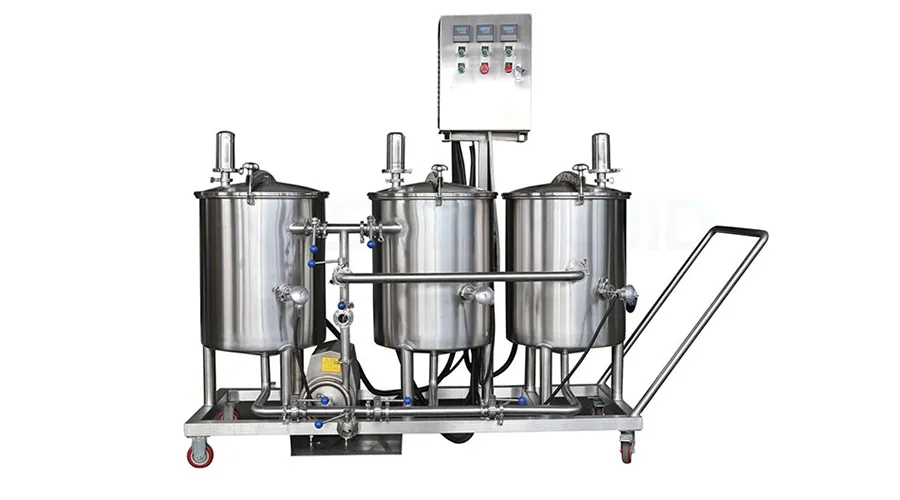
What “Microbrewery Equipment” Actually Covers
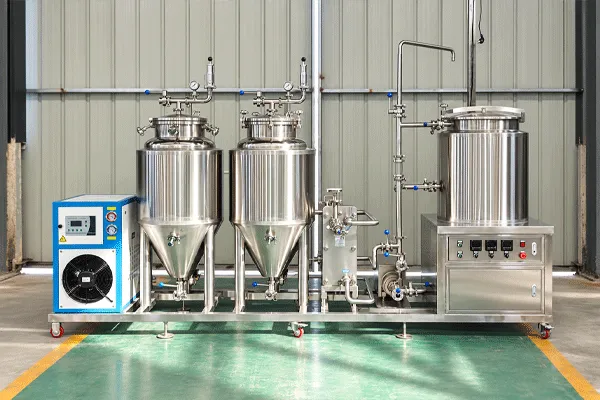
Search results and vendor pages under this term mostly show a brewhouse — the mash tun, kettle, and whirlpool that produce wort. That’s one piece of a 7-30 BBL microbrewery system, not the whole thing. A working system at this tier also needs somewhere for that wort to ferment and condition (the cellar), a way to hold fermentation and cold-crash temperatures (glycol), a way to clean tanks and lines between batches (CIP), and something coordinating all three (controls).
Skipping any one of these in the initial spec doesn’t just mean a follow-up purchase later. It means the follow-up purchase has to match interface points — pipe sizes, glycol supply temperature, CIP circuit length — that were fixed by the first vendor’s equipment, whether or not that vendor is involved in round two.
The Five Subsystems and How They Depend on Each Other
A microbrewery system only works as a system if each piece is sized against the others, not against a target batch volume in isolation.
- Brewhousesets batch size and brew frequency, which in turn sets how much fermentation capacity the cellar needs and how often the glycol loop has to handle a wort knockdown load on top of active fermentation.
- Cellar(fermentation tanks and bright beer tanks) sets the total glycol heat load the chiller has to carry, and its tank count and geometry determine how long the CIP loop has to run per cycle.
- Glycol loophas to be sized for the worst realistic combination of active fermentation, cold crash, and wort cooling happening at once — not for one tank in isolation.
- CIP loophas to reach adequate cleaning velocity in the longest run and largest vessel in the cellar, not just the brewhouse.
- Controlstie sensor and valve data from all four into one interface, and how much automation is worth paying for at this tier depends on labor plans more than on batch size.
The rest of this guide walks through each piece with the sizing questions that actually determine whether they work together.
Brewhouse: Vessel Count and Heat Source
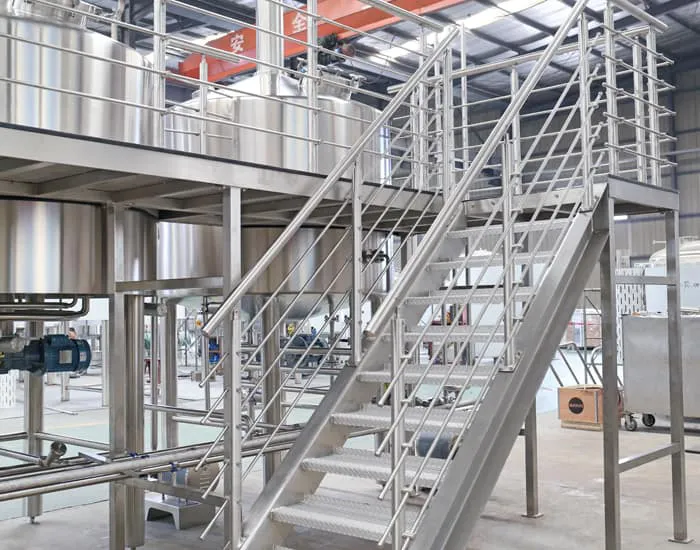
At the 7-30 BBL tier, brewhouses typically run 3-vessel to 4-vessel configurations (mash/lauter, kettle/whirlpool, and sometimes a separate hot liquor tank), heated by steam or electric elements. Direct-fire heating, common at the smaller nano and pilot tiers, is less common at this scale because of the surface area and burn-risk considerations that come with larger kettle volumes.
The heat source decision made here isn’t isolated. Steam heating requires a boiler and steam distribution, which adds a utility interface the cellar and CIP loop don’t touch but the facility’s overall plant sizing does. Electric heating simplifies utilities but changes boil vigor and evaporation rate compared to steam — a detail that matters more for recipe consistency than for capacity planning, but shows up the first time a brewer tries to reproduce a pilot-scale recipe at production volume.
Cellar: Fermentation Tanks and Bright Beer Tanks
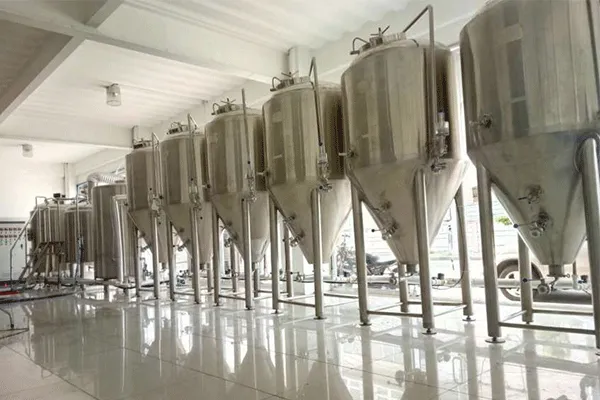
خزانات التخمير و خزانات البيرة اللامعة at this tier share the same specification baseline: SS304/316L construction, 0.4 μm mirror-polish interior finish, dimple cooling jacket, optional side manway, and pressure testing, backed by a 10-year structural warranty on the vessel work. The design decision that actually matters for a 7-30 BBL buyer isn’t the finish spec — most vendors converge on similar numbers — it’s tank count relative to brew frequency.
A single brewhouse feeding too few fermenters creates a bottleneck: the brewhouse sits idle waiting for tank space to free up, which is the opposite of what a “high-efficiency” microbrewery system is supposed to deliver. As a rough starting point, a brewery running one brew day per fermentation cycle needs enough fermenters to hold at least two to three cycles’ worth of beer in various stages (active fermentation, conditioning, and one being cleaned or awaiting transfer) before it becomes brewhouse-limited rather than cellar-limited. The right ratio depends on fermentation length for the beer styles being brewed and how often the brewhouse actually runs, which is a conversation worth having with a vendor before tank count gets fixed.
Glycol Loop: Size for the Worst Combination, Not the Average Day
Glycol chiller sizing is where under-specification shows up fastest, because the failure mode isn’t a missing part — it’s a chiller that runs but can’t keep up once more than one tank needs cooling at the same time.
A commonly used engineering rule of thumb for active fermentation heat load is roughly 280 BTU per degree Plato per barrel over a 70-hour fermentation window; a 20 BBL batch at 15°P works out to roughly (280 × 15 × 20) ÷ 70 ≈ 1,200 BTU/hr for that single tank in steady active fermentation. That’s a manageable number on its own. The problem is that real breweries rarely run one tank in isolation — a cold crash on one fermenter, active fermentation in two others, and a hot wort knockdown into a fourth can all land on the same afternoon, and the chiller has to handle that combined load, not the single-tank average.
Two variables change the number more than most first-time buyers expect: tank insulation (an insulated jacket meaningfully reduces standing heat gain) and ambient temperature in the brewhouse space. A chiller sized for a temperature-controlled facility will underperform in a hot, poorly ventilated production space, which is a facility question that has nothing to do with the equipment spec sheet.
CIP: Loop Design, Not Just a Pump and a Tank
Clean-in-place systems get treated as a commodity add-on more often than any other subsystem on this list, which is a mistake at 7-30 BBL scale because pipe runs and vessel sizes are large enough for velocity shortfalls to actually show up as visible residue.
Sanitary process design conventions consistent with 3-A Sanitary Standards call for CIP circulation velocity of at least 5 ft/s (1.5 m/s) to sustain the turbulent flow that mechanically scrubs interior surfaces — lower velocities can leave laminar zones where residue simply doesn’t get moved. A CIP pump and supply tank sized around the brewhouse’s smaller lines will often fail to reach that velocity in the cellar’s larger bright beer tank connections, which is exactly the kind of mismatch that shows up only after the system is already installed.
The practical fix is sizing the CIP loop around the largest vessel and longest run in the system — typically the bright beer tank or the largest fermenter — rather than around whatever pipe diameter the brewhouse happens to use.
Controls: Where Automation Earns Its Keep at This Tier
Full PLC/HMI automation is standard at the 40 BBL-and-above commercial tier, where continuous, multi-shift operation makes manual monitoring impractical. At 7-30 BBL, the calculation is different. A microbrewery running one or two brew days a week with a small crew often gets more value from targeted automation — temperature control on fermenters, automated CIP cycle sequencing — than from a fully integrated HMI covering every subsystem.
The interface question matters here too: whatever controls layer gets specified needs to actually talk to the glycol chiller’s own control panel and the brewhouse’s temperature probes, not run as three separate systems that happen to sit in the same room. That integration point is worth confirming with a vendor in writing before ordering, not assumed to work because all the individual components are automation-capable.
Sequencing a Microbrewery System Purchase
- Fix brewhouse batch size and target brew frequency first.Everything downstream sizes against these two numbers.
- Size the cellar to brewhouse throughput, not to a round tank count — work backward from how many brew cycles need to be in-progress simultaneously without idling the brewhouse.
- Calculate glycol load for the worst realistic simultaneous scenario(cold crash plus active fermentation plus wort knockdown), not the average day.
- Design the CIP loop around the largest vessel and longest run, confirming minimum circulation velocity rather than assuming pump size scales linearly with tank count.
- Decide the controls layer against labor plans, not against what’s technically available at the next tier up.
- Confirm export compliance requirementsfor the target market before fabrication — PED (CE) for Europe, UL/cUL for North American control panels, AS1210 for Australia — since retrofitting compliance after fabrication is far more expensive than designing to it from the start.
Buying One System vs. Assembling One from Multiple Vendors
Some breweries buy the brewhouse from one manufacturer and the cellar, glycol, and CIP from others, usually chasing the lowest price on each individual piece. Compared to a single-vendor turnkey system, that approach can lower sticker price on paper but shifts interface risk onto the buyer.
The single-vendor route means brewhouse output rate, cellar tank connections, glycol supply lines, and CIP loop diameters get engineered against each other before fabrication starts — which is the practical meaning behind 3D layout engineering completed before the order is placed, rather than each vendor engineering their own piece in isolation. The tradeoff is less room to individually price-shop each subsystem against the cheapest available option.
The multi-vendor route can win on a line-item basis, but every interface between vendors — pipe fittings, control signal compatibility, glycol supply temperature and flow rate — becomes something the buyer has to specify and verify themselves, since no single vendor is responsible for whether the pieces actually fit together. For a first-time buyer without in-house engineering support, that verification burden is easy to underestimate until the installation crew is standing in the room with mismatched connections.
What to Ask a Vendor Before Signing
- Does the quote include a 3D facility layout showing brewhouse, cellar, glycol, and CIP interface points, or only the brewhouse?
- What heat source does the brewhouse use, and does that match the utilities already available or planned at the site?
- What glycol load calculation was the chiller sized against — single-tank average or worst-case simultaneous operation?
- What CIP circulation velocity does the loop design target, and against which vessel?
- What compliance standards is the system engineered to meet for the intended export market?
On pricing: microbrewery systems at this tier are quoted per project rather than off a published price list, since brewhouse configuration, tank count, and automation level all move the total. Factory-direct pricing without distributor markup is a fair general expectation from a manufacturer selling directly, but any specific number requires a quote against an actual spec — a listed range on a vendor page without that context isn’t especially useful for budgeting.
الأسئلة الشائعة
Q: What’s included in “microbrewery equipment”?
At the 7-30 BBL tier, a complete system includes the brewhouse (mash/lauter, kettle/whirlpool), a fermentation and bright beer tank cellar, a glycol refrigeration loop, a CIP cleaning loop, and a controls layer connecting them. Many vendor pages under this search term show brewhouse equipment only.
Q: How many fermenters does a 7-30 BBL microbrewery need?
Enough to hold two to three brew cycles’ worth of beer across active fermentation, conditioning, and cleaning/transfer stages without idling the brewhouse — the exact count depends on fermentation length for the beer styles being brewed and how often the brewhouse runs.
Q: Is PLC/HMI automation necessary at this tier?
Not universally. Full automation becomes more valuable at 40 BBL and above, where continuous multi-shift operation makes manual monitoring impractical. At 7-30 BBL, targeted automation on fermentation temperature and CIP sequencing often delivers more value per dollar than a fully integrated system.
Q: Does glycol sizing scale linearly with tank count?
No. It scales with the worst realistic combination of simultaneous loads — cold crash, active fermentation, and wort knockdown happening at once — plus facility-specific variables like insulation and ambient temperature.