David Zhang | Founder & CEO, ZPET (Shandong ZhongPi Machinery Equipment Co., Ltd.) | Published August 7, 2026
A 3-vessel brewing system separates the whirlpool (or the lauter tun) from the vessels it shares in a 2-vessel setup, cutting knockout-to-knockout cycle time from roughly six hours to under four. That buys two to three brew-day turns instead of one. A fourth vessel buys a third or fourth turn.
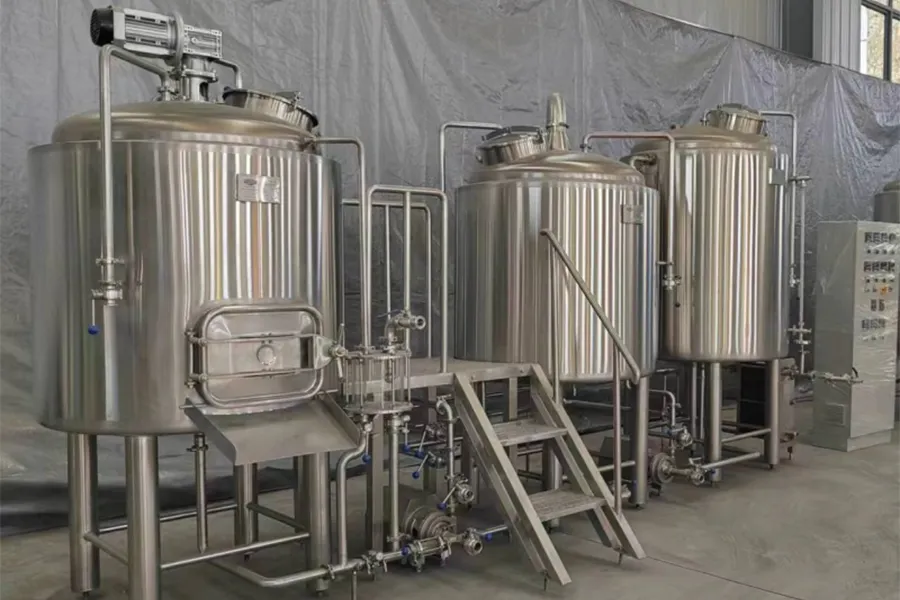
First, settle what “vessel” means — suppliers don’t agree
This is where most quote comparisons go wrong. Some manufacturers count the hot liquor tank and cold liquor tank in the vessel total; others count only the vessels that hold mash or wort. A quote for a “4-vessel system” from one factory can be functionally identical to a “2-vessel system plus HLT and CLT” from another, at a very different headline number.
Before comparing anything, ask each supplier to list the vessels by function. The process vessels are:
- Mash tun— mixes grist with strike water and holds it through the conversion rest.
- Lauter tun— holds the grain bed and separates sweet wort from spent grain, usually with rakes and a false bottom.
- Kettle— boils the wort and takes hop additions.
- Whirlpool— spins out trub and hot break, and holds post-boil hop stands.
- Hot liquor tank / cold liquor tank— water service, not process vessels. Every configuration needs them.
A 2-vessel brewhouse combines items 1 and 2 into a mash-lauter tun, and items 3 and 4 into a kettle-whirlpool. A 4-vessel brewhouse keeps all four separate. A 3-vessel brewhouse splits one of those pairs and leaves the other combined, which is why two systems both sold as “3-vessel” can behave differently:
- Mash-lauter tun + kettle + whirlpool.Frees the kettle early. Favors hop-forward beers with long whirlpool stands.
- Mash tun + lauter tun + kettle-whirlpool.Protects lauter performance on wheat, rye and high-adjunct grists. Favors breweries with awkward mashes rather than heavy hop schedules.
Neither is the “correct” 3-vessel. The right one depends on whether your bottleneck is the kettle or the grain bed.
Configuration comparison
Figures assume a 1,200 L (approx. 10 BBL) brewhouse on standard-gravity ale, steam-heated, one trained brewer plus a helper.
| Dimension | وعائين (2-vessel) | ثلاثة أوعية (3-vessel) | 4-vessel |
| Process vessels | Mash-lauter tun; kettle-whirlpool | Mash-lauter tun + kettle + whirlpool, أو mash tun + lauter tun + kettle-whirlpool | Mash tun; lauter tun; kettle; whirlpool |
| Knockout-to-knockout cycle | 5.5–7 h | 3.5–4.5 h | 2–2.5 h |
| Realistic turns per 10-hour shift | 1 (2 with overtime) | 2, or 3 with a disciplined crew | 3–4 |
| Parallel operation available | None; every step waits for the vessel in front of it | Mash the next batch while the previous one whirlpools | Mash the next batch while the previous one lauters |
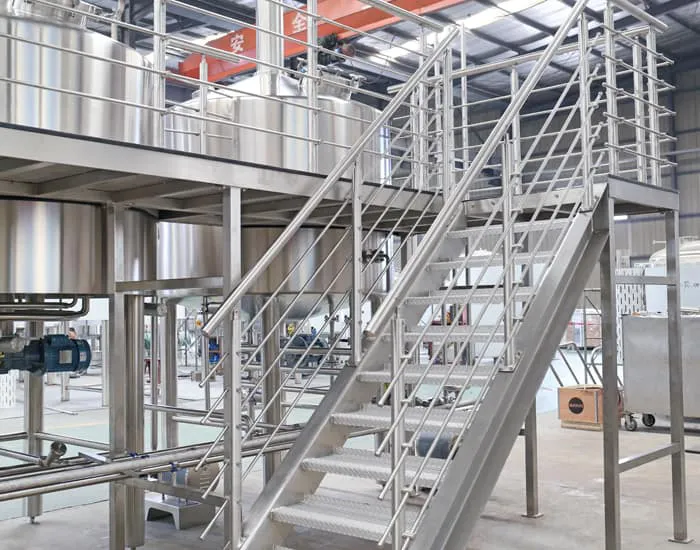
| Added platform length vs 2-vessel | — | +1.2–1.5 m | +2.4–3.0 m |
| Added platform area vs 2-vessel | — | +2.5–3.5 m² | +5–7 m² |
| Lautering with >30% wheat or adjunct | Compromised; rake geometry is a mixing/raking trade-off | Good with a separate lauter tun; moderate otherwise | Best |
| Late hop additions and whirlpool stands | Occupy the kettle; delays kettle CIP | Dedicated (in the mash-lauter variant) | Dedicated |
| Peak steam demand | Lowest | Same as 2-vessel; the whirlpool is unjacketed for heat input | Higher if the mash tun carries its own heating |
| Crew during a turn | 1 | 1–2 | 2 |
| Common capacity band | 400–2,000 L (approx. 3.5–17 BBL) | 1,000–3,500 L (approx. 8.5–30 BBL) | 2,000 L (approx. 17 BBL) and up |
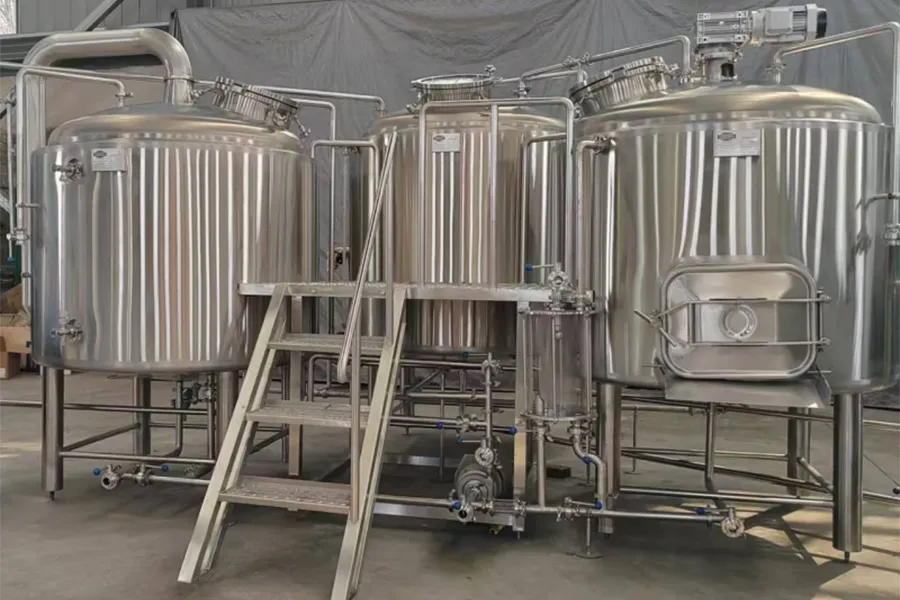
Turns per day, not vessel count, is what you’re actually buying
Vessel count adds no volume. A 4-vessel 1,200 L brewhouse produces exactly 1,200 L per turn, the same as a 2-vessel one. What the extra vessels buy is overlap, and overlap only matters if lautering or boiling is your constraint.
Run the arithmetic on annual capacity for that 1,200 L (approx. 10 BBL) system across four brew days a week and 48 working weeks:
| Configuration | Avg. turns/day | Turns/year | Gross annual wort |
| وعائين (2-vessel) | 1.5 | 288 | approx. 2,880 BBL |
| ثلاثة أوعية (3-vessel) | 2.5 | 480 | approx. 4,800 BBL |
| 4-vessel | 3.5 | 672 | approx. 6,720 BBL |
Deduct 6–8% for brewhouse-to-packaging losses and the 3-vessel column lands near 4,450 BBL of finished beer. For reference on where that sits in the market, the Brewers Association defines its US brewery categories by annual barrelage, with the مصنع جعة صغير band topping out at 15,000 BBL (Brewers Association, brewery definitions).
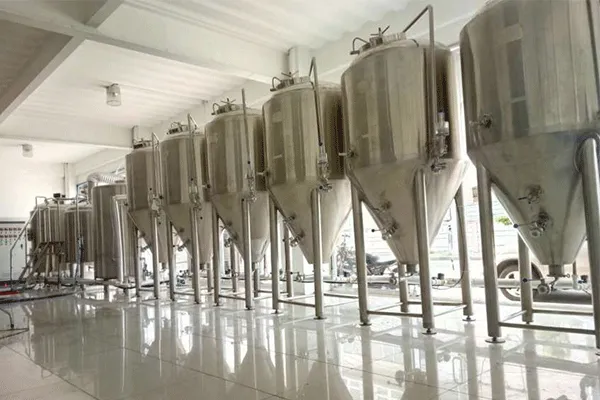
Here is the part that sinks plenty of build-outs: those turns are worthless without tanks to put them in. Ten turns a week at 14 days of ale occupancy means roughly 20 batch-volumes of fermentation capacity standing in the cellar at all times — say ten double-batch 2,400 L fermenters, before you allow anything for dry-hop headspace, a lager or two at 28 days, or a tank down for repair. Buying a fourth vessel while the cellar can absorb six batches a week is spending money on a bottleneck you don’t have.
What the extra vessels cost you in the building
Platform length is the visible cost. The less visible ones:
- Ceiling height. A mash-lauter tun with rake drive and a vent stack wants 4.5–5.0 m of clear height at 1,200–2,000 L. Adding vessels doesn’t raise that requirement, but it does mean the whole run needs it, not just one bay.
- Piping and valve count. Each additional vessel adds transfer legs, a CIP branch and typically 6–10 more sanitary connections. More joints means more CIP volume, more gaskets on the replacement schedule, and more places for a swab to come back positive.
- CIP cycles per brew day. Four vessels at three turns is twelve vessel washes, against two washes at one turn on a 2-vessel system. Caustic, hot water and labor all scale with it.
- Operator load. Three turns a day on a 4-vessel brewhouse is a two-person job for ten hours with overlapping timers. Breweries that budget for the steel and not the second brewer end up running two turns anyway.
Where the fourth vessel stops paying for itself
Below roughly 1,000 BBL a year, a 2-vessel brewhouse is the honest answer. One turn a day, four days a week, is enough, and the money is better spent on التخمير capacity or a glycol system with real reserve.
Between roughly 1,000 and 4,500 BBL a year, a 3-vessel configuration is the usual fit. It doubles achievable turns for a modest platform extension, and it fixes whichever specific problem you have — kettle occupancy or grain bed depth — depending on which pair you split.
Above roughly 4,500–5,000 BBL a year at a fixed batch size, the fourth vessel starts to earn its area. But test the alternative first, because it often wins: a 3-vessel brewhouse at double the batch size reaches the same annual output as a 4-vessel at the original size, with half the CIP cycles and one fewer operator. A 2,400 L (approx. 20 BBL) 3-vessel system running 2.5 turns a day matches a 1,200 L 4-vessel system running 3.5 turns, and it does so on fewer brew-day hours.
The reason not to take that trade is SKU flexibility. Larger batches mean your smallest seasonal now fills two fermenters you’d rather use for the flagship, and a slow-moving release sits on tank longer. Breweries with 12 active SKUs and a taproom-driven mix often prefer more turns at a smaller batch size, even knowing the labor cost. Breweries with four core brands and distribution volume almost always prefer the bigger batch.
One more case where more vessels genuinely can’t substitute for volume: if your building’s clear height caps vessel diameter and your fermenters are already at footprint capacity, the fourth vessel may be the only way to add output without moving. That is a real scenario, and it is a different decision from the throughput one.
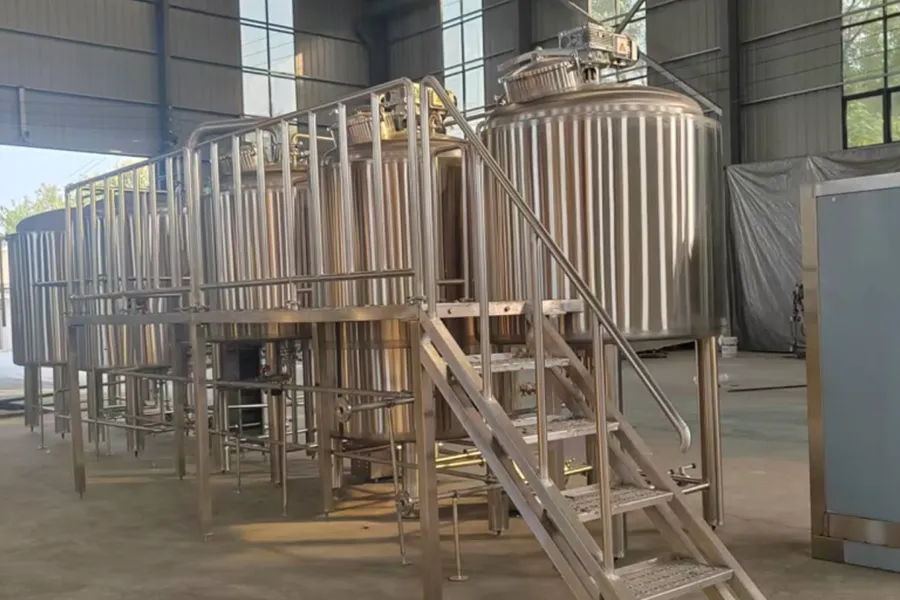
ZPET brewhouse configurations
ZPET builds أنظمة مصنع الجعة in 2-vessel through 5-vessel configurations, with the layout resolved during engineering rather than picked from a catalogue page.
| البند | المواصفات |
| Configurations | من 2 وعاء إلى 5 أوعية |
| خيارات التدفئة | Steam, electric, direct fire |
| Contact materials | SS304 / SS316L sanitary grade |
| التشطيبات الداخلية | صقل عاكس بدقة 0.4 ميكرومتر |
| اللحام | Double-sided TIG argon arc; CNC laser cutting; automatic welding robots |
| Testing | Spectrometer material analysis; 24-hour pressure hold test; X-ray weld inspection; 5-step QC |
| الضمان الهيكلي | 10 سنوات |
| الامتثال لقوانين التصدير | صُممت لتلبية متطلبات PED (CE) و UL/cUL و AS1210 |
| Platform | Ergonomic operating platform, laid out to the building footprint |
| Pricing | Quoted per project; no published price list or price range |
A 0.4 μm Ra figure is a measurable number rather than a descriptor. ASME BPE defines surface finish designations and Ra measurement conventions for hygienic process equipment, which is the reference point worth asking any supplier to quote against — and worth asking whether the figure applies to shell interiors only or to welds as well.
The engineering step matters more than the vessel count for this particular decision. Before fabrication, ZPET produces 3D layouts, technical drawings and process flow charts against your actual building dimensions and available utilities. A 4-vessel arrangement that doesn’t fit under a 4.2 m ceiling is a problem better found in a drawing than on a receiving dock. Because systems ship factory-direct without distributor markup, the budget difference between three and four vessels tends to land in plate thickness and component selection rather than in margin.
The trade-offs worth naming
Against the 2-vessel: single-turn brew days cap you early, and every mash-lauter tun is a compromise between a rake set that mixes well and one that cuts a grain bed well. Sparge efficiency on a 2-vessel typically runs a few points behind a dedicated lauter tun on the same recipe.
Against the 3-vessel: you have to choose which pair to split before you know your five-year recipe mix. Breweries that pick the mash-lauter variant and then move into wheat-heavy or rye programs live with slower runoffs.
Against the 4-vessel: the platform, the piping, the CIP load and the second operator are all real and recurring, while the extra turn is only available on days when the cellar can take it. Under-utilized, it’s the most expensive idle steel in the building.
What to settle before you request a configuration quote
Work through these in order. Answering them out of order is how breweries end up with a brewhouse that outruns the cellar:
- Target annual barrelage in year three, not year one.
- Fermentation capacity you can physically fit, in batch-volumes, and your average days on tank.
- Number of active SKUs and the smallest batch you need to be able to brew.
- Clear ceiling height at the brewhouse location, measured to the lowest obstruction.
- Available steam or electrical capacity, and whether the boiler is sized for peak or average.
- How many operator-hours per week you will actually staff.
Two topics this comparison doesn’t cover: 5-vessel arrangements with a dedicated mash mixer or a mash filter, which change the lauter math entirely and are worth a separate look above 4,000 L; and vapor condensers with heat recovery, which alter the energy case for extra turns enough to move the crossover point. Both are worth raising in the same conversation as vessel count, since they compete for the same floor area.
الأسئلة الشائعة
Q: Is a 3-vessel brewing system better than a 2-vessel?
A: Only if brew-day throughput is your constraint. A 3-vessel roughly doubles achievable turns per day for about 1.2–1.5 m of extra platform. If you brew once a day and have spare fermentation capacity, the second vessel pair adds cost without adding output.
Q: Does a 4-vessel brewhouse produce more beer per batch?
A: No. Batch volume is set by vessel capacity, not vessel count. A 4-vessel system produces more beer per day, by allowing you to mash one batch while lautering the previous one.
Q: In a 3-vessel system, should I split the mash-lauter tun or the kettle-whirlpool?
A: Split the kettle-whirlpool if you run long hop stands or want to start kettle CIP earlier. Split the mash-lauter tun if your grists carry more than about 30% wheat, rye or unmalted adjunct, where grain bed separation is the slower step.
Q: Do the hot and cold liquor tanks count as vessels?
A: Not in process terms, but some suppliers include them in the headline vessel count. Always ask for the vessel list by function before comparing quotes.
Q: What does a 3-vessel ZPET brewhouse cost?
A: Pricing is quoted per project — configuration, capacity, heating method, automation level and destination compliance all move the number, and no price list is published. Send your target capacity, building dimensions and utility details for a quotation and a 3D layout.
Q: How much fermentation capacity does a 3-vessel brewhouse need behind it?
A: As a planning figure, allow roughly two batch-volumes of fermentation capacity for every weekly turn on a 14-day ale schedule. Ten turns a week points to about 20 batch-volumes. Lagers and extended dry-hop programs push that number up.