David Zhang | Founder & CEO, ZPET | Published August 15, 2026
A commercial automated brewing system uses a PLC, HMI, sensors and controlled valves or drives to execute defined brewhouse functions. The specification should state what the system measures, what it controls, which decisions remain with the brewer, how faults are handled and how production can continue when a device fails.
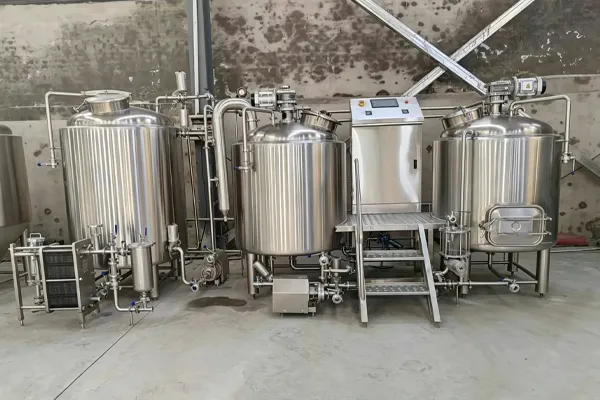
Commercial automated brewing system specification table
| Control area | What the purchase specification should define | Acceptance evidence |
|---|---|---|
| PLC and I/O | Controller family, installed and spare inputs/outputs, panel architecture and network | Approved I/O list, panel drawing and live point test |
| HMI | Process screens, setpoints, alarm history, user levels, manual controls and language | Screen review and operator test |
| Instrumentation | Sensor type, range, accuracy, location, hygienic connection and calibration method | Instrument schedule and calibration records |
| Sequences | Step order, transition conditions, operator confirmations, holds and abort behavior | Control narrative and witnessed sequence test |
| Interlocks | Conditions that block heaters, pumps, agitators, transfers or valve movement | Cause-and-effect test |
| Recipes | Editable parameters, version control, batch identification and permitted changes | Recipe creation and repeat-run test |
| CIP | Cleaning circuits, flow or pressure conditions, temperature, time and return path | Approved CIP matrix and coverage test |
| Data | Logged values, sample interval, storage duration, export format and time settings | Exported batch record |
| الخدمة | Backups, electrical documentation, source-file policy, remote support and spare parts | Recovery test and document handover |
1. Start with the process, not the automation level
Terms such as semi-automatic, automatic and fully automatic are not consistent technical definitions. One supplier may use “automatic” for temperature control and pump switching, while another includes recipe sequences, pneumatic valves, automatic transfers and batch reporting. Compare functions line by line.
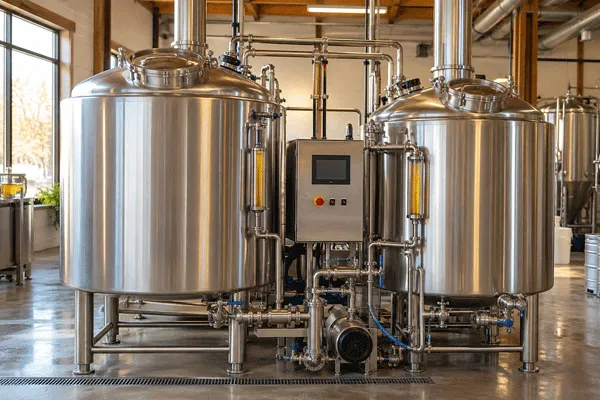
Draw the intended wort path from water preparation through mashing, lautering, boiling, whirlpool, cooling and transfer. Mark every operator action: adding ingredients, confirming a sample, connecting a hose, opening a manual valve, cleaning a screen or approving the next process step. The brewhouse vessel configuration guide helps identify where separated vessels can support overlapping work.
Then decide which actions should be automatic. A controlled transfer may still require an operator to confirm that the receiving fermenter is empty, clean and connected. Retaining that confirmation is often safer than programming around information the control system cannot verify.
2. Approve the PLC architecture and I/O list
The PLC is the execution layer for sequences, permissives, alarms and output commands. The quotation should identify the controller and HMI families, communication protocols, remote I/O, variable-frequency drives, panel voltage, enclosure protection and the destination market’s electrical requirements.
Request an input/output list before panel fabrication. Each row should identify the tag, device, signal type, engineering range, normal state, alarm limits and the action caused by loss of signal. Include spare I/O for defined expansion rather than an unspecified promise that the panel is “expandable.”
For North American projects, UL’s industrial control panel guidance is a useful reference when defining the panel scope. ZPET states that control panels can be engineered to meet UL/cUL requirements; project-specific conformity must be confirmed in the order documents.
3. Make the HMI useful during normal and abnormal operation
A brewery HMI should show more than animated tanks. Operators need clear equipment status, process values, active setpoints, sequence step, permissive status and the reason a command is unavailable. Color conventions should be consistent across pumps, valves, heaters and alarms.
Specify at least four access levels: view-only, operator, supervisor and service. Define which level may edit recipes, override a sequence, change alarm limits or place equipment in manual mode. User permissions should protect critical settings without making routine operation dependent on a service password.
Alarm messages must describe the condition and affected equipment. “Transfer stopped: receiving vessel high level” is more useful than “Alarm 103.” Require active-alarm, acknowledged-alarm and alarm-history views with timestamps.
4. Specify instruments by measurement duty
Automation quality depends on the measurements supplied to the PLC. Define temperature sensor locations according to the process question: vessel product temperature, heat-exchanger outlet temperature or utility temperature. A sensor mounted in a poorly mixed zone can be accurate at its tip and still give a misleading process value.
Flow, level, pressure and conductivity instruments should be selected for the fluid, temperature, cleaning chemicals, expected range and hygienic connection. Where a value is used for an interlock or batch record, state the required accuracy and calibration method. Do not assume that every displayed value is suitable for custody, compliance or recipe accounting.
Identify the failed-signal response. A broken temperature input should not leave a heater energized because the PLC sees an implausibly low value. The program should detect an open circuit, out-of-range signal or frozen value where applicable and move the process to a defined state.
5. Write sequences as a control narrative
A control narrative describes each automated phase in plain language before programming begins. It states the entry conditions, commanded devices, controlled setpoints, transition conditions, operator prompts, timeout alarms and abort behavior. This document gives the brewer, equipment engineer and programmer one shared reference.
- List the process phases and the permitted starting conditions for each phase.
- Define every automatic valve, pump, agitator, heater and drive command.
- State how temperature, flow, pressure or level is controlled during the phase.
- Define the condition that completes the phase and any operator confirmation required.
- Define what happens after a timeout, lost signal, emergency stop or manual abort.
- Review the narrative against the piping and instrumentation diagram before code approval.
Do not hide process decisions inside source code. If the brewery changes a vessel duty, valve arrangement or cleaning route, the control narrative and program should be revised together.
6. Test safety interlocks and permissives
A permissive allows an action only when required conditions are true. An interlock stops or blocks an action when an unsafe or damaging condition exists. Examples include blocking electric heat below minimum liquid level, preventing a pump from running against a closed path, stopping an agitator when a protected access point is open, and preventing transfer into a high-level receiving vessel.
The project needs a cause-and-effect matrix. For every abnormal input, list the automatic outputs, alarm message, reset condition and whether operator acknowledgement is required. Emergency-stop behavior should be coordinated with the electrical design and risk assessment rather than treated as an ordinary software alarm.
Manual mode must not remove essential hardware protections. It is useful for commissioning and maintenance, but a manual button should still respect critical equipment limits. Test the interlocks by creating the actual input condition or a controlled simulation during factory acceptance.
7. Control recipes without locking the brewer out
Recipe management should separate process structure from editable product parameters. A brewer may need to adjust rest temperatures, hold times, flow targets or hop-addition prompts without changing valve logic or motor protection. Define which fields are editable and their allowed ranges.
Each batch record should retain the recipe name and revision, start time, operator, selected setpoints, key actual values, alarms and manual changes. This creates traceability when two batches produce different results. It also helps determine whether the variation came from ingredients, process execution or equipment behavior.
Automation improves repeatability only when the physical system is repeatable. Valve leakage, changing grain condition, inconsistent milling, fouled heat-transfer surfaces and poorly positioned sensors can still change results. The PLC cannot compensate for every mechanical or raw-material variation.
8. Integrate CIP as an engineered circuit
CIP automation requires a defined supply path, return path, spray-device duty and chemical sequence for each vessel or line. Time alone is not proof of cleaning. The design should establish the required flow or pressure, temperature, chemical condition and complete wetting for the specific circuit.
Create a CIP matrix showing which valves and pumps are active for each circuit. Confirm that incompatible routes cannot be opened together and that product cannot be transferred into a circuit under cleaning. Where conductivity is used to distinguish water, chemical and rinse phases, state the sensor location and transition criteria.
3-A Sanitary Standards و ASME BPE provide useful hygienic-design references. A citation does not claim that the system is certified to either standard.
9. Define data ownership, backup and service access
Agree on the data that must be logged, its sampling interval, storage period and export format. Useful records include temperatures, flow totals, phase times, alarms, recipe revisions and manual interventions. Confirm time zone, clock synchronization and what happens when storage is full.
The handover package should include electrical drawings, panel layout, I/O list, instrument schedule, network map, HMI screen list, alarm list, control narrative, backup files and recovery instructions. Clarify whether the brewery receives editable PLC and HMI source files or only compiled backups.
Remote support can shorten diagnosis, but it creates an access-control decision. Define how access is enabled, authenticated, logged and disabled. The brewery should be able to isolate remote connectivity without preventing local production.
Automation scope comparison
| Scope | Typical controlled functions | Operator workload | Best-fit condition |
|---|---|---|---|
| Instrumented manual | Temperature display, basic motor controls and alarms | Manual valve routing and process decisions | Low brew frequency and simple piping |
| شبه أوتوماتيكي | Temperature loops, pump speeds, selected valves and guided steps | Ingredient additions, confirmations and some routing | Brewer wants repeatability without fully actuated piping |
| Sequence automated | Recipe phases, automated routing, interlocks, alarms and data logging | Supervision, additions, sampling and exception handling | Higher brew frequency with repeatable product routes |
ZPET’s disclosed commercial brewery equipment line includes PLC/HMI automation for 40 BBL and larger systems, while أنظمة مصنع الجعة are available in two- through five-vessel configurations. The appropriate control scope depends on the vessel layout, brew schedule, staffing, utilities and required records. For smaller production plants, review the microbrewery equipment range and specify automation by function rather than by scale label.
Factory acceptance test checklist
- Verify every physical input and output against the approved I/O list.
- Run each pump, valve, agitator, heater and drive in the permitted manual modes.
- Execute one complete process sequence using simulated or water-test conditions.
- Trigger high, low, failed-signal and timeout conditions for critical instruments.
- Test interlocks and confirm that alarm text identifies the real cause.
- Create, revise, select and run a recipe under the correct user permissions.
- Export a batch record and verify timestamps, values and recipe revision.
- Restore the PLC and HMI from the delivered backup procedure.
- Record open items, responsible parties and retest evidence before shipment.
ZPET reports SS304 or SS316L product-contact construction, double-sided TIG argon-arc welding, spectrometer material analysis, X-ray weld inspection and a 24-hour pressure hold test as company-level practices. The project inspection plan should identify which checks apply to each vessel and automated assembly. The stated 10-year structural warranty should be reviewed separately from electrical-component warranties and software support.
الأسئلة الشائعة
What does a commercial automated brewing system control?
Depending on scope, it can control temperature, pumps, agitators, valves, heating, transfers, recipe steps, alarms, CIP phases and batch records. The quotation should list each function because the word “automatic” does not define them.
Does brewery automation replace the brewer?
No. It can execute repeatable sequences and enforce equipment limits, but the brewer still manages ingredients, sensory decisions, sampling, exceptions, maintenance and production planning.
Is a PLC brewing system suitable for a small brewery?
It can be, especially where repeatability, labor scheduling or data records justify it. A smaller brewery may choose automated temperature and pump control while retaining manual valve routing to control complexity.
What should be included in brewery automation handover?
Include electrical drawings, I/O and instrument lists, control narrative, alarm list, user-access matrix, network details, backups, recovery instructions, manuals and factory acceptance records.
How should automation be priced and compared?
Compare the I/O count, instruments, actuated valves, drive controls, sequences, HMI functions, data logging, testing and documentation. ZPET does not publish fixed price ranges; a project-specific quotation is required.
Request an automation scope review
Send ZPET the intended products, batch size, vessel configuration, piping concept, brew frequency, staffing plan, utility information and destination market. The engineering team can prepare a 3D layout, flow documentation and a function-by-function معدات مصانع الجعة التجارية automation scope before fabrication.
Last reviewed: August 15, 2026 | Reviewed by David Zhang, Founder & CEO