You may find one brewery equipment quote for $30,000 and another for $200,000. Both may look similar at first. That makes budgeting difficult. The real problem is that capacity, fermentation, automation, utilities, packaging, and installation can change the final equipment cost dramatically.
How much does brewery equipment cost? A small commercial brewery system may require roughly $30,000–$100,000, while a 10–15 BBL production setup may reach $100,000–$350,000 or more. Larger automated breweries can exceed $500,000. Your real cost depends on brewhouse size, fermentation tanks, cooling, controls, packaging, utilities, customization, shipping, and installation.
Important: Equipment prices in this guide are planning ranges, not fixed quotations. Actual prices vary by country, specification, automation level, certification requirements, freight, and project scope.
A beer barrel, or BBL, equals 31 U.S. gallons, according to the U.S. Alcohol and Tobacco Tax and Trade Bureau. This means a 10 BBL batch represents about 310 gallons, or roughly 1,173 liters, before process losses.
As a professional brewery and beverage equipment manufacturing plant, we design customized stainless steel brewing systems, أنظمة مصنع الجعة, fermentation tanks, and turnkey brewery solutions. In our experience, the smartest way to budget is not to ask only, “What does a 10 BBL brewhouse cost?” Instead, ask:
“What complete brewing system do I need to reach my planned annual production?”
That one change can prevent costly mistakes.
Brewery Equipment Cost at a Glance
The following ranges can help with early project planning.
| Brewery Size | Typical Brewhouse | Approx. Equipment Investment | Typical Application |
|---|---|---|---|
| Pilot / Nano Brewery | 1–3.5 BBL | $15,000–$60,000 | Testing, taproom, startup |
| Small Brewpub | 5–7 BBL | $40,000–$120,000 | Brewpub, restaurant brewery |
| مصنع جعة صغير | 10–15 BBL | $80,000–$250,000+ | Taproom + local distribution |
| Production Brewery | 20–30 BBL | $150,000–$400,000+ | Regional commercial brewing |
| Large Brewery | 30 BBL+ | $300,000–$1 million+ | High-volume commercial beer |
Recent 2026 market guides place complete brewery equipment packages across a similarly wide range, with nano systems at the lower end and larger production facilities reaching hundreds of thousands of dollars or more.
These numbers normally refer to main brewing equipment and supporting production systems. They do not automatically include property, building renovation, licenses, working capital, branding, taproom furniture, raw materials, or distribution vehicles.
1. How Much Does Brewery Equipment Cost for Different Brewery Sizes?
The size of the brewery is one of the biggest factors affecting your equipment investment. A small taproom that sells most beer on site has very different requirements from a commercial brewery supplying supermarkets, restaurants, and distributors.
For a small startup, a 3–5 BBL brewery may be enough. A growing brewpub may choose 7–10 BBL. Breweries planning wholesale distribution often move toward 10–30 BBL or larger beer brewing systems.
A simple planning model looks like this:
Illustrative Equipment Cost by Production Scale
1–3.5 BBL     $15k–$60k       ███
5–7 BBL       $40k–$120k      █████
10–15 BBL     $80k–$250k      █████████
20–30 BBL     $150k–$400k     █████████████
30+ BBL       $300k–$1M+      ███████████████████
Do not automatically buy the largest system you can afford. A larger brewery system also requires more fermentation capacity, greater cooling capacity, more floor space, more utilities, and often more labor.
The best capacity is the one that matches your sales plan.
2. What Brewing Equipment Do You Need to Start a Brewery?
Many new brewery owners think the brewhouse is almost the whole brewery.
It is not.
The brewhouse makes wort. The rest of the facility turns that wort into finished beer.
A normal commercial brewery setup may include:
- Malt mill
- Malt handling system
- Mash tun
- Lauter tun
- Brew kettle
- Whirlpool tank
- Hot liquor tank
- Cold liquor tank
- Wort heat exchanger
- Sanitary pumps
- خزانات التخمير
- Brite beer tanks
- نظام التبريد بالجليكول
- نظام التنظيف CIP
- لوحة التحكم
- Water treatment equipment
- Air compressor
- Steam boiler or electric heating system
- Keg washer
- Keg filler
- Bottling or canning equipment
- Sanitary piping, valves, hoses, and fittings
This is why comparing only the price of the kettle or mash vessel tells you very little about the real brewing equipment cost.
When we prepare a brewery quotation, we first look at the complete brewing process—from malt handling and wort production through fermentation, conditioning, cooling, cleaning, and packaging.
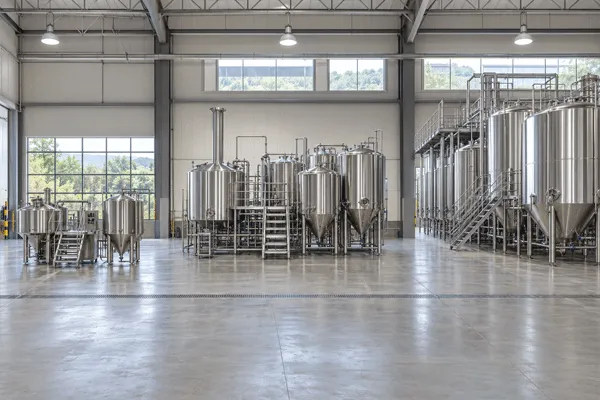
3. How Does Brewing Capacity Affect Brewery Equipment Cost?
Brewing capacity influences more than tank volume.
Imagine two breweries using a 10 BBL brewhouse.
Brewery A
- Brews twice per week
- Mostly sells draft beer
- Uses four fermenters
- Has a simple manual control system
Brewery B
- Brews twice per day
- Produces several beer styles
- Supplies distributors
- Uses twelve fermenters
- Has semi-automated controls
- Packages cans and kegs
The brewhouses may be the same nominal size, but Brewery B requires a much larger equipment investment.
Fermentation is especially important because beer can occupy a tank for days or weeks. Your brewer may finish producing wort in several hours, but the next stage creates the real capacity bottleneck.
That is why we often recommend planning fermentation tanks around production cycles rather than simply matching the number of brewhouse vessels.
4. What Does a Commercial Brewhouse System Cost?
The brewhouse is the heart of commercial brewing equipment.
A typical system may combine:
- Mash/lauter tun
- Kettle/whirlpool
- Hot liquor tank
More advanced configurations separate these operations into three, four, or even five vessels.
Why?
Because separating vessels allows a brewer to overlap production steps and brew more batches per day.
A simple two-vessel brewhouse may make sense for a brewpub. A busy production facility may prefer a three- or four-vessel system because higher throughput can reduce the effective cost of brewing over time.
The price also changes according to:
| Configuration Factor | Lower-Cost Option | Higher-Cost Option |
|---|---|---|
| التدفئة | Electric | بخار |
| عناصر التحكم | يدوي | PLC / automated |
| Pumps | Fixed speed | VFD controlled |
| Platform | Simple | Full operating platform |
| Valves | يدوي | Pneumatic |
| Recipe Control | Brewer controlled | Automated recipe system |
| Vessel Layout | وعائين (2-vessel) | 3–5 vessel |
| التنظيف | يدوي | Integrated CIP |
So when asking “much does commercial brewing equipment cost?”, always compare specifications, not just tank diameter and volume.
5. How Much Do Fermentation Tanks Add to the Equipment Cost?
Fermenters are often one of the largest parts of the total cellar budget.
A typical stainless steel conical fermenter may include:
- Cooling jackets
- العزل
- Pressure gauge
- Safety valve
- CIP spray ball
- صمام أخذ العينات
- Temperature sensor
- Racking arm
- Carbonation connection
- Sanitary fittings
304 and 316 stainless steels are widely used for brewing vessels, and commercial suppliers commonly use sanitary interiors, cooling jackets, and hygienic fittings for fermentation and conditioning equipment.
For many craft breweries, buying one extra fermenter may create more practical capacity than buying a larger brewhouse.
For example, a 10 BBL brewhouse paired with eight correctly sized fermenters may support a much healthier production schedule than a larger hot-side system with only three fermentation tanks.
That is why cellar planning should happen before you place the equipment order.
6. Does Stainless Steel Quality Change Brewery Equipment Cost?
Yes.
Brewery equipment material affects hygiene, corrosion resistance, durability, appearance, welding quality, and service life.
Food-grade 304 stainless steel is common for beer brewing equipment. Some applications may use 316 or 316L, especially where process conditions or chemical resistance justify it.
But steel grade alone does not define quality.
When buying equipment, also check:
- Internal polishing
- Weld quality
- Tank wall thickness
- Jacket construction
- العزل
- Pressure rating
- Sanitary fittings
- Valve quality
- CIP coverage
- اختبار الضغط
- Electrical component quality
You may also see copper brewery equipment, especially in traditional or decorative installations. Copper can create a classic appearance, but modern commercial breweries commonly use stainless steel because it is durable and easier to clean.
If two tanks look almost identical in photographs but have very different prices, inspect the technical specification carefully.
7. How Much Does Automation Add to Commercial Brewing Equipment Cost?
Automation usually raises upfront costs, but it can reduce repetitive work and improve production consistency.
A basic brewery may use manual valves and separate motor controls.
A more advanced system may include:
- Touch-screen HMI
- PLC
- Automatic temperature control
- VFD pumps
- Pneumatic valves
- Automatic water filling
- تخزين الوصفات
- Timed mash steps
- Automated wort transfer
- CIP sequences
- Alarm systems
This automated equipment becomes more valuable as production frequency increases.
A brewer making two batches each week may not need the same automation level as a commercial operation making three or four batches per day.
The key question is not:
“Can I automate this?”
It is:
“Will automation improve consistency, throughput, safety, or labor efficiency enough to justify the investment?”
For some projects, semi-automatic controls offer the best balance.
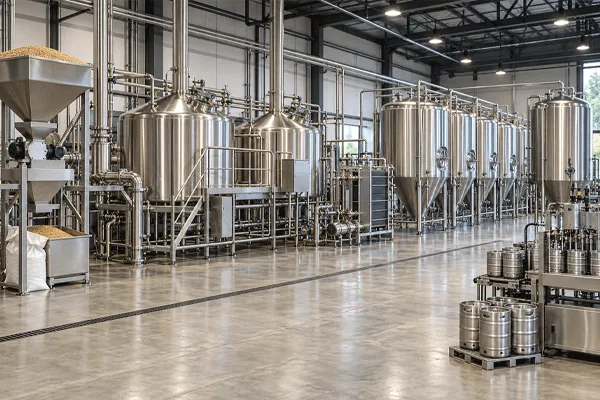
8. Should You Buy New or Used Brewery Equipment?
The choice between new or used equipment can significantly affect your initial budget.
Used brewery equipment may offer:
- Lower purchase price
- Faster availability
- Access to larger tanks within a limited budget
However, second-hand equipment can also create risks.
You may discover damaged cooling jackets, old electrical components, unsuitable voltage, worn pumps, incorrect pressure ratings, poor weld repairs, or tanks that simply do not fit your building.
Shipping can also become complicated.
New equipment offers different advantages:
- Capacity designed around your project
- Custom vessel dimensions
- Matching utilities
- Planned tank quantity
- Consistent fittings
- New controls
- Integrated layout
- Manufacturer support
When choosing new equipment, we can customize vessel diameter, height, heating method, control logic, platform design, piping, fermentation capacity, and packaging connections around the customer’s facility.
For a new brewery, that integrated approach can reduce project risk even when the initial purchase price is higher.
9. What Hidden Costs Should You Include When Opening a Brewery?
This is where many budgets fail.
The quoted price of brewery equipment for sale may not equal the cost of creating an operating brewery.
Common hidden costs include:
| Cost Item | Why It Matters |
|---|---|
| Freight | Stainless tanks require large shipping space |
| Customs / Duties | Varies by destination |
| التركيب | Mechanical and electrical work may be required |
| Boiler | Required for many steam systems |
| Glycol System | Controls fermentation temperature |
| Water Treatment | Important when source water needs adjustment |
| Drainage | Brewing uses substantial wash water |
| Electrical Upgrades | Larger systems may require industrial power |
| Gas / Steam Piping | Required for certain heating systems |
| Air Compressor | Used with pneumatic controls |
| Packaging | Kegs, cans, bottles, washers, fillers |
| Laboratory Equipment | Supports quality control |
| Spare Parts | Useful for pumps, seals, valves, and controls |
Do not forget labor costs and local contractor expenses either.
A low equipment quotation can become expensive if major support systems are missing.
This is why, when calculating the cost of opening a brewery, buyers should request a clear scope of supply.
10. What Is the Average Cost of Opening a Brewery?
The average cost of opening a brewery is much higher than the brewing equipment price alone.
Your total project budget may include:
- Brewing machinery
- Shipping
- Installation costs
- Facility rent or purchase
- Renovation
- Drainage
- Electrical infrastructure
- Licensing
- Raw materials
- Kegs and packaging
- Taproom furniture
- Marketing
- Staff
- Working capital
Therefore, the cost to start a brewery cannot be calculated from one equipment number.
The Brewers Association specifically treats starting a brewery as a broader planning process that includes financial planning, business goals, equipment selection, taproom design, and beer quality—not simply buying tanks.
If your goal is to understand the cost to open a brewery, prepare two budgets:
Budget A — Equipment and installation
Budget B — Complete business startup
Keeping those numbers separate makes financing much easier to understand.
11. How Should You Choose the Right Equipment Configuration?
The cheapest system is not always economical.
The most expensive system is not automatically better either.
Your ideal equipment configuration depends on how you plan to sell beer.
Before we design brewery equipment for your startup, we normally need answers to questions such as:
| Planning Question | Example |
|---|---|
| Target batch size | 500L, 1000L, 2000L |
| Annual beer volume | Planned production |
| Brews per day | 1, 2, 3+ |
| Beer styles | Lager, IPA, stout, wheat beer |
| Fermentation time | Varies by recipe |
| Sales format | Taproom, keg, bottle, can |
| Building size | Available production area |
| Ceiling height | Determines tank geometry |
| Heating source | Electric, steam, direct fire |
| Power supply | Local voltage / frequency |
| Automation | Manual, semi-auto, automatic |
| Future expansion | Planned growth |
Consider a brewery small enough to fit today’s sales but designed so additional fermenters can be installed later.
That can be more sensible than buying too much equipment on day one.
12. Is Home Brewing Equipment Suitable for a Commercial Brewery Startup?
Usually not.
Home brewing equipment and commercial systems solve different problems.
A small brewing kit is excellent for recipe development, education, and personal making beer. It is not designed for the production frequency, sanitation workflow, temperature control, cleaning procedures, and output expected from a commercial brewery.
Professional commercial beer production usually requires:
- Sanitary stainless vessels
- Controlled wort cooling
- Reliable temperature management
- Commercial pumps
- Repeatable cleaning
- Proper pressure control
- Production-scale fermentation
- Safe access platforms
- Suitable electrical systems
Small brewing kits can still be useful as pilot systems.
Some commercial breweries keep a small pilot brewhouse for recipe testing before transferring successful recipes to the main production system.
That is a very different role from using home equipment as your primary brewery.
13. How Can New Brewery Owners Reduce Equipment Investment Without Limiting Growth?
You do not need to purchase every possible piece of equipment immediately.
Smart brewery startup planning focuses money on bottlenecks.
For example, you might:
- Start with manual valves instead of full automation
- Add more fermenters instead of oversizing the brewhouse
- Begin with keg sales before adding a canning line
- Prepare piping for future tanks
- Design glycol capacity for expansion
- Leave floor space for future cellar equipment
- Use modular control systems
- Install a brewhouse that can support multiple daily batches later
Suppose you expect demand to double in three years.
Rather than replacing your entire brewing system, you could design the utilities, pipe routes, glycol system, electrical capacity, and cellar layout so that new tanks can be added.
Good engineering turns expansion into an upgrade instead of a rebuild.
14. Why Customized Brewery Equipment Can Lower Long-Term Project Cost
Customized equipment sometimes costs more than a standard package initially.
But customization can save money when it solves a real production problem.
Imagine your building has a low ceiling.
A standard fermenter may not fit. A custom tank can use a wider diameter and shorter overall height while maintaining the required working capacity.
Or perhaps your production plan includes beer, cider, kombucha, and cold brew coffee.
Instead of buying unrelated pieces of equipment, we can evaluate where tanks, cooling systems, pumps, CIP systems, and controls can share infrastructure.
Our role as a brewery and beverage equipment manufacturing plant is therefore not limited to manufacturing a kettle or fermenter. We can help plan:
- Brewhouse capacity
- Fermentation capacity
- Tank dimensions
- Equipment layout
- Cooling load
- Heating method
- Piping
- عناصر التحكم
- Packaging connections
- Installation requirements
- Future expansion
This is particularly useful for craft breweries, brewpubs, taprooms, cideries, wineries, kombucha producers, distilleries, cold brew producers, project investors, and engineering contractors.
15. How Do You Get an Accurate Brewery Equipment Quote?
If you simply ask:
“Please send me the price of a 1000L brewery.”
you will probably receive very different quotations.
Why?
Because “1000L brewery” does not define the complete project.
For a useful quotation, provide:
1. Required brew capacity
For example: 500L, 1000L, 2000L, 10 BBL, or 20 BBL.
2. Desired annual production
This helps determine the number of fermenters.
3. Number of brews per day
This affects brewhouse configuration.
4. Product type
Beer, kombucha, cider, wine, spirits, cold brew, or another beverage.
5. Packaging method
Keg, bottle, can, or bulk tank.
6. Available building dimensions
Floor plan and ceiling height are especially useful.
7. Local utilities
Voltage, frequency, steam availability, water supply, and fuel type.
8. Automation preference
Manual, semi-automatic, or fully automatic.
9. Target installation date
This helps coordinate manufacturing, shipping, and project planning.
Once we understand these details, we can recommend the equipment you need rather than simply offering the largest package possible.
That leads to a more accurate quotation—and usually a better brewery.
FAQs About Brewery Equipment Cost
How much does commercial brewing equipment cost?
Small commercial systems may begin around $30,000–$60,000, while 10–15 BBL brewery systems commonly move into roughly the $80,000–$250,000+ range depending on fermentation capacity, controls, cooling, cleaning, and accessories. Large production systems can cost several hundred thousand dollars or more.
What is the smallest brewhouse cost for a commercial brewery?
The smallest brewhouse costs can fall below $20,000 for basic compact equipment, but a practical commercial setup costs more once you add fermentation, cooling, pumps, controls, and cleaning equipment. Extremely low prices should always be checked against the complete scope of supply.
Is fermentation equipment included in a brewhouse quotation?
Not always. Some suppliers quote only the hot-side brewing vessels. Always confirm whether fermentation tanks, brite tanks, glycol chilling, CIP, controls, piping, and accessories are included.
Is used brewery equipment cheaper than new equipment?
Usually, yes. Used brewery equipment can reduce purchase cost, but freight, repairs, modifications, missing parts, outdated controls, or incompatible utilities can reduce those savings. Evaluate total installed cost rather than purchase price alone.
How many fermentation tanks should a brewery buy?
There is no universal number. It depends on batch size, brews per week, fermentation time, beer styles, and annual production. A brewery that brews frequently usually needs significantly more fermentation capacity than hot-side capacity.
Can one brewing system produce beer, kombucha, cider, or other beverages?
Some infrastructure can serve several beverage processes, especially stainless tanks, cooling systems, pumps, and CIP systems. However, each beverage has different process requirements. A customized design should evaluate temperature, pressure, sanitation, mixing, carbonation, filtration, and packaging requirements before equipment is selected.
Final Thoughts: What Should You Remember About Brewery Equipment Cost?
When asking “How much does brewery equipment cost?”, remember that the brewhouse price is only one part of the answer.
The most important points are:
- A small معدات مصانع الجعة التجارية package may start around $30,000–$60,000, while larger production systems can cost hundreds of thousands of dollars.
- Your final equipment cost depends on capacity, tank quantity, automation, material, cooling, heating, cleaning, packaging, and installation.
- A larger brewhouse does not automatically mean a more productive brewery.
- Fermentation capacity is often one of the most important production constraints.
- Compare technical specifications rather than comparing price alone.
- Include glycol cooling, utilities, freight, installation, piping, packaging, and other hidden costs in your budget.
- Choose new or used equipment based on total project risk, not purchase price alone.
- Design the brewery around annual production and sales strategy.
- Plan future expansion before installing the first tank.
- Customized brewery equipment can improve space use, production flow, sanitation, and long-term scalability.
- Before starting your brewery, provide your equipment manufacturer with batch size, annual output, building dimensions, beer styles, packaging method, utilities, and automation requirements.
- The best brewery equipment investment is not necessarily the cheapest system. It is the system that lets you brew consistently, expand efficiently, and operate reliably for years.
For brewery owners, investors, brewpub operators, beverage startups, and engineering contractors, good equipment planning reduces much more than the purchase price. It reduces production bottlenecks, installation problems, expansion costs, and project uncertainty.
As a professional manufacturer of customized stainless steel brewery and beverage equipment, we can design the brewhouse, fermentation tanks, cooling system, controls, layout, and turnkey brewery system around your real production goals.
Before comparing quotations, define what you want your brewery to produce.
Then build the equipment around that plan.