David Zhang | Founder & CEO, ZPET | Published August 22, 2026
SS304 or SS316L: Which Grade Actually Matters for Your Tank?
Beer tanks are almost always stainless, but “stainless steel” isn’t one material: SS304 and SS316L are the two grades used across fermenters, bright tanks, and storage vessels, differing in chromium/nickel content, chloride resistance, and cost. The grade on a spec sheet says more about durability under your water and CIP chemistry than the shine of the tank.
| Property | SS304 | SS316L |
| Chromium content | Roughly 18–20% | Roughly 16–18% |
| Nickel content | Roughly 8–10.5% | Roughly 10–14% |
| Molybdenum | Not present | Added, roughly 2–3% |
| Chloride / pitting resistance | Adequate for most fresh-water CIP | Higher; better suited to aggressive CIP or high-chloride water |
| Typical brewery use | Most fermenters, bright tanks, storage vessels | Sour beer, kombucha, high-acid or high-chloride environments |
| Weldability | Good | Slightly better — the “L” (low carbon) reduces weld-zone carbide precipitation |
| Relative material cost | أدنى | Higher, from the added nickel and molybdenum |
Most craft breweries default to SS304 for general fermentation and storage, then step up to SS316L for vessels exposed to high-chloride water, sour or fruited beer, kombucha, or aggressive CIP chemistry. ZPET builds fermentation tanks and bright beer tanks in either SS304 or SS316L sanitary grade, so the grade is a spec choice made at order time, not a fixed default baked into the product line.
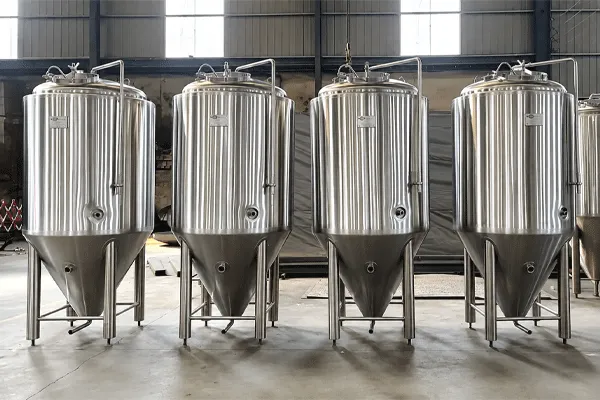
What “Stainless Steel Beer Tank” Actually Means
The term covers more than one vessel type. Fermenters, bright/BBTs, and general-purpose storage tanks are all built on the same sanitary-grade shell principle — food-contact stainless, an interior polish spec, a cooling jacket, and clean-in-place-compatible ports — even though each does a different job in the process. A tank built to this standard doesn’t change grade or polish depending on whether it’s fermenting, holding carbonated beer, or storing finished product; what changes is the internal geometry (cone angle, dish shape) and fittings suited to that stage.
Non-food-contact framing, stands, and platforms sometimes use mild or carbon steel to cut cost, since they never touch the product. Anything the beer actually contacts should stay in the sanitary grade range regardless of which part of the process it’s built for.
ZPET Tank Construction: The Full Spec Sheet
| Spec | ZPET Fermentation & Bright Beer Tanks |
| Shell material | SS304 / SS316L sanitary grade |
| التشطيبات الداخلية | صقل عاكس بدقة 0.4 ميكرومتر |
| Cooling | غلاف التبريد ذو النتوءات |
| Access | Optional side manway |
| Welding method | TIG / double-sided argon arc welding, CNC laser-cut components, automatic welding robots on shell seams |
| Pre-shipment testing | Spectrometer material verification, 24-hour pressure hold test, X-ray weld inspection, 5-step QC |
| الضمان الهيكلي | 10 سنوات |
| Compliance | Engineered to meet PED (CE), UL/cUL (control panels), and AS1210 (Australia) requirements |
| Technical response | Within 24 hours / 1 working day |
Most stainless steel tank guides cover grade chemistry in real depth and then stop, without a written warranty term sitting next to the spec. Pairing the two is the whole point of a spec sheet: a grade only means something in combination with how the shell was welded, tested, and backed after delivery.
ZPET builds to this construction standard across 200+ installations in 40+ countries, mostly for buyers in North America, Europe, and Australia, out of a 5,000 m² facility staffed by 20+ senior engineers and brewmasters.
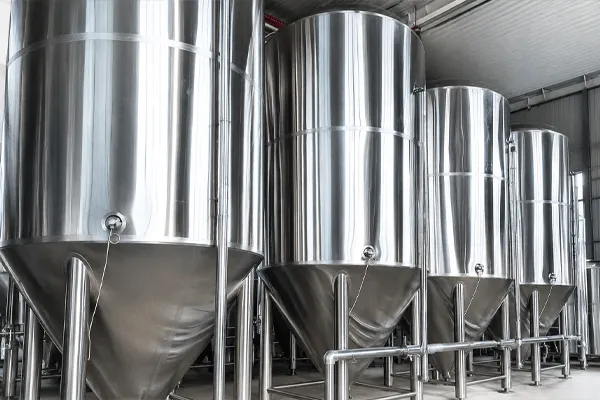
Surface Finish and Welding: The Specs Marketing Copy Skips
μm and Ra aren’t quite the same measurement, and suppliers sometimes move between them without saying which one they mean. The 0.4 μm figure on ZPET’s spec sheet sits toward the smoother end of the surface-finish ranges referenced in ASME BPE’s hygienic-piping framework, the standard most sanitary vessel fabricators build interior polish specs against. Before comparing one supplier’s number to another’s, confirm which measurement method actually produced it.
Welding method affects long-term weld integrity more than shell grade alone does. Double-sided TIG (tungsten inert gas) argon arc welding fuses the seam from both sides of the plate, which lowers the risk of incomplete penetration compared with single-pass welding. ISO 3834’s welding-quality framework is one of the benchmarks fabricators reference for structural weld requirements — worth asking a supplier whether their process is checked against it, not just whether the word “TIG” appears on the page.
Four Steps to Verify Any Supplier’s Stainless Steel Claim
- Ask for the mill test certificate or spectrometer material analysisfor the actual shell plate used, not a generic grade datasheet.
- Ask for the welding method and inspection record.Confirm whether welds are X-ray inspected before shipment, not only after a complaint arrives.
- Ask for the surface finish measurement method.A μm or Ra number without a stated method isn’t fully verifiable.
- Ask for the written structural warranty term and its scope— vessel and welds only, or jacket and fitt ings as well.
Common Mistakes When Comparing Tank Material Specs
- Assuming “stainless steel” alone tells you the grade.SS304 and SS316L behave differently under identical CIP chemistry; the label on a brochure doesn’t specify which one you’re getting.
- Comparing μm figures without confirming the measurement standard.Two suppliers’ “0.4 μm” claims aren’t automatically comparable if they were measured differently.
- Treating “TIG welded” as one uniform process.Single-sided and double-sided TIG welding produce different weld integrity outcomes on the same shell material.
- Sour beer and kombucha producers defaulting to SS304because it’s the brewery-standard grade, without checking whether the acid and chloride exposure in their process actually calls for SS316L.
- Skipping the warranty questionbecause most catalog pages don’t mention one, then discovering the term only after a defect shows up.
Warranty and Compliance: What’s Actually Backed in Writing
A 10-year structural warranty is only as solid as what it’s backed by. ZPET’s warranty follows from the welding method, material grade, and pre-shipment pressure testing on the spec sheet above, not from a standalone marketing line. A claim on a tank built with single-pass welding and no pressure hold test is a different conversation than one built with double-sided TIG welding and a documented 24-hour hold.
Compliance wording deserves the same scrutiny. “Engineered to meet PED (CE)” means the design and fabrication follow that standard’s requirements; “PED certified” means a third-party body issued a certificate against it. ZPET’s tanks are built to meet PED (CE), UL/cUL, and AS1210 requirements — buyers who specifically need a certificate for customs or site-acceptance purposes should confirm which of the two they’re actually asking a supplier for.
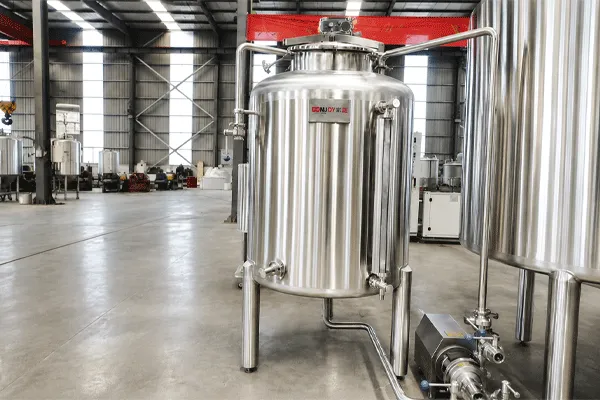
What This Costs
Neither SS304 nor SS316L tanks carry a published price on ZPET’s site, and the same is true across most manufacturers selling direct. Grade choice, shell diameter, jacket configuration, manway placement, and welding method all move cost independently, so a flat number wouldn’t reflect what any given order actually needs. What stays consistent is the pricing structure: factory-direct pricing without a distributor markup between the fabrication shop and the buyer, quoted against the actual spec sheet rather than a catalog size chart.
One detail this piece hasn’t covered: mixed-grade builds. Some breweries spec an SS316L jacket or CIP-exposed zone welded onto an otherwise SS304 shell, keeping the higher-cost grade only where chloride or acid exposure is actually a concern. Worth asking about if budget is tight and only part of the tank sees aggressive chemistry.
الأسئلة الشائعة
Q: What’s the actual difference between SS304 and SS316L for a beer tank?
A: SS316L adds molybdenum to the SS304 base composition, giving it better resistance to chloride-related pitting and corrosion, at a higher material cost.
Q: Do I need SS316L for a standard beer fermenter?
A: Not usually. Most beer fermentation and storage runs fine on SS304; SS316L becomes worth the added cost for sour beer, kombucha, high-chloride water, or aggressive CIP chemistry.
Q: What does “0.4 μm mirror polish” mean on a tank spec sheet?
A: It’s a surface-finish measurement describing how smooth the interior shell is, which affects how easily residue and bacteria can adhere to the surface during cleaning.
Q: Is a TIG-welded stainless tank better than a MIG-welded one?
A: TIG welding generally gives more control over weld quality on thin sanitary-grade stainless, and double-sided TIG in particular reduces the risk of incomplete penetration compared with single-pass methods.
Q: Does a 10-year structural warranty on a stainless tank cover corrosion damage?
A: A structural warranty typically covers the vessel and welds against fabrication defects; get the written terms confirmed at quote stage to see whether corrosion from misapplied grade or chemistry is included.
Q: Can a fermentation tank and a bright tank use the same stainless steel grade?
A: Yes — grade choice (SS304 or SS316L) is independent of which stage of the process the tank is built for, so both can be specified in the same grade if the application calls for it.