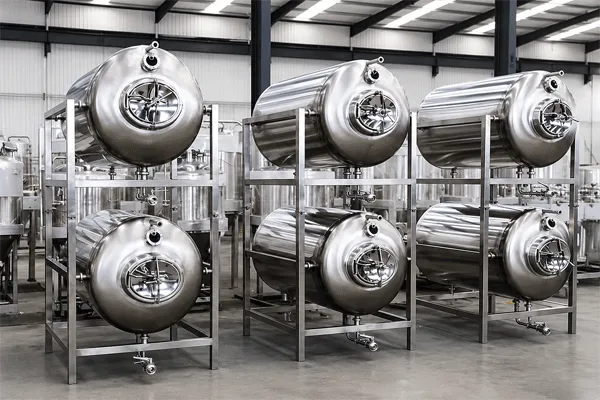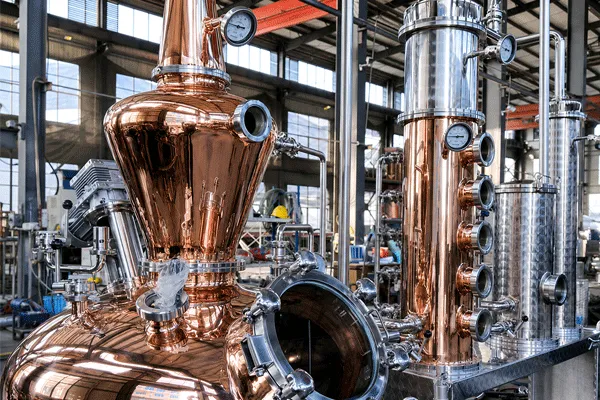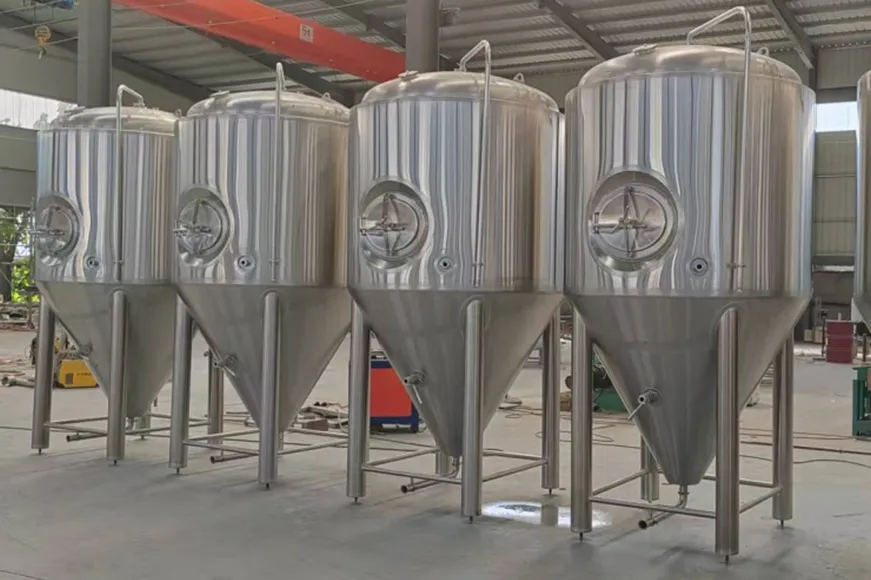
A small brewery can lose time, beer, and floor space when its fermenter does not match batch size, cooling demand, cleaning method, or future production plans. Those problems become costly as volume grows. A properly specified 1 BBL fermenter gives brewers better control without overbuilding the project.
A 1 BBL fermenter is a fermentation vessel designed around a one-barrel brewing scale. In the U.S. brewing industry, 1 bbl equals 31 U.S. gallons. For professional use, buyers should evaluate usable volume, headspace, stainless steel construction, conical geometry, glycol cooling, ports, pressure rating, cleanability, and how the tank integrates with the complete brewing system.
مخطط المقال
- What is a 1 BBL fermenter, and how much beer can it hold?
- Why choose a conical fermenter for small-batch brewing?
- How does a jacketed conical tank use glycol to cool beer?
- Should you choose a unitank or a standard fermentation vessel?
- Which ports, valves, and accessories matter most?
- How do CIP and sanitary design improve cleanability?
- What pressure capability does a 1 BBL tank need?
- Should the tank use a cart, caster, footpad, or adjustable foot?
- How should a 1 BBL fermenter fit into a complete brewing system?
- Frequently asked questions
What Is a 1 BBL Fermenter, and How Much Beer Can It Hold?
A 1 BBL fermenter sits between hobby-scale equipment and larger commercial tanks. The Brewers Association defines one U.S. beer barrel as 31 U.S. gallons. That figure is useful for production planning, but it should not be confused with the total physical gallon capacity of a fermentation tank.
A working vessel normally needs space above the liquid for active fermentation, foam, gas, and process operations. Therefore, a buyer should ask separately about:
| Capacity Item | What It Means |
|---|---|
| Nominal brew size | Target batch size |
| حجم العمل | Recommended liquid volume |
| Total vessel volume | Full internal volume |
| Headspace | Space left above the product |
| Finished volume | Product remaining after process losses |
For a craft brewery, brewpub, pilot plant, beverage startup, or product-development room, this distinction matters. A nominal 1 bbl batch does not guarantee that every gallon entering the vessel becomes packaged beer. Transfers, sediment, yeast, dry-hop material, and operating practices can reduce final yield.
A small fermenter can also serve as a useful pilot tank inside a larger operation. Commercial brewers may use it for recipe trials, limited releases, experimental hop schedules, yeast testing, or other small batch work without tying up a large production vessel.
Why Choose a Conical Fermenter for Small-Batch Brewing?
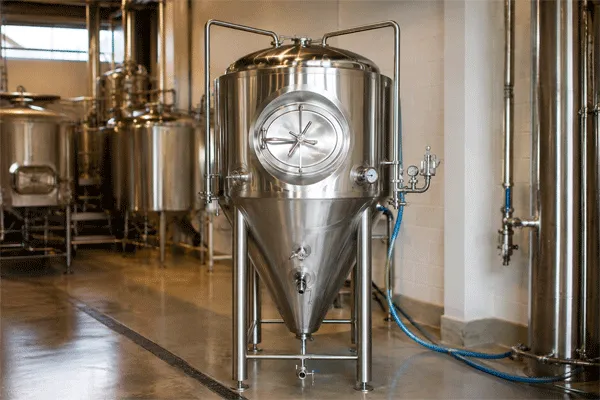
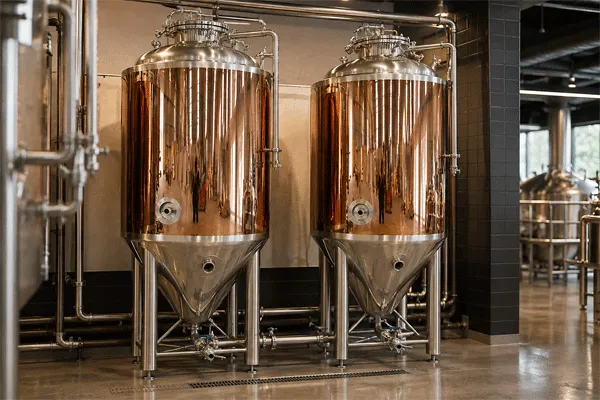
A conical fermenter uses a cone-shaped bottom rather than a simple flat base. For brewers, this geometry helps solids settle toward a defined discharge area. Depending on the tank design and process, operators can manage sediment, collect yeast, and transfer product through dedicated bottom and side connections.
That is one reason a conical configuration is common in professional brewing equipment. It gives the brewer more process options than a basic open or flat-bottom container.
A typical commercial-style layout may include:
- Bottom dump valve
- Side product outlet
- Racking arm
- Sample point
- Temperature sensor connection
- Blow-off connection
- CIP connection
- Pressure instrumentation when required
The exact arrangement should follow the intended beer and operating method.
For example, a brewery doing frequent dry hopping may prioritize an accessible dry-hop port and easy removal of hop sediment. A facility producing clean lager styles may focus more heavily on cooling performance and sediment management. A kombucha producer or cider maker may ask for a different internal configuration again.
This is why we do not view a tank as an isolated piece of brewing equipment. As a professional brewery and beverage equipment manufacturing plant, we first look at batch size, beverage type, temperature program, cleaning method, room layout, and downstream transfer requirements before defining a suitable configuration.
How Does a Jacketed Conical Tank Use Glycol to Cool the Brew?
Fermentation produces heat. If the room temperature changes or the yeast becomes more active, the liquid temperature can move away from the brewer’s target. A cooling jacket gives the operator a controlled way to remove heat from the vessel.
In a jacketed system, chilled glycol solution circulates through an external cooling zone around part of the tank. A controller reads product temperature and operates the cooling circuit as required. The specific jacket area and cooling load should be matched to the process, ambient conditions, insulation, and chiller capacity.
A simplified cooling loop looks like this:
Glycol Chiller
      ↓
Supply Line
      ↓
Tank Jacket
      ↓
Return Line
      ↓
Glycol Chiller
Current commercial nano-scale equipment illustrates how manufacturers approach this problem. For example, Ss Brewtech’s current 1 bbl jacketed unitank lists both lower-cone and body glycol cooling zones. Its broader unitank range also uses welded glycol jackets. These are product-specific examples rather than universal specifications, but they show why jacket design should be reviewed carefully.
A well-designed jacketed conical vessel normally also needs suitable insulation if stable cold-side operation is expected. Insulation reduces unwanted heat gain from the room and helps the cooling system work more efficiently.
When asking a manufacturer to insulate a vessel, clarify:
- Ambient room temperature
- Target fermentation temperature
- Lowest expected product temperature
- Cooling medium
- Glycol supply temperature
- Distance from the glycol chiller
- Pipe routing
- Number of tanks operating at the same time
Do not size the chiller only around one tank if several vessels may call for cooling together.
Should You Choose a Unitank or a Standard Fermentation Vessel?
A conventional fermentation vessel is mainly used to ferment the product and then transfer it to another process tank. A unitank combines more functions in one vessel and may support fermentation, conditioning, pressure transfer, and—in a suitably designed and rated system—carbonation.
That can be attractive when floor space is limited.
However, a unitank is not automatically the best answer for every operation. A brewery with a dedicated brite tank may prefer a different workflow. A taproom producing many rotating beers may value flexibility. A beverage startup may care more about low initial complexity.
| Requirement | Standard Fermenter | Unitank |
|---|---|---|
| Primary fermentation | Yes | Yes |
| Sediment management | Yes | Yes |
| Pressure transfer | Design dependent | Common requirement |
| Carbonation in vessel | Design dependent | Often requested |
| Separate brite tank needed | Often | Sometimes reduced |
| Equipment complexity | أدنى | Usually higher |
Commercial products also demonstrate why the word “unitank” alone is not enough for procurement. Ss Brewtech’s current unitank specifications list items such as glycol cooling, a sampling valve, blow-off connections, pressure instrumentation, and a rotatable racking component. Buyers should compare these functions rather than assuming all tanks marketed under the same name are identical.
You may see buyers comparing a Brewtech unit or a Blichmann product while preparing a project. That is useful for understanding available feature ideas, but your final RFQ should describe your own process rather than simply asking another manufacturer to copy a competitor’s specification.
Which Stainless Steel Ports, Valves, and Accessories Matter?
A good tank is not just a shell. The placement of every port, fitting, instrument, and accessory influences how the operator works.
For professional projects, buyers commonly discuss stainless steel construction and sanitary process connections. Current commercial tank examples use SUS 304 stainless steel and welded TC connections, but the required material grade, wall construction, surface finish, and connection standard should always appear in the final specification rather than being assumed.
Typical items to review include:
| Component | Main Purpose |
|---|---|
| Bottom outlet | Sediment or yeast discharge |
| Product port | Transfer |
| صمام أخذ العينات | Product sampling |
| Thermowell | Temperature measurement |
| CIP port | التنظيف |
| Blow-off arm | Fermentation gas management |
| Pressure gauge | Vessel pressure indication |
| PRV | Pressure protection |
| Dry-hop port | Ingredient addition |
| Racking outlet | Clear-product transfer |
A tri-clamp or TC sanitary connection can make an accessory easier to remove, inspect, and service. A welded tri-clamp ferrule also avoids certain threaded product-contact connections, although the correct sanitary design depends on the complete assembly.
A rotating racking arm or rotating racking outlet can help the brewer select product from a useful level above sediment. Similarly, a properly located sampling point makes routine checks easier.
Do not add ports simply because they appear on a competitor’s drawing. Every added connection increases fabrication, components, cleaning points, and cost.
How Do CIP and Sanitary Design Improve Cleanability?
Cleaning is one of the most important parts of cold-side equipment design. Beer residue, yeast, hop particles, and other soil can remain in poorly accessible areas. If the operator cannot effectively clean or inspect those areas, the risk of contamination increases.
3-A Sanitary Standards states that hygienic standards focus on the design and fabrication of equipment that contacts food. Its guidance emphasizes cleanability, hygienic fabrication, stainless steel components, welded joints, and contamination prevention. These standards cover a broader food-equipment field and should not be interpreted as proof that a particular brewery tank is 3-A certified, but the hygienic design principles are highly relevant.
A professional tank may use a CIP spray ball connected through a dedicated CIP port. During cleaning, the system distributes cleaning solution across internal surfaces. The actual cleaning result still depends on spray coverage, flow, chemistry, time, temperature, drainage, and operating procedure.
Operators should check:
- Internal weld quality
- Drainability
- Dead legs
- Removable fittings
- Valve cleanliness
- Gasket condition
- Spray coverage
- Internal surface condition
- Residual chemical removal
A sanitizer is not a substitute for physical cleaning. Soil must first be removed using an appropriate cleaning procedure.
Before shipment, buyers should also ask how the factory checks for a welding defect, coolant or water leak, fitting problems, and pressure-system integrity. The required inspection method should match the agreed design and applicable local requirements.
What Pressure Capability Does a 1 BBL Tank Need?
Pressure ratings require careful attention because different tanks are built for different operating conditions.
You may see 15 PSI in search results or competitor specifications, but that number must never be treated as a universal rating. For example, Ss Brewtech’s current Unitank 2.0 lists 15 psi operating pressure, while its 1 bbl Nano Jacketed Unitank lists a 17 PSI pressure-relief valve. Those are specific manufacturer specifications, not rules for every vessel.
If you plan pressure fermentation, closed transfer, spunding, or carbonation, tell the manufacturer before fabrication.
Important items may include:
- Design pressure
- Working pressure
- Relief setting
- Pressure gauge
- Pressure/vacuum protection
- Gas connection
- CO2 connection
- Closed-transfer arrangement
The pressure capability must come from the engineered tank specification. Never infer it from appearance, wall thickness, or another supplier’s model.
For pressure transfer, the receiving vessel, hose, valve, and connection system must also be suitable for the process. A safe tank does not make an unsafe downstream line safe.
This is one reason detailed engineering communication matters when moving from basic homebrew equipment to professional brewing equipment.
Should the Tank Use a Cart, Caster, Footpad, or Adjustable Foot?
A small tank seems easy to move until it is full. One U.S. barrel represents 31 gallons before considering the weight of the vessel, fittings, accessories, or any additional headspace volume.
A cart may make sense for some pilot systems. A tank with a caster can offer flexibility in a test room, but mobility must be evaluated with stability, hose connections, floor condition, drainage, and operating procedures in mind.
For a fixed commercial installation, a footpad or adjustable foot can make more sense. It may help level the tank and establish a defined production layout.
Before choosing the support design, ask:
- Will the tank move while empty only?
- Does the floor slope toward a drain?
- Are glycol lines permanent?
- Is the tank connected to rigid piping?
- How much service clearance is required?
- Could the vessel become top-heavy?
- Does local regulation require anchoring?
A modular pilot brewery often benefits from flexible equipment placement. A production brewery usually benefits more from stable, repeatable piping and work paths.
The support structure should therefore be considered part of the process design—not an afterthought.
How Should a 1 BBL Fermenter Fit Into Your Brewing System?
A fermentation tank cannot fix a poorly balanced brewing system.
Start upstream. Your mash vessel, kettle, hot liquor tank, pumps, heat source, and brewhouse determine how much wort reaches the cold side and how often.
Then look downstream. Ask how the finished product will move to a brite tank, packaging line, serving tank, or keg.
A simple planning sequence is:
Raw Materials
      ↓
Mash / Brewhouse
      ↓
Kettle
      ↓
Wort Cooling
      ↓
Fermenter
      ↓
Conditioning
      ↓
Packaging / Keg
Now consider time.
If one batch takes a day to brew but occupies the fermentation vessel for many days, the cold side—not the brewhouse—may control production capacity. Adding fermentation capacity can sometimes deliver a more practical upgrade than increasing brewhouse size.
That is why our engineering discussions begin with the whole project. As a professional manufacturer of customized stainless steel brewing systems, خزانات التخمير, أنظمة مصنع الجعة, و turnkey brewery solutions, we ask B2B customers to think in terms of production flow rather than individual machines.
For a project inquiry, prepare a specification containing:
- Target batch size
- Beverage type
- Annual or weekly production goal
- Fermentation schedule
- Temperature range
- Cooling method
- Required pressure operation
- Vessel quantity
- Tank dimensions
- Available ceiling height
- Door and access dimensions
- Drain location
- Utility conditions
- Cleaning method
- Requested ports and valves
- Installation requirements
- Future expansion plan
A craft brewery may prioritize beer variety. A cidery or winery may use different process conditions. A kombucha facility may emphasize different ingredient handling and cleaning steps. An engineering contractor may care strongly about utility connections and layout drawings.
One tank can fit all of those businesses physically. That does not mean one configuration fits all of them operationally.
Frequently Asked Questions
Is a 1 bbl fermenter exactly 31 gallons in total capacity?
No. 1 bbl equals 31 U.S. gallons as a beer-volume unit, but the physical vessel may require additional internal volume for headspace and normal operation. Always ask for both working capacity and total capacity.
Do I need a glycol jacket for a 1 BBL system?
Not every application requires the same cooling arrangement, but controlled cooling becomes increasingly important when the brewer needs stable and repeatable fermentation temperatures. A glycol jacket paired with appropriate temperature control is a common commercial approach; current nano-scale professional tanks are available with jacketed cooling systems.
For a serious commercial project, we recommend calculating the complete cooling demand rather than selecting a glycol chiller from tank volume alone.
Does every unitank operate at 15 PSI?
No. 15 psi is a product-specific value seen on some commercial equipment, not a universal requirement. Different vessels can have different operating and relief specifications. Pressure limits must come from the specific tank engineering documents.
What ports should a professional fermenter include?
That depends on the process. A buyer may request a bottom drain, product outlet, thermometer or sensor connection, sample valve, CIP connection, dry-hop access, blow-off connection, pressure instrumentation, or a rotating racking arm.
Start from the operating procedure and then decide which connections are actually needed.
Is 304 stainless steel suitable for brewing tanks?
SUS 304 is used in current commercial brewing tank products, including professional fermenter examples, but the material grade and fabrication specification should always be stated clearly in your purchase documents.
Material alone does not determine hygienic performance. Weld quality, finish, drainage, geometry, fittings, and cleaning access also matter.
When should a brewery move from a small fermenter to larger tanks?
Look at demand, brew frequency, fermentation time, floor space, labor, utilities, and packaging capacity.
If the brewhouse can produce wort faster than available tanks become free, fermentation capacity may be your bottleneck. A small vessel remains useful for pilot production even after larger tanks are installed, so it does not necessarily become obsolete.