David Zhang | Founder & CEO, ZPET Last reviewed: September 7, 2026 · Reviewed by David Zhang, Founder & CEO
A 30 BBL brewhouse produces roughly 3,500 L of wort per batch, sitting at the top of the microbrewery tier before equipment moves into commercial-scale territory. At this size, vessel configuration and automation level matter more than batch size alone — a 30 BBL system built for one brewery’s throughput target can look very different from another’s.
Where 30 BBL Sits in the Capacity Ladder
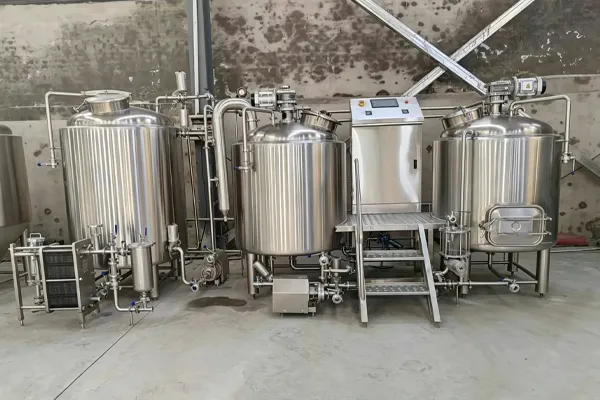
Using Brewers Association capacity conventions, 30 BBL (approximately 3,500 L) sits at the upper edge of the microbrewery range, just below the point where most manufacturers classify equipment as commercial-tier. Breweries reaching this size are usually outgrowing a 10–15 BBL pilot system and planning for wider distribution, not just taproom sales.
That transition changes more than tank dimensions. Vessel count typically moves from 2- or 3-vessel to 3- or 4-vessel configurations, automation shifts from optional to close to standard, and utility infrastructure — glycol capacity, CIP plumbing, steam or electrical service — has to be sized for sustained multi-batch operation rather than occasional brew days.
ZPET 30 BBL Microbrewery Equipment Specifications
| Parametro | Spec |
| Batch size | 30 BBL (approx. 3,500 L) per brew cycle |
| Linea di prodotti | Attrezzature per microbirrifici (7–30 BBL) |
| Vessel configuration | 3-vessel or 4-vessel, per production schedule |
| Riscaldamento | A vapore / elettrico / a fuoco diretto |
| Automation | PLC/HMI control, standard at this tier |
| Materiale | SS304 / SS316L per uso sanitario |
| Surface finish | 0.4 μm mirror polish, aligned with ASME BPE surface-finish conventions |
| Saldatura | TIG / double-sided argon arc welding; CNC laser cutting; automatic welding robots |
| Test | Spectrometer material analysis, 24-hour pressure hold test, X-ray weld inspection, 5-step QC |
| Warranty | 10-year structural warranty |
| Compliance | Engineered to meet PED (CE), UL/cUL, and AS1210 requirements |
Exact footprint and vessel layout are confirmed against the buyer’s building through a 3D layout drawing before fabrication — at 30 BBL, ceiling height for tank placement and utility routing for steam or glycol lines are usually the two constraints that shape the final configuration more than the batch size itself.
3-Vessel vs. 4-Vessel at 30 BBL
| Fattore | 3-Vessel (Mash/Lauter + Kettle + Whirlpool) | 4-Vessel (Mash + Lauter + Kettle + Whirlpool, separate) |
| Impronta ecologica | Smaller | Larger |
| Costo di capitale | Inferiore | Più alto |
| Brew days per week supportable | Moderate — some sequential bottleneck on the combined vessel | Higher — vessels operate more independently |
| Recipe flexibility | Adequate for most standard mash programs | Better for step mashing and back-to-back batches |
| Best fit | Breweries running a handful of core recipes at steady volume | Breweries running varied recipes or scaling toward multiple brews daily |
Neither configuration is a strictly better choice — the decision depends on projected weekly brew frequency and recipe complexity, which is a conversation worth having before finalizing vessel count rather than after equipment arrives.
Common Mistake: Sizing the Brewhouse Without Sizing the Cellar
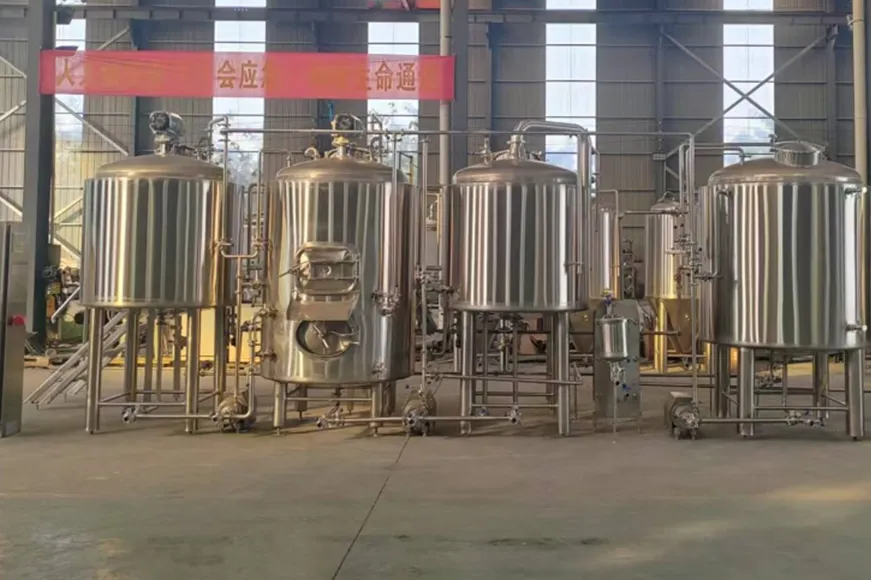
A 30 BBL brewhouse purchased without matching fermentation and bright tank capacity creates a bottleneck identical to the one smaller breweries hit at nano scale, just at higher cost. If cellar capacity can’t cycle through fermentation, conditioning, and cleaning fast enough to keep pace with brew frequency, the 30 BBL brewhouse sits idle between batches regardless of how efficient the brewhouse itself is.
As a starting reference, breweries targeting several brews a week at 30 BBL typically plan for 4–8 fermenters cycling in rotation, sized against their actual fermentation and conditioning timeline rather than a fixed ratio — recipe style and turnaround time both shift the real number.
New-Build vs. Used Equipment at This Scale
At 30 BBL, buyers commonly compare a new factory-built system against used equipment sourced through resale marketplaces. Used equipment can lower upfront capital cost, but it comes with different risk: warranty coverage typically doesn’t transfer or has already expired, weld and material condition depend on how the previous owner maintained the system, and layout dimensions are fixed to whatever the original buyer’s building required — not necessarily compatible with a different floor plan. A new build, engineered against your own site survey, removes that uncertainty at the cost of longer lead time and higher upfront price.
What Drives the Price at 30 BBL
Vessel count, automation level, heating method, and shipping distance all move the price independently at this scale, which is why ZPET doesn’t publish a fixed number for 30 BBL systems the way some vendors publish “starting from” figures. Those published starting prices typically reflect a base configuration — manual controls, minimal automation — that most breweries buying at 30 BBL upgrade past anyway, so the headline number rarely reflects what actually gets ordered.
What buyers can count on is factory-direct pricing with no trading-company markup between fabrication cost and quote. A request-a-quote conversation covering vessel configuration, automation level, and destination country produces a number that reflects your actual build, not a base-model figure that changes once real specs are added.
Domande frequenti
Q: How much beer can a 30 BBL brewhouse produce in a year?
A: Annual output depends on brew frequency and fermentation capacity, not the brewhouse alone. A 30 BBL brewhouse run several times a week with adequate cellar capacity can support production well into the thousands of barrels annually — cellar capacity, not the brewhouse, sets the ceiling.
Q: Is 30 BBL considered microbrewery or commercial scale?
A: It sits at the top edge of the microbrewery tier under common industry conventions. Equipment complexity — automation, vessel count, utility scale — starts resembling commercial-tier systems even though the batch size itself is still classified as microbrewery.
Q: How long does it take to brew a 30 BBL batch?
A: Typically 6–10 hours depending on recipe, mash program, and vessel configuration, with 4-vessel systems generally running faster than 3-vessel setups for the same recipe due to reduced sequential bottlenecks.
Q: Should I buy used 30 BBL equipment to save on upfront cost?
A: It’s a legitimate option if the equipment’s maintenance history and dimensional compatibility with your building are verified first — warranty coverage typically doesn’t carry over, so factor that risk into the total cost comparison, not just the sticker price.
Q: What’s the difference between direct-fire, steam, and electric heating at 30 BBL?
A: Direct-fire is the lowest upfront cost but least precise for temperature control; steam offers strong precision and is common at this scale if a boiler is already available; electric avoids combustion infrastructure but requires higher-capacity electrical service. The right choice depends on what utilities are already available at your site.