David Zhang | Founder and Pressure-Vessel Engineer | Published August 8, 2026
A nano brewery kettle should be specified from the required pre-boil volume,
boil behavior, heat source, site utilities, vent route, cleaning method and
connection to the rest of the brewhouse. The batch label alone is not enough.
A workable specification defines usable liquid levels, process losses, access,
controls and piping before fabrication begins.
For a small brewery, the kettle is where wort volume, thermal load and building
constraints meet. An underspecified vessel can restrict recipes or create
foam-over risk. An oversized vessel can make level control, cleaning and heat
input less practical. This nano brewery kettle specification should be reviewed against the actual brew-day sequence. The objective is not to buy the largest tank that fits;
it is to match the vessel and its interfaces to the planned brew day.
Define the volumes before choosing a kettle size
Start with a volume map rather than a nominal system label. A supplier should
show how wort moves from the mash and lauter stage through boiling, whirlpool,
cooling and transfer. At minimum, the kettle specification should distinguish
these values:
| Volume term | What it describes | Why it matters |
|---|---|---|
| Nominal system size | The batch-size label used to describe the brewhouse | Useful for comparison, but not a guarantee of working or finished volume |
| Pre-boil volume | Wort entering the kettle before boiling | Establishes the highest planned liquid load before foam and thermal expansion |
| Volume di lavoro | The operating range the vessel is designed to handle | Must leave enough freeboard for the intended boil behavior |
| Post-boil volume | Wort remaining after evaporation and recipe additions | Connects the boil plan to whirlpool and knockout targets |
| Transfer volume | Wort expected to reach the fermenter | Accounts for material retained in the kettle, piping and heat exchanger |
| Total vessel volume | The complete internal capacity of the vessel | Includes working liquid plus required headspace; it is not the batch output |
The nano brewery kettle should show these volume assumptions on the process drawing. Ask the supplier to put these values on the process drawing and quotation. The
answer should be tied to your recipes and operating assumptions, not copied from
a standard brochure. A high-gravity wort, a large hop addition or a vigorous
boil may need a different margin from a lightly loaded pilot recipe.
Do not use a single percentage as a universal sizing rule. Instead, document
the expected pre-boil load, planned evaporation, additions during the boil,
acceptable foam margin and transfer losses. That makes the proposed total
volume reviewable by the brewer and equipment engineer.
Select the heat source from the site, not from habit
Electric, steam and direct-fire systems solve the same process requirement in
different ways. The best choice depends on available power, fuel, ventilation,
local approvals, operator workload and the surrounding vessels. For a focused
comparison at small scale, see the guide to a
2 BBL electric brewing system versus steam and direct fire.
| Heat source | Questions to settle before ordering | Common integration concern |
|---|---|---|
| Electric | Available voltage, phase, panel capacity, element arrangement and control stages | Element position and minimum liquid level must suit the operating range |
| Vapore | Boiler location, steam pressure, condensate return, water treatment and operator requirements | The jacket and steam train must be specified as one system |
| Direct fire | Fuel availability, burner approval, combustion air, flue route and room ventilation | The vessel base, burner and exhaust path must be coordinated with the building |
Request the manufacturer’s heat-input calculation and the assumptions behind
it. The calculation should identify the starting temperature, target
temperature, liquid mass, desired heat-up period and expected system losses.
Have the site’s electrical, mechanical and code professionals verify the utility
load and installation requirements.
Avoid treating heat-up speed as the only decision. Control range, surface heat
flux, cleanability, maintenance access, exhaust management and repeatability
also affect daily operation. A heat source that looks simple on the equipment
list may require substantial building work.
Check the internal geometry and process connections
A kettle is not just a cylinder with a heater. Its bottom geometry, outlet,
inlet locations, internal devices and return orientation influence drainage,
circulation, whirlpool behavior and cleaning. Review a section drawing and a
nozzle schedule before approving fabrication.
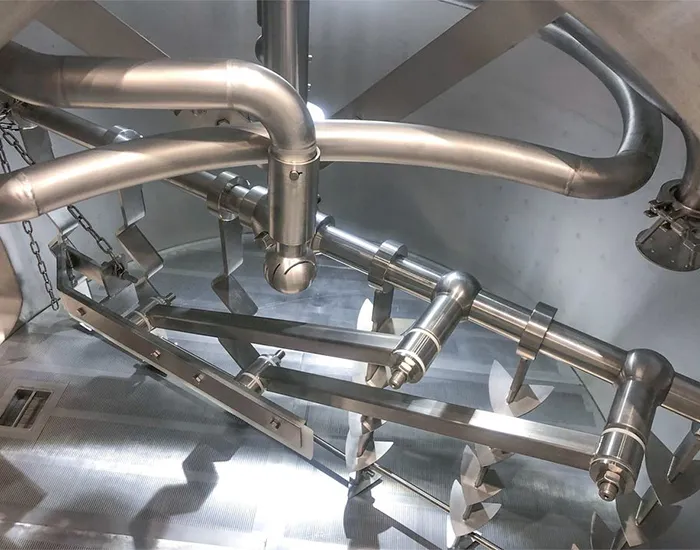
Use this checklist during the drawing review:
- Confirm where the temperature sensor reads relative to the heat source and
normal liquid range. - Identify the product outlet and verify that the bottom can drain as intended.
- Show the wort return or whirlpool inlet direction and its clearance from
internal components. - Define the purpose of every spray device, mixer, screen or internal pipe.
- Check whether the manway provides practical inspection and cleaning access.
- Verify that fittings, gaskets and valves match the brewery’s cleaning method
and spare-parts plan. - Confirm how the vapor outlet, condensate management and any stack connection
are supported. - Require a final nozzle schedule so piping is not improvised during installation.
Material grade, finish, welding procedure and pressure or atmospheric design
should be stated in the purchase specification for the exact vessel. Do not
assume that a website-wide statement applies to every configuration. Ask for
the documents that will accompany the supplied equipment and have regulated
items reviewed for the destination jurisdiction.
Specify pumps, valves and piping as part of the kettle
The kettle cannot perform correctly if the connected flow path is an
afterthought. Pump duty, valve location, pipe diameter, high points, low points
and hose connections affect transfer, drainage and cleaning. The process and
cleaning routes should both be visible on the piping diagram.
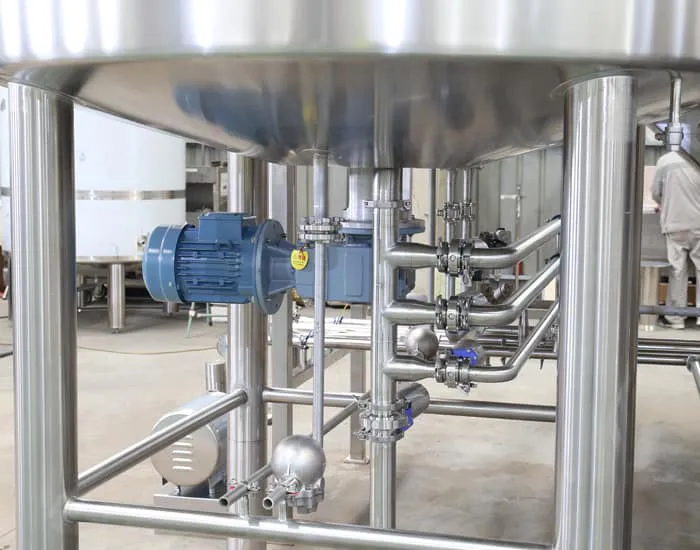
Ask how the system handles each of these operations:
- Transfer into the kettle without unnecessary aeration or splashing.
- Recirculation or whirlpool flow without starving the pump.
- Routing from the kettle to the heat exchanger and fermenter.
- Recovery or controlled disposal of residual wort and rinse water.
- Cleaning solution delivery, return and complete drainage.
A clear valve-state table is useful even on a compact manual system. It shows
which valves are open for each operation and helps identify accidental cross-
connections before commissioning. Make sure an operator can reach the valves,
remove serviceable parts and see critical flow paths without unsafe access.
Match controls and instruments to the operating method
The nano brewery kettle control plan should match the process risk and staffing model. Control complexity should follow the process risk and staffing model. A simple
system still needs defined measurement points, alarms and manual procedures.
An automated system needs a written sequence that explains what the controls do
when a sensor fails, the liquid level is low or an operator interrupts a step.
The kettle control specification may include temperature measurement, staged
heat control, pump commands, mixer or agitator commands, timers, emergency stop
logic and low-level protection where the design requires it. The purchase
documents should identify instrument type, location, control-panel power and
the boundary between equipment controls and building services.
Do not evaluate the interface only from a screenshot. During acceptance, check
that displayed values correspond to physical sensors, manual controls work as
documented, alarms lead to a safe response and operators can recover from an
interrupted brew without bypassing protections.
Plan vapor, drainage and service clearance early
Boiling releases heat and vapor into the room. The equipment drawing should
show the vapor path, stack or hood interface, condensate route and clearance
needed to inspect those components. The building designer should evaluate room
ventilation, makeup air, moisture management and local fire or mechanical-code
requirements.
Floor drainage also belongs in the kettle review. Map the likely discharge from
cleaning, hoses and fittings, then confirm floor slope, drain location and any
wastewater restrictions. Keep electrical equipment, operator paths and wet work
areas coordinated on the layout.
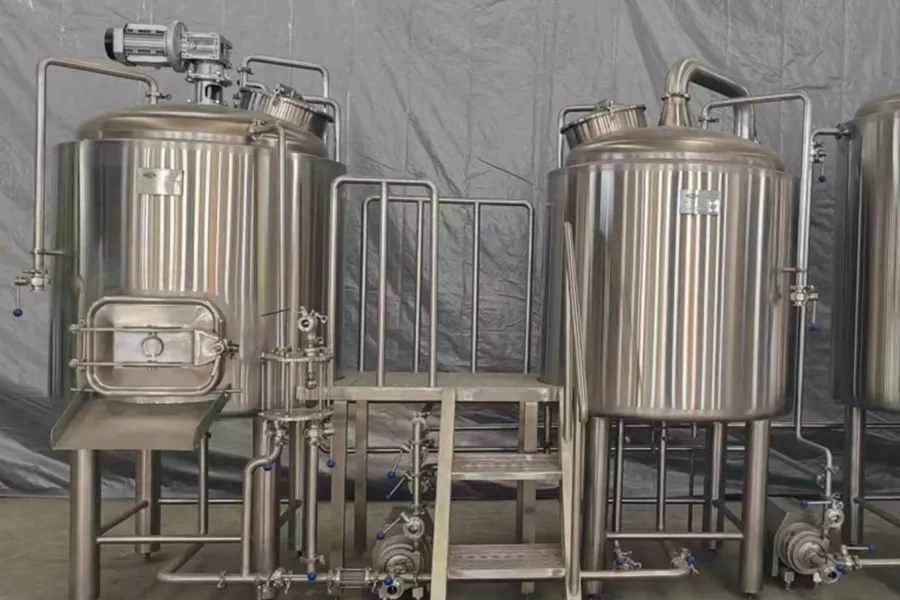
Finally, verify delivery and service access: door openings, ceiling height,
platform steps, removable components, heater access, pump clearance and space
to pull or clean internal devices. A vessel that fits on the floor plan can
still be difficult to install or maintain.
Di ZPET impianti di produzione della birra
page provides a starting point for configuration discussions. For the wider
cellar, cooling, cleaning and utility scope around a small system, use the
complete 1-5 BBL nano brewery equipment checklist.
Nano brewery kettle specification checklist
Before requesting a final quotation, put the following items in one controlled
specification:
- Target recipes, batch frequency and required transfer volume.
- Pre-boil, working, post-boil, transfer and total vessel volumes.
- Vessel arrangement and whether kettle and whirlpool functions are combined.
- Heat source, utility conditions and the reviewed heat-input basis.
- Temperature, level and other required measurement points.
- Bottom geometry, outlet, return, vapor and cleaning connections.
- Pump duties, valve list, piping diagram and cleaning route.
- Operator platform, access, guarding and maintenance clearances.
- Ventilation, vapor, condensate, drainage and wastewater interfaces.
- Material, finish, fabrication, inspection and documentation requirements for
the destination. - Control sequence, alarms, manual fallback and acceptance tests.
- Delivery route, installation boundary, commissioning scope and training.
Compare quotations against this same list. If one supplier includes building
interfaces and another lists only the vessel, the prices do not represent the
same scope.
Common specification mistakes
Buying by batch label alone. A nominal label does not define pre-boil
capacity, headspace or fermenter transfer volume. Require the volume map.
Choosing heat before checking utilities. Confirm electrical service, boiler
or gas constraints, ventilation and local approval before freezing the vessel.
Leaving vapor handling to the installer. Put the equipment-side vapor and
condensate interfaces on the approved drawing.
Ignoring cleanability at low liquid levels. Review spray coverage, complete
drainage, heater protection and access across the planned operating range.
Comparing incomplete quotations. Normalize vessels, instruments, pumps,
valves, controls, platforms, documentation, freight and site work before making
a commercial decision.
Frequently asked questions
Is a nano brewery kettle the same size as the finished batch?
Not necessarily. The kettle must hold the pre-boil wort and suitable freeboard,
while the finished transfer volume reflects evaporation and material retained
in the vessel and connected process path. Ask for all volume definitions in the
quotation.
Is electric heating always the best choice for a nano brewery?
No. Electric heating can suit some small installations, but the decision still
depends on electrical capacity, element arrangement, controls, local approval
and operating goals. Steam or direct fire may fit other sites. Compare the full
equipment and building scope.
Does the kettle need a separate whirlpool vessel?
That depends on the process sequence, desired brew-day throughput, floor space
and product goals. Combining functions can reduce vessel count, while separating
them can change scheduling and piping. Model the complete brew day before
choosing the arrangement.
What drawings should a buyer approve before fabrication?
At minimum, review the general arrangement, vessel section, nozzle schedule,
process and instrumentation diagram, utility list, control description and site
layout. The required document set may be larger when regulated equipment or
local approvals apply.
How should I compare two kettle quotations?
Create one requirement matrix covering volumes, heat source, materials,
connections, controls, pumps, cleaning, venting, access, documents and service
scope. Mark every deviation and exclusion. Do not compare the headline vessel
price until the scopes match.
Request a project-specific kettle review
Il ZPET nanobrewery equipment
range can be configured around a brewery’s process and site constraints. To
review a nano kettle, send the target batch schedule, recipes, available
utilities, room dimensions and preferred level of control through the
ZPET contact page. The resulting
quotation should state its sizing assumptions and interfaces clearly.