Low brewhouse efficiency means more malt may be needed to produce the same volume of beer. It can also lead to inconsistent wort gravity, higher production costs, and poor use of brewing capacity. Understanding where extract is lost helps breweries improve their process without sacrificing beer quality.
Brewhouse efficiency is the percentage of the total potential extract in malt that a brewing system successfully recovers into wort. It measures how effectively a brewer converts malt starch into soluble sugars, collects the wort through lautering and sparging, and transfers the extract to the defined measurement point. Higher efficiency generally means better raw material utilization and more predictable production costs.
1. What Does Brewhouse Efficiency Mean in Beer Brewing?
Brewhouse efficiency is usually expressed as a percentage. For example, a 75% result means the system recovers approximately 75% of the grain’s theoretical extract potential at the selected measurement point.
In practical terms, it tells a brewer how much useful extract the equipment and brewing process recover from the raw materials.
A common mistake is to treat efficiency as a measurement of the mash tun alone. In fact, the final result also depends on lautering, sparging, kettle losses, and wort transfer.
For commercial breweries, this measurement is especially important because small differences can add up over hundreds of batches each year.
2. What Is the Difference Between Mash Efficiency and Brewhouse Efficiency?
Mash efficiency and brewhouse efficiency are closely related, but they measure different stages of production.
Mash efficiency measures how much extract from the malt reaches the kettle after mashing and lautering. It focuses on starch conversion and the separation of wort from spent grain.
Brewhouse efficiency measures how much of the grain’s potential extract reaches the final measurement point, which this guide defines as the wort transferred into the fermenter. It also accounts for losses during boiling, whirlpooling, and transfer.
|
Type of efficiency |
Measurement point |
What it evaluates |
|---|---|---|
| Conversion efficiency | End of mash | Starch-to-extract conversion |
| Lauter efficiency | Kettle collection | Extract recovered from the grain bed |
| Mash efficiency | Wort entering kettle | Conversion and lautering |
| Brewhouse efficiency | Wort entering fermenter | Overall extract recovery |
For example, a brewery may achieve 85% mash efficiency but only 78% brewhouse efficiency. This difference suggests that some extract is lost after wort collection.
The brewer should investigate kettle dead space, trub separation, hop absorption, and transfer losses rather than immediately changing the mash temperature.
BeerSmith also distinguishes these two measurements, defining mash efficiency around the mash and sparging stages and overall efficiency across the system into the fermenter.
Important: Different breweries and software may use different measurement boundaries. Always state whether your efficiency number is measured at the kettle, after boiling, or at the fermenter before comparing results.
3. How Do You Calculate Brewhouse Efficiency?
The basic formula is:
To calculate efficiency, you need:
-
Total grain weight.
-
Extract potential of each malt.
-
Actual wort volume.
-
Wort specific gravity or Plato.
-
A clearly defined measurement point.
There are two common calculation methods.
Method 1: Using gravity points (PPG)
For brewers using pounds and gallons:
Here:
-
Gravity points = (specific gravity − 1.000) × 1,000.
-
PPG = points per pound per gallon.
-
Actual volume = wort volume at the chosen measurement point.
For example, a specific gravity of 1.050 provides 50 gravity points.
Each malt has a different extract potential. Pale malt, crystal malt, and roasted malt should therefore use their own grain potential values when calculating the total.
Method 2: Using kilograms, litres, and Plato
Commercial breweries often prefer metric calculations because they can calculate extract mass directly.
Practical calculation example
Consider a brewery using 100 kg of malt.
|
Parameter |
Value |
|---|---|
| Total grain weight | 100 kg |
| Malt extract potential | 80% |
| Theoretical extract | 80 kg |
| Wort volume into fermenter | 500 L |
| Specific gravity | 1.048 |
| Approximate Plato | 11.9°P |
This is an illustrative example. Actual malt extract potential should come from the malt supplier’s specification sheet, using a consistent moisture basis.
4. What Is Conversion Efficiency and Why Does It Matter?
Conversion efficiency measures how effectively enzymes break down starch in malt and turn it into soluble extract during the mash.
When crushed malt mixes with hot water, natural enzymes become active. They break down starch into different types of sugar, including maltose and other carbohydrates.
The process depends on several conditions:
-
Mash temperature.
-
Mash duration.
-
Mash pH.
-
Malt modification.
-
Water-to-grain ratio.
-
Enzyme activity.
If conversion is incomplete, some starch remains in the grain instead of entering the wort. This reduces the amount of extract available for the next stage.
However, conversion efficiency is not the same as the total extract collected. A mash can achieve excellent starch conversion while the brewery still loses a large amount of extract during lautering.
For example, a brewer may have a well-controlled mash but a poorly designed grain bed that retains too much wort. In this case, conversion is good, but the amount of collected extract remains low.
The key lesson: Improving conversion is only one part of improving the entire brewing process.
5. How Do Mash Temperature and Mash pH Affect Efficiency?
Mash temperature plays an important role in enzyme activity. Different enzymes work best within different temperature ranges, and the selected temperature influences the balance of fermentable and unfermentable sugars.
A lower mash temperature generally favors more fermentable wort, while a higher temperature tends to produce a wort with more dextrins and a fuller body. The exact result also depends on the malt, mash schedule, and enzyme activity.
Mash pH is equally important. If the pH moves too far outside the suitable range, enzyme performance can decline. This may reduce extraction and affect the overall wort profile.
For many traditional all-grain brewing processes, brewers commonly target a mash pH around 5.2–5.6 when measured on a cooled sample. The ideal value depends on the recipe and process.
|
Factor |
Potential problem |
Recommended control |
|---|---|---|
| Mash temperature | Inconsistent enzyme activity | Accurate temperature sensors |
| Mash pH | Reduced enzyme performance | Water analysis and pH testing |
| Mash duration | Incomplete conversion | Consistent mash schedule |
| Water ratio | Poor mixing or extraction | Correct liquor-to-grist ratio |
| Malt quality | Different extract potential | Check malt specifications |
For commercial production, a well-designed mash tun should distribute heat evenly and allow effective mixing. Automated temperature control can also reduce variations between batches.
6. How Do Lautering and Sparging Affect Brewhouse Efficiency?
After mashing, the brewer needs to separate the liquid wort from the spent grain. This process is called lautering.
Sparging then uses additional hot water to rinse more extract from the grain bed.
Both operations have a major effect on mash efficiency.
If the grain crush is too fine, the grain bed may become compacted. This can slow wort flow and create problems during lautering. If the crush is too coarse, the brewer may not extract all the available material.
Other important factors include:
-
False-bottom design.
-
Grain bed depth.
-
Wort collection points.
-
Sparge water distribution.
-
Runoff speed.
Grain bed permeability.
A well-designed lauter tun should collect wort evenly across the grain bed. The false bottom needs to support the grain while allowing liquid to pass through without creating excessive resistance.
During sparging, the brewer should distribute water evenly and control the runoff rate. Excessively fast flow can cause channeling or compact the grain bed, while poor water distribution may leave extract behind.
The objective is not simply to use more sparge water. It is to recover extract in a controlled way while maintaining the desired wort composition.
7. Where Does Wort Loss Occur Between Pre-Boil and Fermentation?
Even when mash and lautering performance are good, the brewery may lose extract during later stages.
To understand these losses, measure wort volume and gravity at several points.
|
Brewing stage |
Measurement |
What to investigate |
|---|---|---|
| Pre-boil | Volume and gravity | Mash and lauter performance |
| Post-boil | Volume and gravity | Evaporation and kettle performance |
| After whirlpool | Volume and gravity | Trub separation |
| Fermenter transfer | Volume and original gravity | Transfer and equipment losses |
One important detail is that boiling reduces wort volume while increasing its gravity. This does not necessarily mean extract has been lost. Water evaporates, but most of the dissolved extract remains in the kettle.
The brewer should therefore calculate extract mass rather than compare gravity readings alone.
Other possible losses include:
Kettle dead space: Some wort remains below the outlet or in areas that cannot drain completely.
Trub loss: Wort remains mixed with hot break, cold break, and hop material.
Hop absorption: Hops retain some wort, especially in heavily hopped recipes.
Pipework losses: Wort remains in transfer pipes, pumps, and connections.
Transfer losses: Incomplete draining can leave usable wort behind.
These factors explain why pre-boil efficiency and overall brewhouse efficiency can produce different results.
The American Institute of Chemical Engineers brewing calculation guide recommends taking intermediate gravity readings after mashing, sparging, whirlpooling, and transfer to help identify where process losses occur.
8. What Equipment Factors Influence Brewhouse Efficiency?
Equipment design has a direct impact on extraction, wort collection, and transfer performance.
A professional brewing system needs to support each stage of production. A large mash tun alone cannot guarantee high efficiency.
Here are the main equipment considerations.
| Equipment | Its Role in Efficiency |
Important Design Features |
|---|---|---|
| Mash tun | Starch conversion | Uniform heating and mixing |
| Lauter tun | Wort separation | False bottom and collection system |
| Brew kettle | Wort boiling | Consistent heat distribution |
| Whirlpool | Trub separation | Proper tangential inlet |
| Pumps | Wort transfer | Suitable flow and capacity |
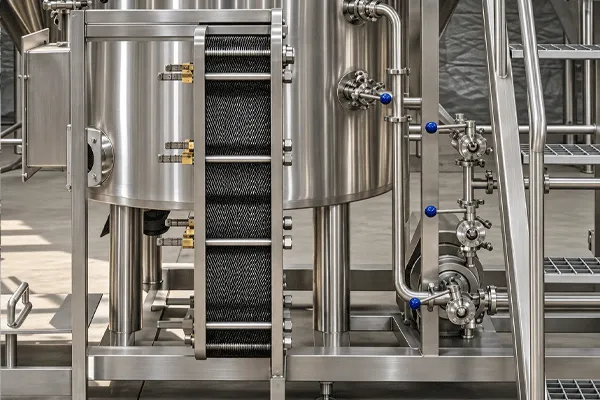
| Piping | Liquid movement | Efficient routing and low dead space |
For example, an effective false bottom helps distribute wort collection and supports stable lautering. A well-designed kettle heating system provides controlled heat distribution, while correctly sized pumps reduce unnecessary transfer delays.
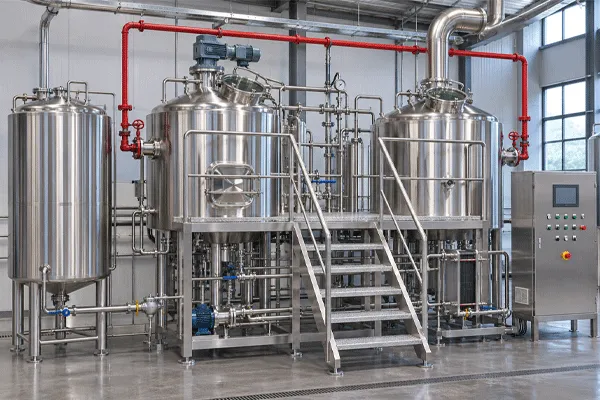
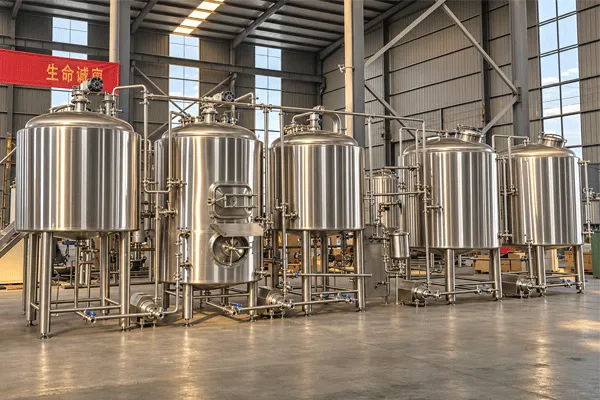
At ZPET, our brewhouse configurations range from two-vessel to six-vessel systems, with capacities from 100L to 5,000L. Heating methods include steam, electric, and direct fire, while vessel geometry, controls, and material grades can be customized to production requirements.
For buyers evaluating equipment, the following pages provide more information:
9. How Can Brewers Improve Low Brewhouse Efficiency?
When efficiency drops, avoid changing the entire recipe or equipment setup immediately. First, identify which stage is causing the problem.
A practical troubleshooting process can help.
| Problem | Possible Cause | Recommended Action |
|---|---|---|
| Low conversion | Incorrect temperature or pH | Check mash conditions |
| Low mash efficiency | Poor grain crush | Inspect mill gap |
| Slow runoff | Compacted grain bed | Adjust crush and flow |
| High extract left in spent grain | Poor sparging | Improve water distribution |
| High kettle losses | Excessive dead space | Review outlet design |
| High transfer losses | Poor pipe drainage | Optimize piping and procedures |
Seven practical ways to improve performance
-
Check grain crush: Make sure malt is crushed consistently.
-
Monitor mash temperature: Use calibrated sensors.
-
Control mash pH: Test the mash rather than relying on water assumptions.
-
Improve sparging: Distribute sparge water evenly.
-
Review wort flow: Avoid excessive runoff speed.
-
Measure equipment losses: Check the kettle, pump, and pipeline volumes.
-
Record every batch: Compare results to identify repeated problems.
It is also important to consider recipe differences. Higher gravity beers use more malt and may have different extraction characteristics from standard-strength beers.
Do not sacrifice beer quality just to achieve a higher efficiency number. A stable brewing process is more valuable than an isolated high result.
10. How Can BeerSmith Help Track Efficiency in Home Brewing and Commercial Brewing?
Brewing software makes efficiency calculations easier by combining grain potential, grain weight, wort volume, and gravity readings.
BeerSmith is a popular choice for recipe development and home brewing. Brewers can enter an efficiency number into an equipment profile and use it to estimate the original gravity of future recipes.
For example, if a recipe has a theoretical gravity of 1.060 at 100% efficiency and the system operates at 75%, the estimated gravity contribution becomes approximately 45 points, or 1.045, assuming the same volume.
This makes recipe planning more accurate.
For beersmith home brewing users, it is important to update the equipment profile when the brewing process or system changes. A profile based on old measurements may lead to incorrect gravity predictions.
Commercial breweries can use the same principles with production software, spreadsheets, or PLC-integrated batch records.
A useful efficiency record should include:
-
Malt type and grain weight.
-
Malt extract potential.
-
Mash temperature and mash pH.
-
Pre-boil volume and gravity.
-
Post-boil volume and gravity.
-
Volume into the fermenter.
-
Original gravity.
-
Trub and transfer losses.
-
Final efficiency number.
Reviewing these records batch to batch helps the brewer understand whether efficiency drops because of raw materials, process control, or equipment design.
How ZPET supports efficient brewery production
For a brewery planning a new brewing system, equipment configuration should match the desired production output and brewing process.
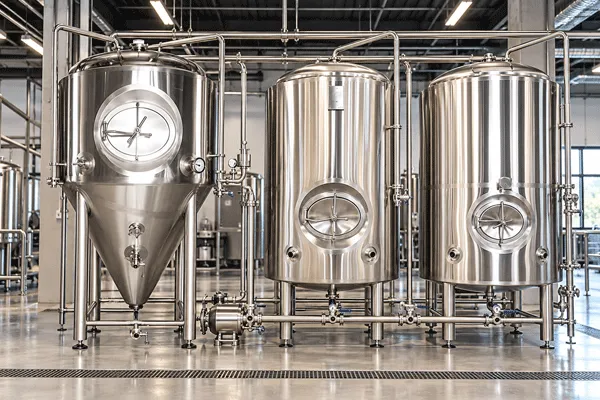
ZPET provides customized brewhouse systems, fermentation tanks, and turnkey brewery solutions. Our engineering team can help evaluate:
-
Mash tun and lauter tun configuration.
-
Wort collection and sparging arrangements.
-
Heating capacity and temperature control.
-
Kettle and whirlpool design.
-
Pump and pipeline layout.
-
Fermentation and cooling capacity.
-
CIP connections and cleaning access.
-
Automation and future expansion requirements.
A suitable system should not only recover extract efficiently but also support stable operation, sanitary production, and long-term business growth.
If you are planning a new brewery or upgrading an existing facility, our team can help you select a brewing system based on your batch size, production schedule, and available space.
Explore ZPET’s customized brewery equipment solutions to discuss your project.
Frequently Asked Questions
What is a good brewhouse efficiency percentage?
There is no universal target for every brewery. Results depend on equipment design, recipe, grain quality, and measurement methods. Consistency across batches is often more valuable than achieving an unusually high number.
Is mash efficiency the same as brewhouse efficiency?
No. Mash efficiency measures extract recovered into the kettle, while brewhouse efficiency measures extract reaching the defined final measurement point, usually the fermenter in this guide.
Does mash temperature affect brewhouse efficiency?
Yes. Mash temperature influences enzyme activity and starch conversion. Poor temperature control can reduce conversion and affect wort composition.
What causes low brewhouse efficiency?
Common causes include poor grain crush, incomplete starch conversion, unsuitable mash pH, inefficient sparging, grain bed compaction, excessive trub loss, and wort remaining in pipes or vessels.
Can a three-vessel brewhouse improve efficiency?
A three-vessel system can improve process flexibility by separating mashing, lautering, and boiling operations. However, more vessels do not automatically guarantee higher efficiency. Correct vessel design and process control are more important.
Can BeerSmith calculate brewhouse efficiency?
Yes. BeerSmith can estimate and calculate efficiency using grain potential, measured gravity, and actual wort volume. The results depend on accurate measurements and the correct equipment profile.
Key Takeaways: What to Remember About Brewhouse Efficiency
-
Brewhouse efficiency measures how much potential extract from malt reaches the defined final measurement point.
-
Mash efficiency focuses on extraction during mashing and lautering.
-
Conversion efficiency measures how effectively enzymes convert starch into soluble extract.
-
Mash temperature, mash pH, malt quality, and grain crush all influence extraction.
-
Lautering and sparging affect how much extract reaches the kettle.
-
Kettle dead space, trub, hop absorption, and transfer losses influence overall performance.
-
Use gravity and volume measurements together when calculating efficiency.
-
BeerSmith can help brewers calculate and track efficiency.
-
Equipment design should support uniform heating, effective wort collection, and efficient transfer.
-
Higher efficiency should never come at the expense of beer quality and process stability.
Planning a new brewery or looking to improve your existing brewhouse? Contact ZPET for customized brewing equipment, professional engineering support, and turnkey brewery solutions designed around your production requirement