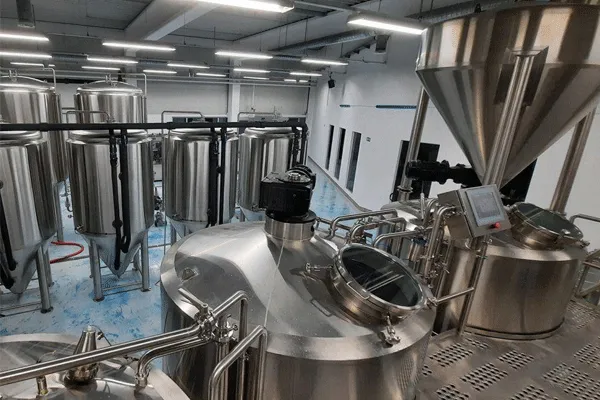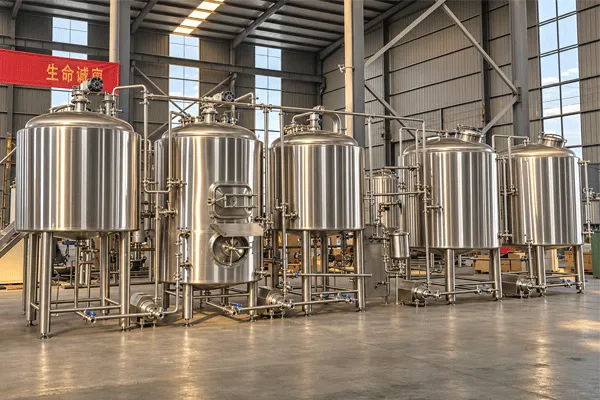
Choosing the wrong brewery equipment manufacturer can lead to poor equipment integration, production delays, rising costs, and long-term maintenance problems. A reliable manufacturing partner helps you avoid these risks by matching equipment design, production capacity, and engineering support to your business goals.
To choose the right brewery equipment manufacturer, evaluate five key areas: manufacturing capabilities, brewing system design, equipment customization, project delivery, and after-sales support. The best partner should understand your brewing process, provide suitable stainless steel equipment, deliver a coordinated production system, and support your brewery from initial planning to commercial operation.
1. What Should a Brewery Equipment Manufacturer Provide Beyond a Basic Equipment List?
When planning a new brewery, many buyers begin by comparing prices, tank sizes, and equipment quantities. However, a complete brewery project involves much more than purchasing individual machines. The manufacturer must understand how each piece of equipment works within the entire beer production process.
A professional equipment manufacturer should provide more than tanks and vessels. Its responsibilities may include process consultation, equipment configuration, technical drawings, production planning, installation guidance, and operational training. These services help ensure that the brewhouse, fermentation area, cooling equipment, and packaging section work together.
For example, a brewery with a 1,000L brewhouse needs an appropriate fermentation configuration, hot water supply, wort cooling equipment, and suitable cleaning facilities. If these components are selected independently, production may become inefficient even when every individual machine meets its specifications.
A good manufacturer sells a coordinated production solution, not simply a collection of stainless steel vessels.
What Is the Difference Between a Manufacturer and an Equipment Supplier?
| Comparison | Equipment Reseller | Professional Manufacturer |
|---|---|---|
| Product selection | Mainly standard products | Standard and customized equipment |
| Engineering | May rely on external partners | Engineering and technical design capabilities |
| Equipment design | Limited modifications | Process-based customization |
| Production | Usually outsourced | Direct manufacturing capabilities |
| Project planning | Mainly product quotations | Integrated technical planning |
| Long-term support | Depends on third parties | Direct technical support |
A reseller can still be suitable for some purchasing situations. However, for a customized brewery project, direct communication with the engineering and manufacturing team can make technical changes, production coordination, and later maintenance easier.
2. How Do You Define Your Brewery Needs and Production Capacity?
Before choosing an equipment manufacturer, define what your brewery needs to produce. Equipment selection should begin with your business model, expected beer sales, target production volume, and available investment.
For example, a brewpub mainly serving draft beer may need a compact brewhouse and flexible fermentation capacity. A production brewery supplying distributors needs a different configuration, with greater attention to repeatable batch output, fermentation scheduling, and packaging capacity.
When starting a brewery, consider these questions:
- What is your expected daily and annual production?
- Which beer styles will you produce?
- How many batches do you plan to brew each week?
- Will you sell draft beer, bottled beer, or canned beer?
- How much fermentation capacity will you need?
- What building space and utilities are available?
- Do you plan to increase production within the next three to five years?
These details help the manufacturer recommend appropriate equipment capacity instead of offering a standard package that may not fit your actual requirements.
Which Brewery Equipment Capacity Is Suitable for Different Businesses?
| Brewery Type | Typical Equipment Scale | Main Business Application |
|---|---|---|
| Nanobrewery | 100L–1,000L | Pilot brewing, small breweries, taprooms |
| Microbrewery | 1,200L–3,000L | Craft beer and regional distribution |
| Commercial Brewery | 4,000L–5,000L and larger customized systems | Commercial beer production |
These are reference ranges, not fixed industry definitions. Actual capacity should be confirmed through working volume, production frequency, and fermentation requirements.
For a more detailed comparison, explore our Nanobrewery Equipment, Microbrewery Equipment, and Commercial Brewery Equipment solutions.
3. Does the Manufacturer Understand the Complete Brewing Process?
A brewery equipment manufacturer should understand how raw materials move through the brewing process. This knowledge is important because equipment design affects production efficiency, beer quality, and operating costs.
The brewing process normally includes malt handling, mashing, lautering, boiling, whirlpool separation, wort cooling, fermentation, maturation, and packaging. Each stage has different equipment and process requirements.
For example, the mash tun needs suitable heating and mixing arrangements, while the kettle needs a heating system that supports stable boiling. Fermentation tanks require appropriate cooling jackets and temperature controls to manage yeast activity.
A manufacturer that understands these relationships can recommend equipment that works as one complete brewing system.
Why Does Process Knowledge Matter When Choosing a Manufacturer?
Consider three important production stages:
- Brewhouse: The mash tun, lauter tun, kettle, and whirlpool determine how wort is prepared.
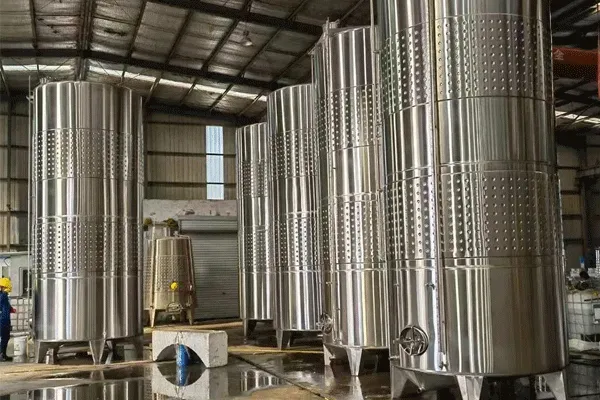
- Fermentation: Fermenters, cooling systems, and temperature controls support consistent fermentation.
- Finishing and Packaging: Bright beer tanks and packaging equipment prepare the finished beer for distribution or serving.
The equipment supplier should also consider cleaning procedures, product transfer, and operator access.
For breweries producing multiple beer styles, flexibility is especially important. Different recipes may require different mash programs, fermentation temperatures, and conditioning periods.
This is why technical brewing knowledge should be part of equipment planning, not something considered only after installation.
4. Which Brewery Equipment Categories Should Your Brewing System Include?
A professional brewery requires several equipment categories that work together. The exact brewery equipment list depends on production capacity, brewing methods, product types, and automation requirements.
A typical commercial beer brewing system includes the following:
| Equipment Category | Main Function | Key Considerations |
|---|---|---|
| Malt Handling Equipment | Stores and prepares malt | Capacity and material handling |
| Brewhouse | Produces wort | Vessel configuration and heating |
| Fermentation Tanks | Ferments beer | Working volume and temperature control |
| Bright Beer Tanks | Conditions and stores finished beer | Pressure rating and carbonation |
| Hot Water Tank | Supplies brewing and cleaning water | Heating capacity |
| Cold Water Tank | Stores cooling water | Cooling demand |
| Glycol Chiller | Controls tank temperatures | Total cooling load |
| CIP System | Cleans vessels and pipelines | Cleaning coverage and automation |
| Packaging Equipment | Fills bottles, cans, or kegs | Required packaging output |
Not every brewery needs every component at the beginning. A small brewpub may use a relatively simple configuration, while a larger production brewery may need more fermentation vessels, automated controls, and dedicated packaging equipment.
How Should You Select the Right Brewhouse?
The brewhouse is the core of beer production. Common configurations include:
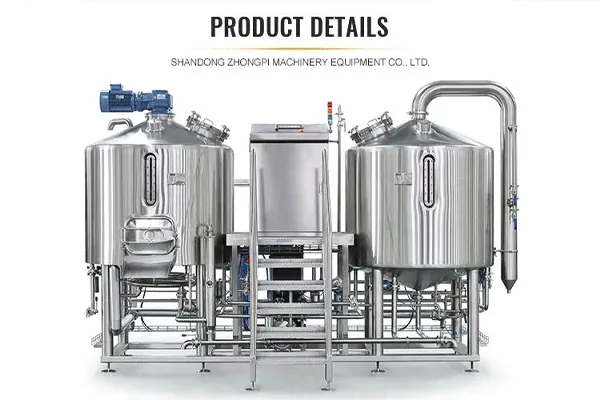
- 2-Vessel Brewhouse: Suitable for compact operations and smaller production targets.
- 3-Vessel Brewhouse: Provides greater process flexibility by separating important brewing stages.
- 4-Vessel Brewhouse: Suitable for more demanding production schedules.
- 5-Vessel and 6-Vessel Systems: Can support specialized process arrangements and higher-throughput operations.
The best configuration depends on batch frequency, available floor space, labor, and investment.
ZPET provides customized 2-vessel to 6-vessel brewhouse configurations, with electric, steam, and direct-fire heating options.
Explore our Brewhouse Systems for equipment configurations and technical details.
5. Can the Manufacturer Customize Equipment Design for Your Brewery?
Every brewery has different requirements. Even two businesses with the same production capacity may need different equipment arrangements because of building dimensions, beer styles, utilities, and production schedules.
This is where customized brewery equipment becomes valuable.
A professional manufacturer should be able to adjust vessel dimensions, working volumes, manway positions, piping connections, cooling jackets, platforms, and control systems according to the project.
For example, a brewery operating in a building with limited ceiling height may need a different tank arrangement from a brewery with a large production hall. Equipment dimensions must also account for installation access, maintenance space, and cleaning operations.
What Should Customized Equipment Design Include?
A complete equipment design process should consider:
- Vessel dimensions and working capacity.
- Material grades and product-contact surfaces.
- Heating and cooling arrangements.
- Pipework and valve connections.
- Pump selection and transfer requirements.
- Electrical and automation configuration.
- Cleaning and maintenance access.
- Future equipment additions.
A customized design should also include a coordinated equipment layout.
This is important because a brewery is not simply a group of machines placed inside a building. The equipment must support a logical workflow from raw materials to finished beer.
For a new brewery project, we recommend reviewing both 2D technical drawings and 3D layout designs before manufacturing begins.
6. How Do You Evaluate Brewery Equipment Manufacturing Capabilities?
A manufacturer’s engineering and production capabilities influence how accurately it can turn a project design into finished equipment.
Look beyond product photographs. Consider whether the company has the manufacturing resources, technical team, and production processes needed to handle your equipment requirements.
Important areas include:
- Stainless steel processing and fabrication.
- CNC cutting and vessel forming.
- Welding and polishing capabilities.
- Customized vessel engineering.
- Production scheduling and quality control.
- Technical drawing and documentation.
- Equipment testing and final inspection.
For stainless steel brewery equipment, material selection, welding quality, and internal surface finishing are especially important. These factors influence durability, sanitation, and long-term maintenance.
What Manufacturing Capabilities Does ZPET Offer?
ZPET focuses on brewery equipment manufacturing and customized brewing solutions for international B2B customers.
Its manufacturing and engineering capabilities support the production of customized brewhouses, fermentation tanks, bright beer tanks, and integrated brewery systems.
Key manufacturing processes and technologies include:
- CNC laser cutting.
- Stainless steel vessel fabrication.
- TIG welding technology.
- Internal and external polishing.
- Customized vessel and pipeline fabrication.
- Equipment inspection and quality control.
- Brewery system engineering and equipment design.
These capabilities allow ZPET to provide customized equipment configurations according to different production capacities, building conditions, and brewing requirements.
For a closer look at the production environment, visit the ZPET Brewery Equipment Factory page.
7. Why Are Equipment Quality, Automation, and CIP Integration Important?
Equipment quality directly affects the long-term performance of a brewery. Poorly designed vessels, unsuitable materials, and inefficient process connections can increase cleaning time, maintenance needs, and production interruptions.
Stainless steel is widely used in professional beer brewing because it provides a durable, cleanable surface suitable for beverage processing. Depending on the process and operating environment, SS304 or SS316L may be selected for different equipment components.
However, material alone does not guarantee equipment quality. Vessel construction, internal polishing, welding, drainage, and cleaning design also matter.
How Does Automation Improve Beer Production?
Automation helps brewers manage repeatable production steps. A PLC/HMI control system can support:
- Mash temperature management.
- Heating and pump control.
- Fermentation temperature monitoring.
- Recipe management.
- Alarm notifications.
- Production data recording.
- Automated CIP procedures.
The level of automation should match the brewery’s production needs. A small brewpub may operate effectively with manual or semi-automatic controls, while larger commercial breweries may benefit from more advanced automation.
Why Should CIP Be Considered During Equipment Selection?
Clean-in-Place (CIP) allows operators to clean tanks and connected pipelines without manually dismantling the entire system.
A properly planned CIP system considers:
- Cleaning solution preparation.
- Pump flow and circulation.
- Spray ball coverage.
- Pipeline connections.
- Cleaning temperature and duration.
- Drainage and solution recovery.
The manufacturer should consider these requirements during equipment design rather than adding cleaning connections as an afterthought.
Good equipment quality is not only about how a tank looks when delivered. It is about how reliably the entire system performs throughout years of operation.
8. What Can Real Brewery Projects Tell You About a Manufacturer?
Product catalogs show what a manufacturer can offer, but actual brewery projects help buyers understand how different equipment configurations work in real production environments.
When reviewing case studies, look for projects that match your intended production scale, brewing method, and equipment requirements.
Pay attention to:
- Brewhouse vessel configuration.
- Fermentation tank quantities and capacities.
- Supporting hot and cold water equipment.
- Heating methods.
- Equipment arrangement.
- Piping and operating platforms.
- Project-specific customization.
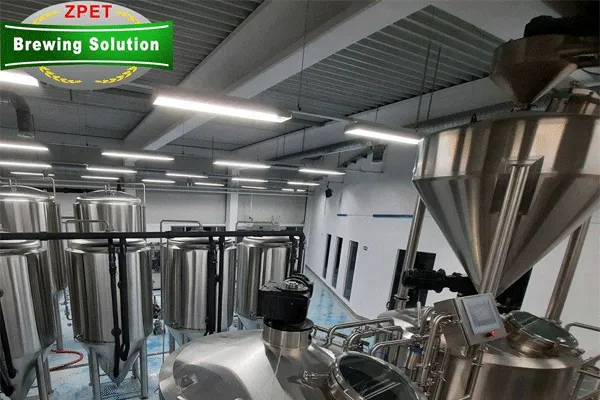
Case Study 1: 1000L Brewery Equipment Project
ZPET’s 1000L brewery equipment project features a steam-heated two-vessel brewhouse, a separate hot water tank, and 1000L conical fermentation tanks with top manways.
This project demonstrates how a compact brewing section can be coordinated with dedicated water preparation and fermentation equipment.
It is a useful reference for buyers planning a smaller commercial brewery or a growing craft beer operation.
Case Study 2: 3000L Four-Vessel Brewery Project
Another ZPET project uses a 3000L four-vessel brewhouse, separate hot and cold water tanks, and fermentation tanks in 3000L and 6000L capacities.
The combination of different tank sizes provides flexibility when planning fermentation schedules and allocating production batches.
This example also shows why equipment selection should consider the entire production system instead of focusing only on brewhouse capacity.
A relevant project reference is more useful than a general promise of manufacturing experience. Ask the manufacturer to explain how its previous configurations relate to your own production requirements.
9. What Installation and After-Sales Support Should You Expect?
Purchasing equipment is only one stage of building a brewery. After manufacturing, the equipment must be packaged, shipped, installed, connected, tested, and prepared for commercial production.
For overseas buyers, this process requires clear coordination between the manufacturer, local contractors, and the brewery’s operating team.
A reliable equipment manufacturer should explain what support is included before the order is confirmed.
What Should a Complete Project Support Package Include?
| Project Stage | Expected Support |
|---|---|
| Planning | Production consultation and equipment configuration |
| Design | 2D drawings and 3D brewery layout |
| Manufacturing | Production updates and quality checks |
| Delivery | Export packaging and shipping coordination |
| Installation | Equipment assembly and connection guidance |
| Commissioning | Water testing, dry runs, and system checks |
| Training | Brewing, cleaning, and equipment operation |
| After-Sales | Technical assistance and spare parts |
Installation and commissioning are especially important for a new brewery. Even well-manufactured equipment may not operate correctly if utility connections, pumps, sensors, and control systems are not properly integrated.
ZPET provides project-related technical support, including customized layout design, utility consultation, manufacturing coordination, installation guidance, commissioning support, and operator training.
Learn more about ZPET Brewery Design, Installation & Support.
10. How Do You Compare Brewery Equipment Manufacturers and Make the Right Decision?
Once you have shortlisted several manufacturers, compare their proposals using the same project requirements.
Do not select a supplier simply because its quotation has the lowest price. A lower initial investment may create additional costs if important equipment, engineering work, or technical support is missing.
Instead, assess the complete equipment package and its expected operating value.
Brewery Equipment Manufacturer Comparison Table
| Evaluation Factor | What to Look For | Importance |
|---|---|---|
| Manufacturing | Real production and fabrication capabilities | Very High |
| Engineering | Customized process and equipment design | Very High |
| Equipment Range | Complete brewing and fermentation solutions | High |
| Customization | Flexible vessel and system configurations | High |
| Equipment Quality | Suitable materials and manufacturing standards | Very High |
| Automation | Controls matching production needs | High |
| Project Experience | Relevant completed brewery projects | High |
| Installation | Commissioning and operator training | Very High |
| After-Sales | Technical support and spare parts | Very High |
| Total Cost | Equipment, installation, operation, and maintenance | Very High |
What Information Should You Prepare Before Requesting a Quotation?
To help an equipment manufacturer assess your project, prepare the following information:
- Target production capacity.
- Preferred brewhouse batch size.
- Expected number of batches per day.
- Beer styles and fermentation requirements.
- Required fermentation and bright beer tank capacities.
- Available building dimensions.
- Electricity, water, steam, and cooling conditions.
- Preferred automation level.
- Packaging requirements.
- Destination country and applicable standards.
- Estimated investment budget.
This information allows the manufacturer to recommend appropriate equipment choices and prepare a more accurate quotation.
Why Consider ZPET for Your Brewery Project?
ZPET focuses on customized brewery equipment and integrated beverage production solutions for international B2B customers.
Its product range covers nanobrewery, microbrewery, and commercial brewery systems, along with brewhouses, fermentation tanks, bright beer tanks, and supporting equipment.
With engineering, manufacturing, and project support capabilities, ZPET works with buyers to develop equipment configurations that match their production goals, available space, and future development plans.
Whether you are planning a new commercial brewery, upgrading existing equipment, or expanding production, the right manufacturer should help you make informed technical decisions before manufacturing starts.
Contact ZPET to discuss your brewery project and request a customized equipment proposal.
Frequently Asked Questions
How Do I Know If a Brewery Equipment Manufacturer Is Reliable?
Review its manufacturing capabilities, engineering team, product range, completed projects, technical documentation, and after-sales services. Ask for evidence of the capabilities that matter to your specific project.
Should I Choose a Direct Manufacturer or a Trading Company?
A direct manufacturer can provide closer communication with its engineering and production teams. A trading company may also be suitable if it offers transparent sourcing and reliable project coordination. The important point is understanding who is responsible for manufacturing, quality, and warranty obligations.
What Equipment Does a New Commercial Brewery Need?
A typical setup includes a brewhouse, fermentation tanks, cooling equipment, hot water storage, pumps, pipelines, CIP equipment, and packaging equipment. The final configuration depends on production volume and business requirements.
Can Brewery Equipment Manufacturers Provide Customized Systems?
Yes. Professional manufacturers can customize vessel capacities, dimensions, heating methods, cooling jackets, piping, automation, and equipment layouts to match the facility and brewing process.
How Important Is After-Sales Support When Purchasing Brewery Equipment?
It is very important, particularly for overseas buyers. Installation guidance, commissioning, operator training, spare parts, and technical assistance help reduce operational risks and maintain production continuity.
How Early Should I Contact a Brewery Equipment Manufacturer?
Ideally, contact the manufacturer during the early planning stage. This allows the engineering team to review building dimensions, utilities, production targets, and equipment configurations before construction and installation decisions become difficult to change.
Key Takeaways: Choosing the Right Brewery Equipment Manufacturer
- Start with production requirements: Define your expected output, beer styles, and business model.
- Evaluate engineering capabilities: Choose a manufacturer that understands the complete brewing process.
- Check equipment compatibility: Brewhouse, fermentation, cooling, and CIP systems must work together.
- Prioritize customization: Equipment should fit your building, utilities, and production workflow.
- Consider manufacturing quality: Material selection, fabrication, polishing, and testing all matter.
- Review actual projects: Compare completed installations with your intended brewery configuration.
- Evaluate lifecycle support: Installation, commissioning, training, and spare parts are important.
- Compare total project value: Look beyond the initial quotation to long-term operating costs.
- Plan for expansion: Leave room for additional tanks and production equipment as demand grows.
The right brewery equipment manufacturer should be a long-term engineering partner, helping you move from an initial business plan to stable, efficient beer production.