David Zhang | Founder & CEO, ZPET (Shandong ZhongPi Machinery Equipment Co., Ltd.) | Published August 7, 2026
Commercial brewery equipment means systems at 4,700 L (approx. 40 BBL) and above, where four thresholds shift at once: pressure-vessel conformity assessment becomes mandatory, CIP outgrows portable carts, glycol must be sized on coincident peak load, and control panels need destination-market listing. Volume alone is the smallest change.
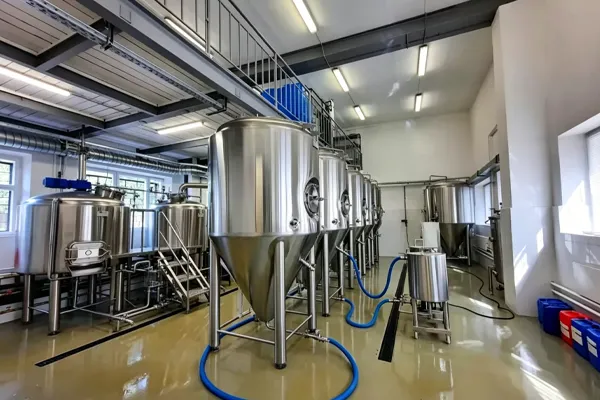
Where “commercial” actually starts
The word gets used loosely. A brewpub selling pints across a bar is running a commercial operation on 700 L of steel, and nobody would call that معدات مصانع الجعة التجارية in a procurement sense.
The useful line is drawn by annual output, and the Brewers Association sets its US brewery categories that way, with the microbrewery band capped at 15,000 BBL a year and regional breweries running from there up to 6,000,000 BBL (Brewers Association, brewery definitions). Equipment vendors map onto that with three broad tiers:
- Nanobrewery, 1–5 BBL.Recipe development, brewpub taprooms, single-operator brew days.
- Microbrewery, 7–30 BBL.The working majority of independent production breweries. Portable CIP, packaged chillers, semi-automatic controls.
- Commercial, 40 BBL and above.Multi-shift operation, skidded utilities, PLC-driven process control, engineered building services.
The jump from the second tier to the third is not proportional. Doubling from 20 to 40 BBL doubles wort volume, but it more than doubles cooling demand at peak, changes which regulatory pathway your vessels fall under, and moves cleaning from a task one person does with a cart to a fixed system with its own footprint and chemical inventory.
The four thresholds you cross at 40 BBL
Everything in this guide sits under one of these. If you only take four things away:
- Pressure-vessel conformity assessment stops being optional.PED categorization is driven by the product of maximum allowable pressure and volume, so vessel size alone can push a fermenter out of the “sound engineering practice” route and into a category requiring notified-body involvement.
- Glycol has to be sized on coincident peak, not the sum of nameplate loads.Wort knockout is the spike, and above 40 BBL it starts overlapping with crash cooling on other tanks.
- CIP flow is set by tank circumference, not tank volume.That single fact is what retires the portable cart.
- Control panels need listing for the destination market, and a listed component does not make a listed panel.This is the most common and most expensive import surprise at this scale.
Brewhouse: the utility bill you sign at the same time
A commercial brewing system at 4,700 L per turn is, from the boiler’s point of view, two large heat demands that you can either stack or sequence.
Boil-off. At 7% evaporation per hour on 4,700 L, you are vaporizing roughly 330 kg of water an hour. At about 2,260 kJ/kg of latent heat, that is close to 207 kW of continuous heat input just to hold a rolling boil.
Heat-up ramp. Raising 4,700 L of wort from 72 °C to boiling in 40 minutes needs about 526,000 kJ, or 219 kW. The ramp, not the boil, sets your peak.
Hot liquor recharge. Bringing 6,000 L of strike and sparge water from 15 °C to 78 °C over three hours adds about 146 kW.
Stack the kettle ramp and the HLT recharge in the same window and you are asking for roughly 365 kW, which lands a boiler in the neighborhood of 700–900 kg/h of steam once you allow for distribution losses and margin. Sequence them so the HLT recharges during the boil instead, and a materially smaller boiler does the same work. That sequencing decision belongs in the PLC program, and it is worth raising during layout engineering rather than after the boiler is bought.
Heating method changes with scale too. Direct fire becomes impractical above roughly 2,000 L because the heat flux at the pan scorches wort. Electric elements stay viable to about 3,000 L before the connected load and element density get awkward. Above 40 BBL, steam through a jacketed or external calandria commercial brew kettle is effectively the default, and the boiler becomes a permitted piece of plant with its own inspection regime in most jurisdictions.
Glycol: size on the coincident peak
This is where large scale brewing equipment projects most often get under-specified, because the person sizing the chiller adds up every load in the cellar and then, alarmed at the total, applies a discount to something. The correct method is to identify which loads actually happen at the same time.
Worked example: a 4,700 L brewhouse feeding six 9,400 L (approx. 80 BBL) double-batch fermenters.
| Load | Basis | Peak draw |
| Wort knockout, second-stage cooling | 4,700 L from 18 °C to 10 °C over 60 min | 42 kW |
| Active fermentation, two tanks at krausen | 18,800 L at approx. 0.8 kW per 1,000 L | 15 kW |
| Crash cooling, one tank | 9,400 L from 20 °C to 4 °C over 24 h | 7 kW |
| Bright tank hold plus trunk line losses | — | 4 kW |
| Coincident peak | 68 kW | |
| With 20% design margin | approx. 82 kW (approx. 23 tons refrigeration) |
Notice the shape of that table: knockout is 62% of the peak and it lasts one hour. Sizing a chiller to cover it means buying a machine that spends most of the week at part load, short-cycling compressors and running below its rated efficiency.
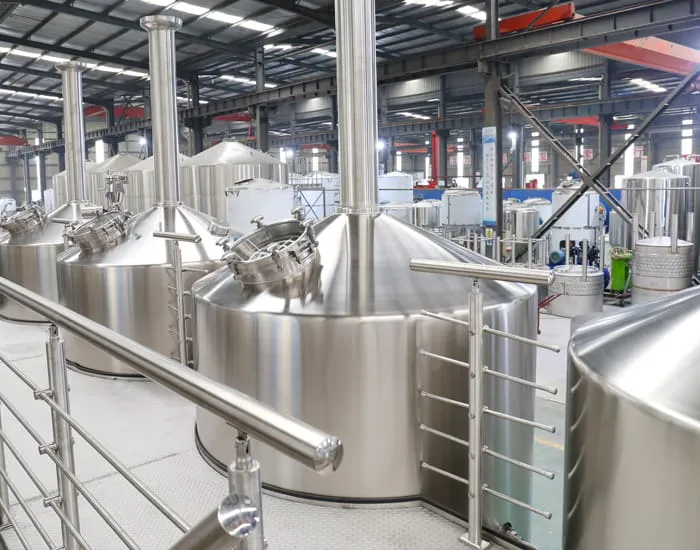
The alternative is a glycol reservoir that rides through the spike. Absorbing the full 42 kW for an hour at a 6 K glycol temperature swing would need roughly 6,600 L of reservoir, which is more buffer than most plants want to house. So real installations split the difference: a 2,000–3,000 L reservoir plus a chiller sized for about 60–70% of coincident peak, with knockout scheduled away from crash-cool starts. Get that scheduling rule into the control program and the reservoir does its job. Leave it to whoever is on shift and you will eventually knock out into a warm cellar.
Two details that get skipped in quotations at this scale:
- Glycol concentration.Propylene glycol at 30–35% protects to roughly −13 to −17 °C, but it also carries a viscosity penalty that cuts heat-transfer coefficient and raises pump head. Specify the concentration, not just “glycol.”
- Trunk line design.At 40 BBL+ the mains run long enough that a reverse-return loop and correctly sized trunk (typically 2 inch and up) determine whether your last tank in the loop can hold temperature at all. Balancing valves at each tank are not a luxury.
CIP stops being something you wheel over
Spray device flow requirements scale with the circumference of the vessel being cleaned, not its capacity. The working figure is 2.5–3.0 US gpm per foot of tank circumference.
A 9,400 L fermenter at roughly 2.4 m diameter has a circumference of 7.5 m, or 24.7 ft. That calls for 62–74 gpm, which is 14–17 m³/h delivered at the spray ball, not at the pump discharge. Portable CIP carts typically manage 5–8 m³/h. The gap is not something you close with a longer cycle time; below the design flow, a static spray ball simply does not produce full coverage.
So above 40 BBL you are buying a CIP skid, and with it:
| Element | What changes at production scale |
| Supply pump | 14–17 m³/h at 2–3 bar at the spray device |
| Return pump and line | Sized to match supply; drain lines typically 2–2.5 inch |
| Caustic tank | Recovered and reused rather than dumped; 400–800 L working volume |
| Acid tank | Separate vessel; phosphoric or nitric at 0.5–1% |
| التدفئة | Steam or electric to hold caustic at 70–80 °C through the circuit |
| Conductivity and temperature control | Automated phase changeover and verification logging |
| Effluent | Neutralization before discharge; production volumes usually trigger a permit |
That last line surprises people. A microbrewery dumping caustic into a trench drain is often within its local limits by accident. At 40 BBL with three turns a day, the pH excursions and BOD load frequently put you inside a discharge permit, with sampling obligations attached. Ask about it before the slab is poured, because a neutralization pit is cheap to build and expensive to retrofit.
Surface finish matters more here for the same reason. ASME BPE defines surface designations and Ra measurement conventions for hygienic process equipment, and 3-A Sanitary Standards govern drainability and crevice-free design. A 0.4 μm Ra interior cleans faster at a given flow than a coarser finish, which shows up directly as CIP minutes per tank across three turns a day. Ask whether a quoted Ra figure covers welds and heads or only shell interiors.
PLC and HMI: what to automate, and what to leave alone
A commercial automated brewing system at this scale typically brings the following under PLC control:
- Mash step ramping with hold timers and agitator interlocks.
- Sparge water flow and temperature, usually with a flow meter and modulating valve.
- Kettle boil intensity via a modulating steam valve rather than on/off.
- Whirlpool rest timing and knockout temperature, with PID control on the heat exchanger coolant side.
- Per-tank fermentation temperature with individual solenoid control and setpoint profiles.
- CIP recipe sequencing, phase timing and conductivity-based changeover.
- Batch data logging: every setpoint, actual and deviation, retained per batch.
That last item earns its keep at production scale. When a batch drifts out of spec across a 4,700 L turn, the log is the difference between a diagnosis and a guess.
Now the misconception worth naming. Automation does not substitute for instrumentation. A recipe that automates mash-in is still hostage to grist accuracy if there is no mass measurement on the mill. A PID loop on knockout temperature is only as good as its RTD placement. Before agreeing to an automation tier, list every measured variable the program depends on and confirm each one has a sensor, in a sensible location, with a calibration route.
Two more specification points that only bite after delivery:
- PLC brand and local support.Siemens, Allen-Bradley and Mitsubishi platforms all work. What differs is whether an integrator within driving distance of your plant can open the program and whether spare I/O cards are stocked in your country. A lower-cost platform with no local support is a downtime exposure, not a saving.
- HMI language and units.Panels programmed in metric with a Chinese-language interface arriving at a US brewery is an avoidable problem. Specify English HMI text and a °F/gallon display toggle in the purchase order.
The 24/7 duty cycle changes component selection
Professional brewing equipment running one turn a day and the same equipment running three turns a day are not the same specification, even when the drawings look identical.
Pumps.
Continuous-duty centrifugal pumps need mechanical seals rated for the hours, and seal flush arrangements on anything running hot. A seal that lasts two years at one turn a day fails in eight months at three.
Motors.
Continuous duty S1 rating, IP55 or better for washdown areas, and VFDs specified for the destination voltage and frequency. A 400 V / 50 Hz motor set delivered to a 480 V / 60 Hz site is a rewire at best.
Valve actuators.
At three turns a day, a butterfly valve in a CIP circuit sees several thousand cycles a year. Actuator cycle life belongs on the datasheet.
Redundancy.
This is the real difference. At microbrewery scale, a failed glycol pump delays a brew day. At 40 BBL with tanks in active fermentation, it threatens product. N+1 on glycol circulation pumps and on the compressed air supply is the usual answer, along with a commissioning spare kit: gaskets, seals, one spare RTD, one spare actuator, one spare solid-state relay.
Building services people forget to check
A 9,400 L fermenter holds about 9,400 kg of beer and weighs perhaps 1,400 kg empty. That is 10,800 kg standing on four legs, or roughly 2,700 kg per leg as a point load. A 100 mm unreinforced slab will not take it. Production cellars generally want 150–200 mm reinforced concrete with spread footings under tank legs, and that is a structural engineer’s call against your soil report, not a number to take from a vendor brochure.
Alongside that:
- Clear height. A 9,400 L cylindroconical fermenter needs roughly 5.5–6.5 m to the lowest obstruction, plus clearance to swing a manway and to lift a spray ball out.
- Trench drains. Size for CIP dump volume, not for hose washdown. A 600 L caustic drop needs somewhere to go quickly.
- Water supply. Plan on 4:1 to 7:1 water to beer at production scale, including CIP and knockout. Metered supply capacity, not just pressure.
- Electrical service. Total connected load across brewhouse, chiller, air compressor, CIP skid and packaging typically pushes a 40 BBL plant into a service upgrade conversation with the utility. Lead times on that can exceed equipment lead times.
Export compliance: the requirements that only appear at this scale
A 5 BBL system crosses a border as machinery. A 40 BBL plant crosses as pressure equipment plus an industrial control assembly, and each has its own documentary pathway.
| Market | Framework | What it means in practice |
| European Union / EEA | Pressure Equipment Directive 2014/68/EU | Category depends on PS × V and fluid group. Above the Article 4.3 “sound engineering practice” threshold, conformity assessment with notified-body involvement applies. The glycol jacket is a separate pressure space, assessed on its own PS and V. |
| United States / Canada | UL 508A (industrial control panels), plus state and local AHJ | The panel assembly needs its own listing and a marked short-circuit current rating. Provincial and state pressure-vessel registration may also apply to the vessels. |
| Australia | AS 1210 (pressure vessels), with hazard-level classification per AS 4343 | Hazard level determines whether design registration with the state regulator is required before installation. |
The single most common failure is on the control panel, so it is worth spelling out. A panel built from UL-listed components is not a UL-listed panel. Listing applies to the assembly, and the assembly must carry a marked SCCR that exceeds the available fault current at the point of installation. Fault current at a production site fed from a dedicated transformer is far higher than at a taproom on a shared service, so a panel that passed inspection at 20 BBL premises can fail at 40 BBL premises. The remediation path is an NRTL field evaluation after the fact, which costs more than specifying it correctly and can hold up your occupancy permit.
The documentation package matters as much as the hardware. Ask for, at minimum:
- Material certificates traceable to the plate, in EN 10204 3.1 format.
- Welding procedure specifications and welder qualification records, referenced to ISO 3834 quality requirements and ISO 9606 welder qualification.
- Pressure test records, including hold duration and gauge calibration.
- Nameplate data with PS, TS, volume and fluid group.
- Declaration of conformity and a technical file for CE-marked equipment.
- Electrical schematics as-built, not as-designed, with the PLC program backed up and handed over.
If a supplier can produce the equipment but not the file, you own the compliance problem at the port.
ZPET معدات مصانع الجعة التجارية
ZPET builds turnkey systems at 40 BBL and above, engineered against the buyer’s building and utilities rather than configured from a catalogue page.
| البند | المواصفات |
| Capacity tier | 40 BBL (approx. 4,700 L) and above; brewhouse configurations from 2-vessel to 5-vessel |
| Automation | PLC/HMI control with recipe management, per-tank fermentation profiles and CIP sequencing |
| Duty | Designed for 24/7 continuous operation |
| التدفئة | Steam, electric or direct fire, specified to capacity and site utilities |
| Contact materials | SS304 / SS316L sanitary grade |
| التشطيبات الداخلية | صقل عاكس بدقة 0.4 ميكرومتر |
| Fabrication | Double-sided TIG argon arc welding; CNC laser cutting; automatic welding robots |
| Testing | Spectrometer material analysis; 24-hour pressure hold test; X-ray weld inspection; 5-step QC |
| الضمان الهيكلي | 10 سنوات |
| الامتثال لقوانين التصدير | صُممت لتلبية متطلبات PED (CE) و UL/cUL و AS1210 |
| Engineering deliverables | 3D brewery layout, technical drawings and process flow charts completed before fabrication |
| التركيب | Global on-site installation and commissioning teams |
| Technical response | Within one working day |
| Pricing | Quoted per project; no published price list or price range |
The pre-fabrication engineering step carries more weight at this scale than at any other. A 4,700 L brewhouse that does not fit under a 5.2 m ceiling, or a cellar layout that puts the last fermenter 40 m down a glycol trunk with no balancing valve, is a problem that costs a drawing revision to fix in June and a shutdown to fix in December. Because systems ship factory-direct without distributor markup, the budget that would otherwise sit in trading-company margin goes into plate thickness, valve quality and instrumentation count instead.
What this scale costs you
Being straight about the downsides, because they are decision-relevant:
Utility capital comes before revenue.
Boiler, chiller, air compressor, electrical service upgrade and slab work are largely spent before your first commercial batch. At microbrewery scale several of those are packaged or deferrable. At 40 BBL they are not.
Flexibility drops.
A 4,700 L minimum batch means a small seasonal release either fills tanks you would rather use for a core brand or does not get brewed. Breweries with a dozen active SKUs and a taproom-led sales mix often find the batch size fights their range.
Staffing changes shape.
Three turns a day on an automated system still needs two brewers per shift plus someone competent on the PLC and the utilities. That is a different hiring problem from a two-person microbrewery, and the automation reduces labor per barrel without reducing headcount to zero.
Compliance becomes a recurring cost.
Pressure vessel re-inspection intervals, boiler inspections, effluent sampling and calibration schedules all arrive annually once you are at this scale.
Sequence for getting a usable quotation
Work through these in order. Answering them out of order is how plants end up with a brewhouse the cellar cannot absorb or a chiller the service cannot feed:
- Year-three annual barrelage target, and the SKU count behind it.
- Turns per brew day you will actually staff, and brew days per week.
- Fermentation capacity in batch-volumes, with average days on tank by beer style.
- Destination market, which fixes the compliance pathway and the panel listing before anything else is drawn.
- Building constraints measured on site: clear height to lowest obstruction, slab thickness and reinforcement, drain locations, door and access dimensions for rigging.
- Available utilities as numbers: steam capacity in kg/h or boiler kW, electrical service in amps at a stated voltage and frequency, water flow rate.
- Automation tier, listed as the variables you want under closed-loop control.
- Spares and service expectations, including who supports the PLC locally.
Two subjects this guide deliberately leaves aside, both of which change the economics above 40 BBL: vapor condensers with heat recovery, which can return a large fraction of that 207 kW boil-off load and shift the boiler sizing above; and packaging line integration, where canning or bottling speed becomes the plant bottleneck long before the brewhouse does. Raise both in the same conversation as capacity, since they compete for the same floor and the same capital.
الأسئلة الشائعة
Q: What counts as commercial brewery equipment?
A: In procurement terms, systems at 4,700 L (approx. 40 BBL) per batch and above, with PLC/HMI control, a fixed CIP system and utilities engineered as plant rather than packaged appliances. The distinguishing features are the duty cycle and the compliance pathway, not the vessel size alone.
Q: How much does a commercial brewing system cost?
A: Pricing is quoted per project. Capacity, vessel count, heating method, automation tier, destination compliance requirements and scope of utilities all move the figure substantially, and no price list is published. Send capacity target, building dimensions and utility details for a quotation and a 3D layout.
Q: What size glycol chiller does a 40 BBL brewery need?
A: Size it on coincident peak load, not the sum of all loads. For a 4,700 L brewhouse with six 9,400 L fermenters, coincident peak lands near 68 kW, or about 82 kW with margin. A 2,000–3,000 L glycol reservoir plus knockout scheduling lets you buy a smaller machine that runs closer to its efficient range.
Q: Can I use my existing CIP cart on 40 BBL tanks?
A: No. Spray device flow scales with tank circumference at 2.5–3.0 gpm per foot, so a 9,400 L fermenter needs 14–17 m³/h at the spray ball. Portable carts deliver 5–8 m³/h, and running below design flow leaves uncovered surface regardless of cycle length.
Q: Does a UL-listed PLC mean my control panel is compliant in the US?
A: No. Listing applies to the panel as an assembly, and the assembly must carry a marked short-circuit current rating that exceeds available fault current at your service. Specify UL 508A panel construction at order stage; an NRTL field evaluation after delivery costs more and can delay occupancy.
Q: Is Chinese-made commercial brewing equipment acceptable in the EU and Australia?
A: Country of manufacture is not the compliance question; the technical file is. What matters is whether the equipment is engineered to PED (CE) and AS 1210 requirements, whether the correct conformity assessment route was followed for the vessel category, and whether material certificates, welding qualifications and pressure test records are supplied with the shipment.
Q: How much fermentation capacity should sit behind a 40 BBL brewhouse?
A: As a planning figure, allow roughly two batch-volumes of fermentation capacity per weekly turn on a 14-day ale schedule. Two turns a day across four days is eight turns weekly, pointing to about 16 batch-volumes. Lagers at 28 days and extended dry-hop programs raise that.
Q: Steam, electric or direct fire above 40 BBL?
A: Steam, in nearly all cases. Direct fire becomes impractical above roughly 2,000 L because heat flux at the pan scorches wort, and electric heating gets awkward on connected load and element density above roughly 3,000 L.