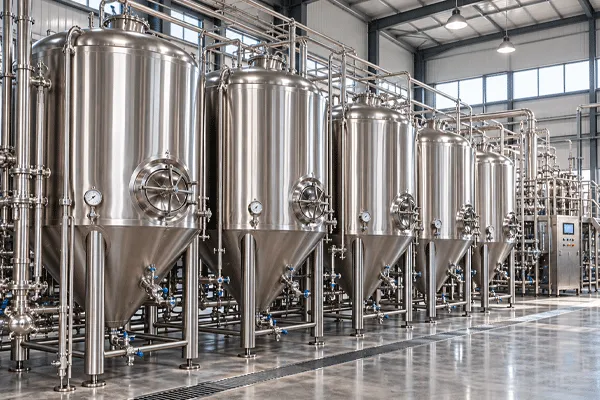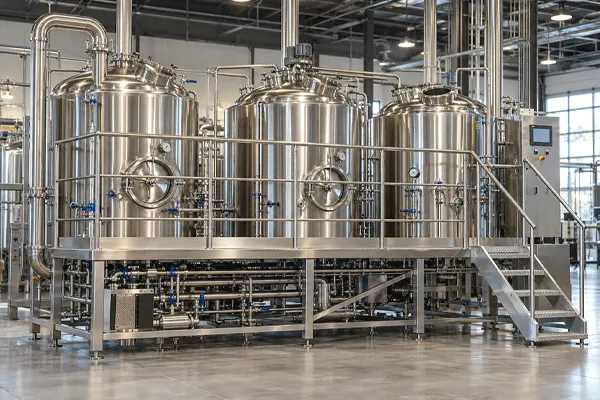
A small brewery can make good beer without a separate brite tank, but using every fermenter for fermentation, conditioning, carbonation, and holding can eventually slow production. The right choice depends on how often you brew, how you package beer, and how quickly you need fermenters back.
A small brewery does not always need a brite tank. A brewpub or low-volume taproom can often use pressure-rated unitanks for fermentation and carbonation. A separate brite tank becomes more useful when packaging volume grows, fermenters stay occupied waiting for finished beer, or the brewery needs more consistent carbonation, clarification, serving, and production scheduling.
1. What Does a Brite Tank Actually Add to a Small Brewery?
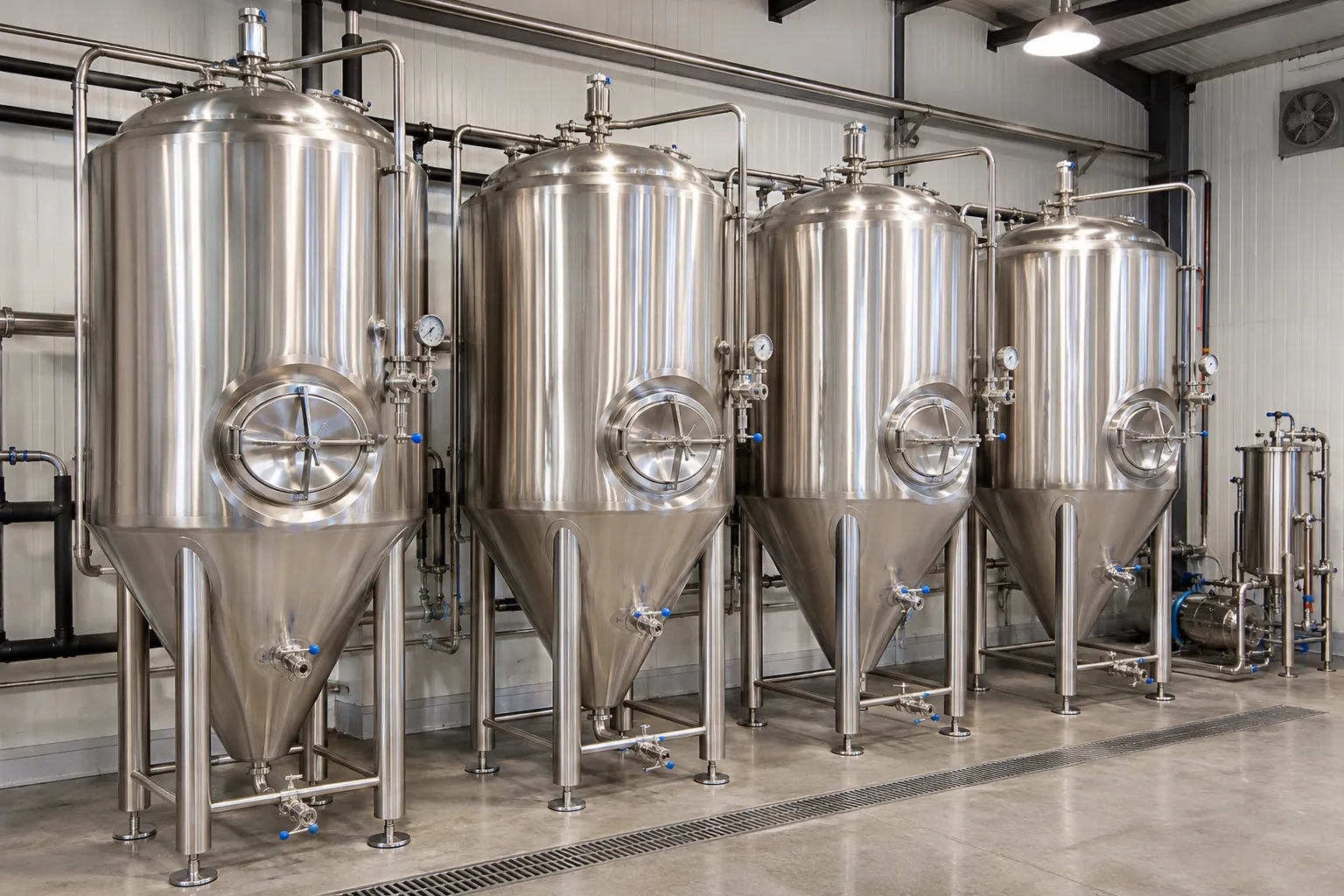
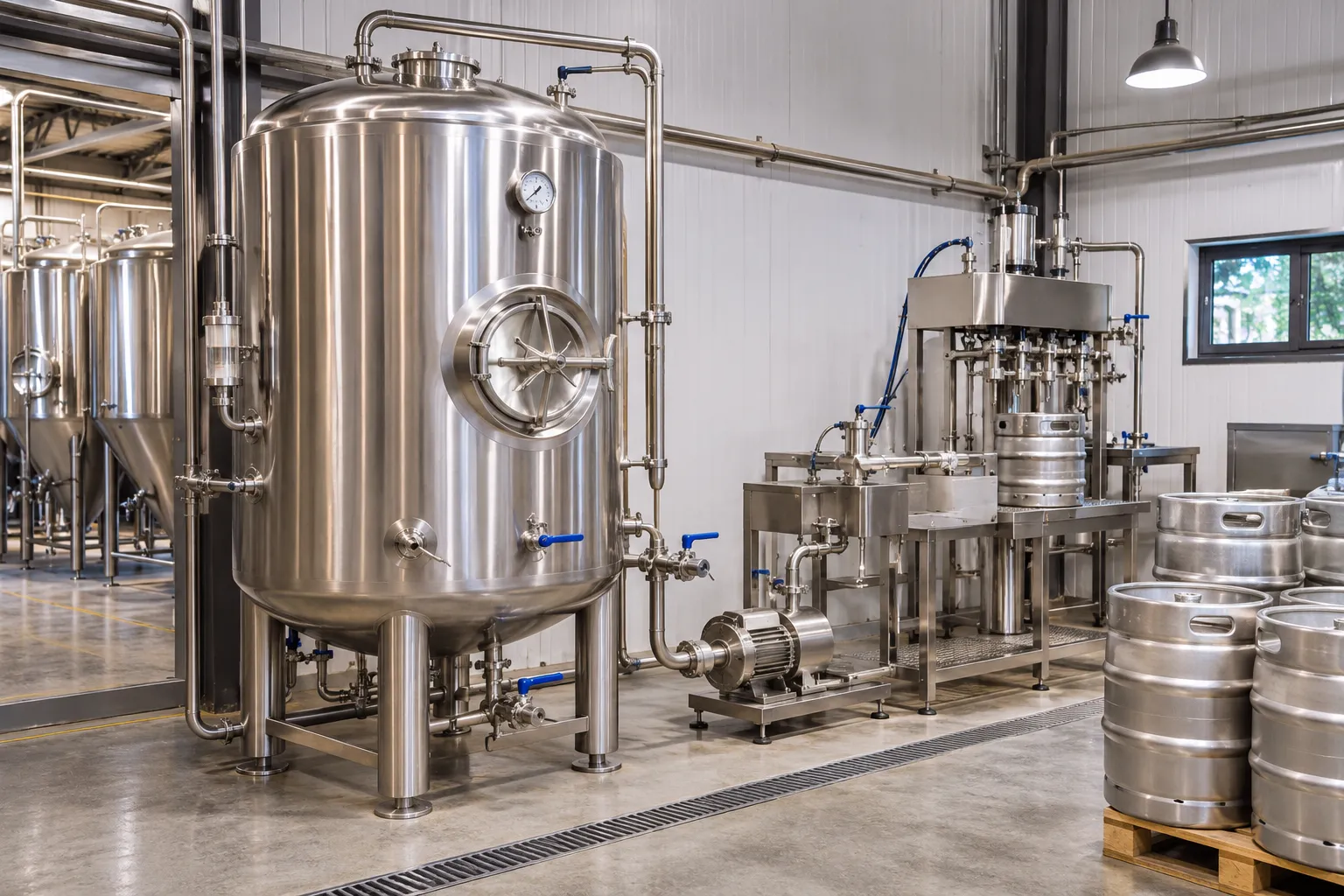
A brite tank, also called a bright tank or brite beer tank, is a pressure-capable beer tank used after the main fermentation stage. It gives the brewer a separate place for carbonation, clarification, cold holding, maturation, and preparation for serving or packaging.
That definition is simple. The business value is more important.
The biggest advantage is that a finished batch no longer needs to occupy a fermenter while waiting for the next step. Once beer is ready to leave fermentation, the brewer can transfer it into the brite tank. The fermentation tank can then be cleaned and filled with the next brew.
For a small operation, that can change the whole production schedule.
Consider two breweries with four fermenters.
Brewery A has no brite tank. Each fermenter stays occupied through fermentation, conditioning, carbonation, and the wait for packaging.
Brewery B has a dedicated brite tank. Once fermentation and the required conditioning steps are complete, suitable beer can move forward, making a fermenter available sooner.
The total number of fermentation tanks did not change.
The effective brewing capacity did.
That is the main reason a brite tank deserves attention when planning small commercial brewing equipment.
2. Can a Small Brewery Brew Without a Brite Tank?
Yes.
Many small breweries can operate without one, especially during the early stage of the business.
A modern pressure-rated unitank can combine several steps in one vessel. The brewer can ferment the wort, cool the beer, allow yeast and sediment to settle, carbonate the beer where the tank design permits, and then transfer the finished beer to kegs.
This arrangement can work well for:
- Nano breweries
- Small brewpubs
- Taprooms with limited production
- Breweries making only a few batches per week
- Facilities with very limited floor space
- Startups trying to control initial equipment investment
For these operations, buying another beer tank simply because larger breweries use one may not make financial sense.
The key question is not:
“Do professional breweries use brite tanks?”
Ask instead:
“Is the lack of a brite tank limiting my production?”
If a brewery can complete each batch in a unitank, package it on schedule, clean the fermenter, and keep up with demand, a separate finishing tank may provide limited immediate value.
This is why we do not recommend adding pieces of equipment simply to make a brewery look more complete.
Every tank should solve a real production problem.
3. When Does a Unitank Start Becoming a Production Bottleneck?
A unitank saves equipment and transfers, but it has one unavoidable limitation:
While finished beer remains inside it, you cannot fill that tank with the next batch.
Imagine a fermentation cycle takes 12 days.
Fermentation is complete, but the beer stays inside the tank for another four days for cold conditioning, carbonation, and packaging scheduling.
The actual tank occupancy is now:
12 days + 4 days = 16 days
With six unitanks, those extra four days are repeated across the cellar.
Over time, that can reduce how many batches the brewhouse can send into fermentation.
Simple tank-occupancy comparison
| Production Stage | Unitank-Only Workflow | Separate Brite Tank Workflow |
|---|---|---|
| Fermentation | 12 days | 12 days |
| Final cold holding | 2 days | May move to brite tank |
| Carbonatation | 1 day | Brite tank |
| Packaging wait | 1 day | Brite tank |
| Fermenter occupied | About 16 days | Potentially closer to 12 days |
| Next brew can enter | Later | Earlier |
This is only an illustrative example. Actual fermentation, maturation, and carbonation times vary by recipe and process.
Still, the principle is important.
When finished beer remains in a fermenter only because the packaging line is not ready, you are using expensive fermentation capacity as finished-beer storage.
That is often the point where a separate tank begins making sense.
4. Does a Brite Tank Help You Brew More Beer Without Buying More Fermenters?
Sometimes, yes.
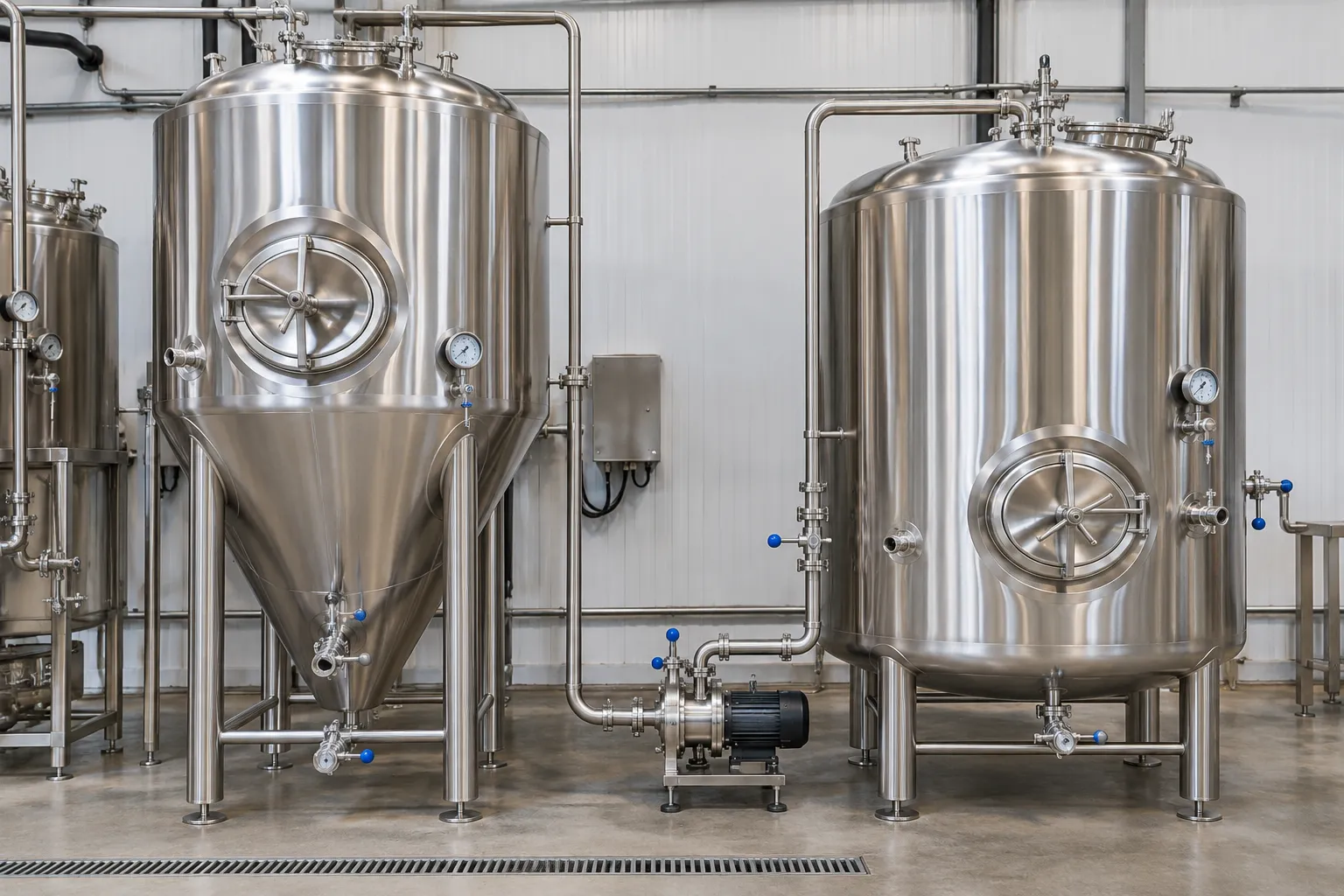
This is one of the strongest reasons for adding a brite tank to an existing small brewery.
Suppose you have:
- 10 BBL brewhouse
- 6 × 10 BBL fermenters
- 3 brews per week
- Limited packaging days
If each fermenter stays occupied after fermentation while beer waits to be kegged or canned, the brewhouse may eventually run out of available fermentation capacity.
You have several possible solutions:
- Buy another fermenter.
- Reduce brewing frequency.
- Package more frequently.
- Move finished beer to a separate brite tank.
The fourth option can sometimes increase usable fermentation capacity without adding several new fermentation vessels.
This does not mean one brite tank replaces multiple fermenters mathematically. The actual benefit depends on how many days it removes from fermenter occupancy.
A better way to evaluate the investment is:
Fermenter days released per month × average production value of those days
If the new tank frees enough fermentation time to support more saleable beer, it may generate a stronger return than another fermenter.
This is why a brite tank often becomes more valuable as a small brewery moves from casual production to a fixed weekly schedule.
5. Is a Brite Tank Better for Carbonation Than a Unitank?
Both vessels can support carbonation when properly designed and pressure-rated.
The real difference is workflow and control.
A dedicated brite tank gives the brewer a vessel whose main job is handling finished beer. This can make carbonation easier to standardize because fermentation activity is already complete or nearly complete and the tank can focus on cold-side finishing.
A typical setup may include:
- Pierre de carbonatation
- CO₂ connection
- Pressure gauge
- Pressure relief protection
- Vanne de prélèvement
- Enveloppe de refroidissement
- Temperature control
- Sanitary beer outlet
Carbon dioxide solubility in beer depends strongly on temperature and pressure. The Brewers Association notes that proper carbonation and beer quality depend on maintaining the correct relationship between beer temperature and applied pressure.
This matters whether you carbonate in a unitank or bright tank.
A dedicated tank does not automatically produce better carbonation. It simply gives the brewer a separate, controlled production stage for setting and maintaining target carbonation levels without continuing to occupy a fermentation vessel.
For a taproom serving many products directly, that extra control may also help maintain more predictable beer readiness.
6. Does a Brite Tank Make Beer Clearer?
It can support clarification, but the word “brite” should not be misunderstood.
A bright tank does not automatically turn hazy beer crystal clear.
Beer clarity depends on:
- Style de bière
- Yeast strain
- Cold conditioning
- Protein content
- Hop material
- Fining methods
- Filtration, if used
- Centrifugation, if used
- Settling time
- Temperature
After fermentation, remaining yeast and other particles may continue to settle. Cold beer generally supports this clarification process.
The brite tank provides a controlled place for this final stage.
For a naturally hazy beer, clarity may not even be the brewer’s goal.
For a lager or another product where the final appearance should be bright and stable, the tank may play a more important role in the clarification process.
So the correct statement is:
A brite tank supports clarification. It is not a substitute for the complete clarification process.
This distinction matters when selecting brewery equipment because buyers sometimes expect one tank to solve every product-quality problem.
Equipment helps control the process.
It does not replace good brewing practice.
7. Brewpub, Taproom, or Packaging Brewery: Who Needs a Brite Tank Most?
The answer changes with the business model.
Small Brewpub
A brewpub that produces one or two batches each week and serves almost everything onsite may not need a dedicated brite tank immediately.
A unitank-focused system may be more practical.
Advantages include:
- Fewer tanks
- Lower initial investment
- Less floor space
- Fewer transfers
- Simple operating workflow
If beer moves directly from the unitank to kegs or serving tanks, production may remain manageable.
Busy Taproom
A busy taproom with several rotating beers can benefit from one or more finishing tanks if fermenters regularly wait for taps, kegs, or service capacity.
A serving tank may also make sense depending on the draft system.
Here, the question becomes inventory management.
The brewery may want finished beer ready for service while new beer is already fermenting.
Small Packaging Brewery
This is where a dedicated tank often becomes more valuable.
If beer is routinely:
- Kegged
- Canned
- Bottled
- Sent to distributors
the packaging line usually operates on a schedule.
A batch may finish fermentation on Tuesday but the packaging crew may not run until Thursday.
Without separate storage, the fermenter stays occupied.
With a brite tank, finished beer can move forward while the fermenter returns to production.
Quick Decision Table
| Brewery Type | Brite Tank Priority |
|---|---|
| Nano brewery, very low output | Low |
| Small brewpub | Low to medium |
| Taproom with frequent brewing | Moyen |
| Microbrasserie with keg distribution | Medium to high |
| Brewery with canning/bottling | Élevé |
| Growing production brewery | Élevé |
The table is a planning framework, not a fixed rule.
8. How Many Brite Tanks Does a Small Brewery Need?
Many small breweries do not need one bright tank for every fermenter.
The ratio is usually much lower because a brite tank normally holds beer for less time than fermentation vessels do.
Imagine:
- Fermentation tank occupancy: 14 days
- Brite tank occupancy: 2 days
A single brite beer tank may therefore serve several fermentation tanks over the same production period.
A useful planning formula is:
Required brite capacity ≈ beer entering finishing during the busiest packaging window
Do not calculate it only from total annual beer production.
Instead, look at your actual weekly workflow.
For example:
Example A
A small brewery packages one 10 BBL batch at a time.
A single 10 BBL working-volume bright tank may be enough if production dates do not overlap.
Example B
Two 10 BBL batches frequently need finishing at the same time.
The brewery might consider:
- 2 × 10 BBL brite tanks, or
- 1 × appropriately sized 20 BBL tank where batching and product compatibility permit
Example C
The brewery sells several different beers simultaneously.
Two smaller tanks may provide more flexibility than one large tank because two beer styles can remain separate.
Tank capacity should therefore match:
batch size + beer mix + packaging schedule + finished-beer dwell time
Not simply the size of the brewhouse.
9. Should a Brite Tank Match the Brewhouse or Fermenter Size?
Often, matching the normal packaged batch is a practical starting point.
If you normally transfer a 10 BBL finished batch, a tank with enough working capacity for that beer volume makes operational sense.
However, there are exceptions.
Some breweries use larger fermentation tanks that receive two brewhouse batches. In that case, the bright tank may also need to handle the larger finished batch.
Other breweries split one large batch across different packaging formats or serving locations.
The important measurements are:
- Volume de travail
- Gross tank volume
- Normal transfer volume
- Required headspace
- Packaging batch
- Serving inventory
Do not buy a tank simply because its label says “10 BBL.”
Ask the supplier what that number represents.
For a pressure-rated beer tank, also confirm:
- Design pressure
- Operating pressure
- PRV configuration
- Pierre de carbonatation
- Enveloppe de refroidissement
- Isolation
- CIP device
- Beer outlet
- Sampling connection
ZPET’s current bright beer tank range includes vertical and horizontal configurations, pressure-rated carbonation equipment, cooling jackets, and options designed for direct serving or packaging workflows.
The final configuration should follow how you actually move beer through the brewery.
10. What Is the Difference Between a Brite Tank, Serving Tank, and Lagering Tank?
These vessels can overlap in function, but they are not always the same.
Brite Tank
Main roles:
- Carbonatation
- Clarification
- Final conditioning
- Finished-beer holding
- Packaging preparation
Serving Tank
A serving tank holds finished beer for direct draft service.
Some brewpubs use serving tanks connected directly to taps. This can reduce keg handling and provide useful storage behind the bar or in a cold room.
A brite tank may also serve beer directly when the system is designed for it.
Lagering Tank
A lagering tank is used for cold maturation.
Traditional lagering may require longer cold storage before beer is ready. Depending on the process, the brewery may use:
- Unitanks
- Dedicated lagering tanks
- Horizontal storage tanks
- Cuves à bière claires
The best choice depends on tank availability and the beer’s required maturation schedule.
Do not create extra transfers just because the equipment has different names.
Design the process backward from the finished product.
For some small breweries, one pressure-rated unitank can handle many stages.
For others, separating fermentation, lagering, and finished-beer storage creates a much more efficient cellar.
11. When Is Buying Another Fermenter Better Than Buying a Brite Tank?
This is one of the most important questions for a growing small brewery.
Suppose your production is constrained.
Should you buy:
another fermenter
ou
a brite tank?
The answer depends on where the bottleneck occurs.
Buy another fermenter when:
- Fermentation itself is using all available capacity.
- Beer requires long fermentation or maturation inside the fermentation vessels.
- You want to produce more different beer styles simultaneously.
- Finished beer already moves quickly into kegs or cans.
- Packaging is not delaying tank turnover.
Consider a brite tank when:
- Fermentation finishes but tanks remain occupied waiting for packaging.
- Carbonation is inconsistent between batches.
- You want a dedicated finished-beer buffer.
- Your canning or bottling line operates only on certain days.
- Fermenters are frequently used as temporary storage tanks.
- You need better separation between fermentation and packaging operations.
Simplified decision tree
Are fermenters full because yeast is still actively fermenting beer?
→ Add fermentation capacity.
Are fermenters full because finished beer has nowhere to go?
→ A brite tank may solve the bigger problem.
That distinction can prevent unnecessary equipment spending.
12. How Do CIP, Glycol, and Pressure Requirements Change the Decision?
A bright tank adds more than another stainless steel vessel.
It adds another piece of equipment to the brewery’s utility system.
Glycol
The tank may require cooling to keep beer at the required temperature during carbonation, clarification, storage, or serving.
Your glycol chiller must have enough reserve capacity.
CIP
The tank needs regular cleaning and sanitation between batches.
A professional CIP process should reach:
- Tank interior
- Pierre de carbonatation
- Valves
- Spray device
- Beer outlet
- Sample connection
- Product lines
Cleaning and maintenance must fit into the production schedule.
Pressure
Carbonation and finished-beer holding can involve pressure.
The tank must be designed to withstand its intended operating conditions and include appropriate pressure-relief protection.
Do not compare tanks based only on price and capacity.
For B2B buyers, a proper equipment review should include:
| Objet | Check Before Purchasing |
|---|---|
| Working capacity | Matches packaged batch |
| Matériau | Food-grade stainless steel |
| Pressure rating | Matches process requirements |
| Carbonatation | Correct stone and gas connections |
| Refroidissement | Suitable jacket and glycol load |
| CIP | Proper cleaning coverage |
| Magasin d'usine | Compatible with packaging/serving |
| Controls | Temperature and pressure monitoring |
| Installation | Access, drains, piping, utilities |
This is especially important when adding the tank to an existing brewery rather than designing a completely new cellar.
13. Small Brewery Case Studies: When Does a Brite Tank Make Sense?
The following examples are planning scenarios, not claims about specific customer projects.
Case 1: 3 BBL Taproom
Production: 2 brews per week
Sales: Almost all onsite
Packaging: Mainly kegs
Cellar: 5 pressure-rated unitanks
Likely decision:
No separate brite tank initially.
The unitanks provide enough capacity, and packaging is simple. Floor space may be more valuable than another piece of specialized equipment.
Case 2: 7 BBL Brewpub
Production: 3 brews per week
Sales: Taproom + local keg accounts
Problem: Finished beer sometimes waits several days inside fermenters
Likely decision:
One 7 BBL brite tank becomes worth evaluating.
The goal is not simply clearer beer. It is releasing cuves de fermentation faster.
Case 3: 10 BBL Microbrewery
Production: 3–4 brews per week
Sales: Taproom + kegs + cans
Packaging: Canning one or two days per week
Likely decision:
Dedicated brite capacity is increasingly valuable.
Finished beer can be prepared for the packaging line while fermentation vessels return to production.
Case 4: Lager-Focused Small Brewery
Production: Moderate
Beer style: Lager-heavy
Constraint: Long cold maturation
Here, simply adding one bright tank may not solve the problem.
The brewery should evaluate total lagering and finished-beer capacity together.
This is why equipment configuration must follow the production model.
14. How Should You Choose the Right Brite Tank for a Small Brewery?
Start with your weekly production.
Then work through the process step by step.
Ask:
How large is each finished batch?
This determines basic tank capacity.
How often do you package?
If packaging happens once weekly, you may need more finished-beer buffer capacity than a brewery packaging every day.
How many beer styles need to stay separate?
More styles may favor multiple smaller tanks.
Are unitanks currently delaying the next brew?
If yes, calculate how many fermenter days a dedicated finishing tank could release.
Will the tank serve beer directly?
If yes, serving connections and cellar layout become important.
Do you need carbonation in the tank?
Confirm the tank is properly pressure-rated and equipped with the required carbonation hardware.
Is glycol capacity available?
Adding a jacketed tank without checking the cooling system can create another bottleneck.
Can your CIP system clean it efficiently?
More tanks mean more cleaning cycles.
At ZPET, we design brewery tanks as part of a complete production flow. The goal is to match the brewhouse, fermentation tanks, bright beer tanks, glycol system, CIP, packaging line, and building layout rather than selecting each vessel independently.
That is especially important for a small brewery because every square meter and every equipment investment matters.
FAQs About Brite Tanks for Small Breweries
Does every small brewery need a brite tank?
No. Small breweries using pressure-rated unitanks may ferment, condition, carbonate, and hold beer in the same vessel. A brite tank becomes more useful when finished beer starts blocking fermentation capacity or when packaging and serving require a separate finished-beer stage.
Can I carbonate beer in a unitank instead?
Yes, when the unitank is designed and pressure-rated for carbonation. A separate brite tank is not mandatory simply to carbonate beer.
Will a brite tank make my beer taste better?
Not automatically. It gives the brewer more control over carbonation, clarification, storage, and workflow. Beer quality still depends on recipe, fermentation, oxygen control, sanitation, temperature, and proper handling.
Can I serve beer directly from a brite tank?
Yes, some brewery systems use bright beer tanks for direct serving when the tank, draft system, pressure, cooling, and connections are designed for that purpose.
How many brite tanks should a small brewery have?
Many small breweries can begin with one tank. The required number depends on batch size, packaging frequency, number of beer styles, and how long each batch stays in the finishing stage.
Should I buy a brite tank or another fermenter first?
If active fermentation is the bottleneck, buy more fermentation capacity. If completed beer is keeping fermenters occupied while waiting for carbonation, packaging, or service, a brite tank may provide greater production value.
Points clés à retenir
- A small brewery does not automatically need a brite tank.
- Pressure-rated unitanks can combine fermentation, conditioning, and carbonation for low-volume operations.
- A separate brite tank becomes more valuable when finished beer keeps fermenters occupied.
- The main business benefit is often faster fermenter turnover, not simply clearer beer.
- Brewpubs with low packaging volume may operate efficiently without one.
- Breweries using regular kegging, canning, or bottling schedules are more likely to benefit.
- A brite tank can support carbonation, clarification, maturation, storage, serving, and packaging preparation.
- Carbonation depends on correct beer temperature and pressure, not simply owning a bright tank.
- A bright tank does not replace good fermentation, filtration, sanitation, or oxygen-control practices.
- Match the tank capacity to the finished batch and packaging schedule, not only the salle de brassage size.
- Before buying another fermenter, determine whether the real bottleneck is fermentation or finished-beer storage.
- Check glycol, CIP, pressure rating, floor space, packaging connections, and utility capacity before adding another tank.
- As production grows, separating fermentation from finishing can make the entire brewery easier to schedule.
For a new small brewery, the smartest approach is not to install every possible piece of brewery equipment on day one. Build a system that meets today’s production needs while making tomorrow’s expansion practical.
At ZPET, we manufacture customized stainless steel brewhouses, fermentation tanks, brite beer tanks, cooling systems, and turnkey brewery solutions for commercial B2B projects.
If you are deciding whether your brewery needs a brite tank, send us your brewhouse batch size, number of fermenters, brews per week, beer styles, packaging method, available floor space, and expected production growth. We can help compare a unitank-only cellar with a separate fermenter-and-brite-tank configuration and determine which approach fits your actual workflow.