Choosing the wrong fermentation tank can lead to wasted ingredients, overflow, production delays, and higher operating costs. Whether you are building a brewery or planning wine production, selecting the correct tank size helps protect product quality, improve efficiency, and support future growth.
The right fermentation tank size depends on your batch volume, fermentation time, required headspace, product type, and production schedule. For beer, a fermenter often needs 15–25% additional capacity beyond the intended working volume, depending on the recipe and fermentation process. Wine production requires separate consideration of fermentation headspace and storage needs.
Article Outline
- Why Does Fermentation Tank Size Matter?
- How Do You Calculate the Right Fermentation Tank Capacity?
- What Size Fermentation Tank Does a Brewery Need?
- Is a 500 L, 1000 L, or 2000 L Fermenter Right for You?
- How Many Fermentation Tanks Does Your Brewery Need?
- How Does Wine Fermentation Affect Tank Selection?
- What Are the Different Types of Fermentation Tanks?
- Which Tank Materials and Features Should You Consider?
- How Should You Plan Tank Capacity for Future Expansion?
- How Can You Choose the Right Fermentation Tank Manufacturer?
1. Why Does Fermentation Tank Size Matter?
A fermentation tank does much more than hold liquid. It provides a controlled environment for yeast activity, temperature management, and product development. The correct tank size helps a brewer or winemaker manage each batch while making efficient use of space, equipment, and labor.
A tank that is too small may not leave enough room for foam, carbon dioxide, or other changes during active fermentation. An oversized tank can increase the initial investment and may create problems when storing small quantities of finished wine. The right choice depends on both the product and the stage of production.
For a brewery, fermentation tanks play a crucial role in matching brewhouse output with cellar capacity. For a winery, the same planning process must account for harvest volumes, grape varieties, fermentation methods, and later storage. As a professional brewery and beverage equipment manufacturer, we recommend evaluating the entire production process before selecting an individual vessel.
2. How Do You Calculate the Right Fermentation Tank Capacity?
Start by determining the maximum volume of liquid you expect to transfer into the tank. Then allow enough free space for fermentation activity. This free space is called headspace, and it is especially important when producing beer with vigorous foam formation.
For beer, a planning allowance of approximately 15–25% additional capacity is a useful starting point, although some recipes and processes require more. The exact requirement depends on the yeast strain, wort composition, fermentation method, and tank design. Always confirm the recommended working volume with your equipment supplier.
Use this simple formula:
Required gross tank volume = Planned working volume ÷ Target fill ratio
For example, if you want to ferment 1,000 liters of wort and plan to fill the tank to 80% of its gross volume:
1,000 L ÷ 0.80 = 1,250 L gross tank volume
| Planned working volume | Illustrative fill ratio | Approximate gross capacity |
|---|---|---|
| 500 L | 80% | 625 L |
| 1,000 L | 80% | 1,250 L |
| 2,000 L | 80% | 2,500 L |
| 3,000 L | 80% | 3,750 L |
These are planning examples, not universal tank specifications. Some manufacturers list working capacity, while others advertise total vessel volume. Confirm which measurement appears on every quotation before comparing prices.
3. What Size Fermentation Tank Does a Brewery Need?
The size a brewery needs depends on its brewhouse output, weekly production targets, fermentation cycle, and range of beer styles. A brewery producing one batch per week has different requirements from one brewing several times per day.
Ideally, the fermenter should accommodate the planned batch without forcing the brewer to split the wort into unsuitable volumes. Matching tank capacity to brewhouse output also helps simplify transfers, cleaning, and production scheduling.
Consider these illustrative configurations:
| Brewery operation | Example batch volume | Initial planning consideration |
|---|---|---|
| Small brewpub | 200–500 L | Compact tanks and flexible production |
| Growing microbrewery | 500–1,000 L | Multiple fermenters for different batches |
| Craft brewery | 1,000–2,000 L | Tank capacity matched to regular brew length |
| Larger commercial brewery | 2,000 L and above | Integrated cellar and production planning |
These ranges are examples rather than fixed industry standards. A suitable configuration may differ depending on fermentation time, recipe, and packaging demand.
When planning a new brewery or expanding an existing one, consider how much beer must be in fermentation at the same time. A single large fermenter may suit a brewery producing one main beer, while several smaller vessels may be better for a business offering seasonal beers and frequent recipe changes.
4. Is a 500 L, 1000 L, or 2000 L Fermenter Right for You?
A 500 L fermentation tank may suit a brewpub, pilot brewery, or small beverage producer testing new recipes. It allows smaller production runs and makes it easier to separate different products. However, too many small batches can increase cleaning time and labor if demand grows.
A 1000 L fermenter may be appropriate for a microbrewery with steady local demand. Before choosing one, confirm whether 1,000 L refers to the tank’s working volume or total volume. If the required batch is 1,000 L, a vessel with only 1,000 L of total capacity may not provide sufficient headspace.
A 2000 L fermenter can support larger batches and reduce the number of brewing cycles needed to meet demand. However, larger equipment is not automatically more economical. If sales are unpredictable, several smaller tanks may provide greater flexibility.
To decide what size suits your project, compare:
- Your normal and maximum batch volumes
- The number of brewing days per week
- Average fermentation and conditioning time
- The variety of products you plan to make
- Available floor space and installation access
- Your budget and expected growth
The goal is to choose a tank that serves current production without restricting future plans.
5. How Many Fermentation Tanks Does Your Brewery Need?
Tank capacity and tank quantity are separate decisions. Even if a fermenter matches your batch volume perfectly, you may need several vessels to maintain a steady production schedule.
A useful starting point is to estimate how long each tank remains occupied, including fermentation, conditioning when performed in the same vessel, emptying, and cleaning. Then compare that period with how frequently you brew.
A simple planning formula is:
Estimated tank count = Batches per week × Tank occupancy time in weeks
For example, a brewery that fills two fermenters per week and keeps each vessel occupied for two weeks needs approximately four fermenters for that schedule. It may need additional capacity if production overlaps, cleaning takes longer than expected, or demand increases.
This calculation is an initial estimate, not a complete engineering design. Different beer styles have different fermentation requirements, and some beers remain in tanks much longer than others. A brewery producing mainly fast-turnover ales may need fewer fermenters than a brewery specializing in lagers with longer fermentation and conditioning periods.
When choosing the right number of vessels, also consider whether you need separate tanks for maturation, dry hopping, or product trials. A well-planned tank configuration helps prevent bottlenecks and keeps the brewing schedule predictable.
6. How Does Wine Fermentation Affect Tank Selection?
Wine fermentation has different requirements from beer fermentation. The correct wine tank depends on grape variety, batch size, fermentation method, and the amount of solids present during processing.
Red wine production often involves fermenting juice together with grape skins and seeds. These solids form a cap and take up space, so the tank must allow sufficient room for cap management and mixing. White wine is commonly fermented as juice after pressing, so its tank requirements may differ.
If your goal is to choose the right wine fermentation tank, consider the entire production cycle rather than just the initial juice volume. Ask whether the vessel will handle crushed grapes, clarified juice, active fermentation, or finished wine storage. Each stage can require a different fill level.
| Wine production stage | Main tank consideration |
|---|---|
| Red wine fermentation | Extra room for skins, seeds, and cap management |
| White wine fermentation | Temperature control and suitable working volume |
| Small-lot production | Flexible capacity for different grape varieties |
| Wine maturation | Suitable materials and oxygen management |
| Finished wine storage | Minimize unnecessary headspace |
During active wine fermentation, headspace is important. After fermentation, storage usually requires a different approach: wine is generally kept in a full or nearly full vessel to reduce unwanted oxygen exposure.
Variable-capacity wine tanks can help winemakers manage different lot sizes, particularly during storage. However, seals and lids must be maintained correctly.
7. What Are the Different Types of Fermentation Tanks?
Different types of fermentation tanks serve different production needs. The best option depends on the beverage, fermentation process, and how much flexibility your operation requires.
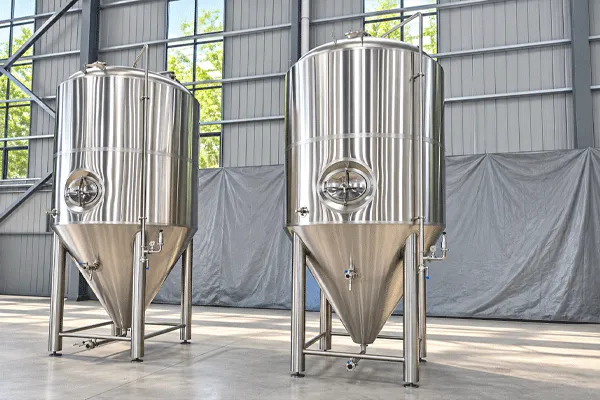
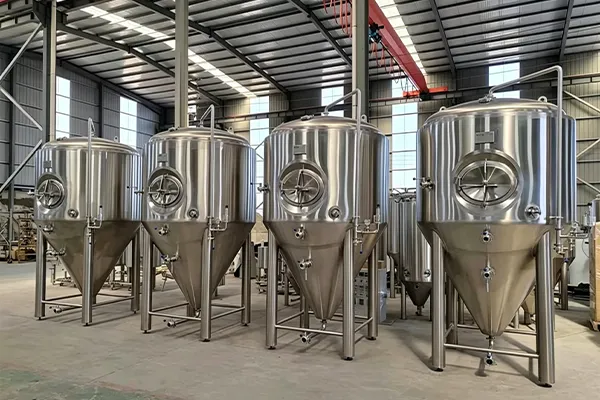
Conical fermenters are widely used in beer production. Their sloped bottoms help collect yeast and sediment, making it easier to remove material after fermentation. Many commercial models include cooling jackets, sampling ports, and sanitary connections.
Unitanks combine fermentation and certain conditioning or carbonation functions in a single pressure-rated vessel. They can reduce the need to transfer beer between tanks, but their pressure rating, fittings, and intended use must match the process.
Wine fermentation tanks may use open or closed designs, depending on the wine style and fermentation method. Some wineries choose variable-capacity tanks to accommodate changing batch volumes, especially during wine storage. Other operations use dedicated vessels for fermentation and maturation.
Before purchasing, confirm the intended application. A tank suitable for atmospheric fermentation is not automatically suitable for pressurized beer production. Similarly, a vessel designed for beer may not have the features needed for handling grape solids or managing wine oxidation.
8. Which Tank Materials and Features Should You Consider?
Material quality and tank design affect sanitation, service life, and daily operating costs. For many commercial beverage applications, stainless steel is a practical choice because it is durable, corrosion-resistant under suitable conditions, and compatible with established cleaning procedures.
High-quality stainless steel fermentation tanks can be configured with insulation, cooling jackets, temperature sensors, sampling ports, and cleaning systems. The exact features depend on the beverage and production requirements.
When comparing equipment, review more than the external appearance. Ask the manufacturer about:
- Material grade and thickness
- Internal surface finish
- Welding quality and inspection
- Working volume and total volume
- Pressure and vacuum ratings, where applicable
- Cooling performance and temperature monitoring
- Cleaning-in-place (CIP) arrangements
- Valves, fittings, and maintenance access
Temperature control is particularly important when a recipe requires a stable fermentation temperature. Cooling capacity must be suitable for the tank volume and the heat generated during active fermentation.
A well-designed fermentation system should support the complete process, from filling and monitoring to emptying and cleaning. These details can make a major difference to long-term performance.
9. How Should You Plan Tank Capacity for Future Expansion?
A fermentation system should meet today’s needs while leaving room for reasonable growth. If you expect production to increase, plan for future expansion before finalizing the layout.
Start by estimating annual output, weekly batch frequency, and the mix of products you want to produce. Then calculate the total fermentation capacity required to keep up with your planned schedule. Remember that total capacity is not the same as usable working volume.
A brewery producing several beer styles may benefit from a mix of tank sizes rather than buying every vessel in one standard volume. Larger tanks can serve regular products, while smaller tanks can support seasonal releases or experimental batches. Wineries can use a similar approach to handle different grape varieties and harvest volumes.
An illustrative planning checklist includes:
- Forecast production for the next one to three years.
- Identify the longest fermentation and conditioning cycles.
- Calculate the required number of occupied tanks.
- Allow for cleaning, maintenance, and schedule changes.
- Check utilities, floor space, drainage, and access.
- Decide whether future tanks can connect to the existing system.
For a new brewery or expanding beverage facility, this approach can help avoid unnecessary equipment replacement. It also makes it easier to plan cooling capacity, piping, cleaning systems, and packaging operations as production grows.

10. How Can You Choose the Right Fermentation Tank Manufacturer?
The right equipment supplier should understand your production process, not simply offer a list of standard tank sizes. A reliable manufacturer can help translate batch targets, beverage type, and operating conditions into a practical tank configuration.
As a professional brewery and beverage equipment manufacturing plant, we provide customized stainless steel brewing systems, fermentation tanks, brewhouse systems, and turnkey brewery solutions for global B2B customers. We work with craft breweries, brewpubs, microbreweries, commercial producers, beverage startups, and project contractors.
When evaluating a supplier, ask for clear specifications and technical support. The quotation should state the tank’s working and gross capacity, material, dimensions, cooling arrangement, fittings, pressure rating where applicable, and cleaning provisions.
It is also worth discussing the full production layout. A tank that fits the batch volume may still be unsuitable if it blocks access, exceeds available ceiling height, or cannot connect efficiently to the cooling and cleaning systems.
Before requesting a quotation, prepare the following information:
- Beverage type and intended production volume
- Batch size and number of batches per week
- Fermentation and conditioning time
- Required working capacity per tank
- Available building dimensions
- Desired automation and cleaning systems
- Plans for future production growth
With these details, an equipment manufacturer can recommend a suitable fermenter and a more efficient overall system.
Frequently Asked Questions
Is a bigger fermentation tank always better?
No. A larger tank may support higher output, but it can increase initial costs and occupy valuable floor space. The best size matches your working volume, fermentation process, and production schedule.
How much headspace should a beer fermentation tank have?
A 15–25% allowance is a useful initial planning range for many beer fermentations, but it is not universal. Recipe strength, yeast behavior, foam formation, and tank design can change the requirement. Confirm the working volume with your supplier.
What size fermentation tank does a 1000 L brewery need?
If the brewery produces a 1,000 L batch, a tank with approximately 1,250 L gross capacity may be a reasonable starting point when using an 80% fill ratio. The final choice depends on the actual process and whether the quoted capacity refers to working or total volume.
What size fermentation tank does a 2000 L brewery need?
For a 2,000 L working batch, a tank with around 2,500 L gross capacity illustrates the same 80% fill-ratio calculation. Confirm the required headspace, cooling performance, and tank specifications before purchasing.
Can one tank be used for both fermentation and storage?
Sometimes. A suitable unitank may support fermentation, conditioning, and carbonation. Wine operations may also use a variable-capacity vessel for fermentation and storage, provided the tank is designed for those duties and operated correctly. Separate tanks may offer better scheduling flexibility.
Are stainless steel fermentation tanks suitable for both beer and wine?
Stainless steel tanks are used for both beverages, but the design and fittings must suit the application. Beer production may require pressure-rated vessels and carbonation features, while wine production may require different cap-management or variable-capacity arrangements.
Key Takeaways
- Match tank size to working volume, not just the advertised nominal capacity.
- Allow sufficient headspace for the beverage and fermentation method.
- Consider batch size, fermentation time, cleaning, and tank occupancy when calculating total capacity.
- Beer and wine have different fermentation and storage requirements.
- Choose tank types, materials, and features based on the actual production process.
- Plan for future growth without investing in capacity that may remain unused.
- Compare manufacturers on technical specifications, customization, support, and long-term reliability.
Need help selecting the right fermentation tank for your brewery or winery? Our team can help you plan tank capacity, compare configurations, and develop a customized stainless steel fermentation system for your production goals. Contact us to discuss your project and request a tailored equipment solution.