David Zhang | Founder & CEO, ZPET (Shandong ZhongPi Machinery Equipment Co., Ltd.) | Published August , 2026
A 5 BBL brewhouse produces 587 L per batch; a 7 BBL produces 822 L — 40% more beer for the same 6–8 hour brew day. The choice turns on how many fermenters each needs to keep taps full, and on whether you expect to outgrow 5 BBL within two years.
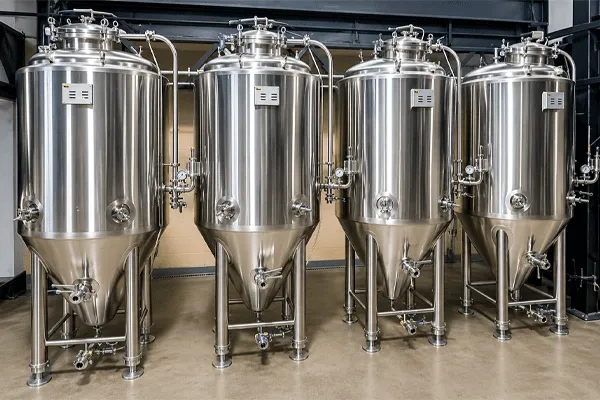
The two sizes side by side
| 5 BBL | 7 barils | |
| Working volume per batch | 587 L | 822 L |
| Half-barrel kegs per batch | 10.0 | 14.0 |
| US pints (16 oz) per batch | 1,241 | 1,738 |
| Product line | Nano tier ceiling | Micro tier entry |
| Kettle diameter (typical) | 1.05 m | 1.15 m |
| Kettle overall height | 2.05–2.35 m | 2.20–2.50 m |
| Fermenter overall height | 2.35–2.65 m | 2.55–2.90 m |
| Brewhouse floor area, 2-vessel | 2.6–3.1 m² | 3.2–3.8 m² |
| Working brewery footprint, 6 FVs | 60–80 m² | 75–100 m² |
| Practical minimum ceiling | 3.4 m | 3.6 m |
| Electric brewhouse supply | 45–60 kW three-phase | 60–80 kW three-phase |
| Brew day, grain-in to clean-down | 6–8 hours | 6–8 hours |
| Malt per batch at 1.050 OG | 110–120 kg | 155–165 kg |
| Water per brew day | 1,760–2,935 L | 2,470–4,110 L |
| Weekly output, 6 FVs at 14-day turn | 15,0 BBL | 21.0 BBL |
| Annual ceiling, 6 FVs, 48 weeks | environ 720 BBL | ~1,008 BBL |
Basis: 1 US beer barrel = 117.3 L; half-barrel keg = 58.67 L; 16 oz pint = 0.473 L. Dimensions calculated from working volume plus 25% brewhouse headspace and 30% fermenter headspace, at height-to-diameter ratios common in this band, with dished heads, cone, and leg height added. Footprint includes brewhouse clearance, fermenter aisle, grain handling, glycol, CIP, and keg logistics. Request stamped drawings before committing to a lease.
Three lines in that table do the actual work of the decision.
The batch volume gap is 235 L, two full half-barrel kegs plus a little. The brew day is identical. And the footprint gap is 15–20 m², which at most commercial lease rates is a smaller annual cost than one extra brew day per week in labor.
Labor per litre: the argument that usually settles it
Brew-day hours barely move with vessel size in this range. Milling 165 kg takes longer than milling 115 kg, and cleaning a 1.15 m kettle takes marginally longer than a 1.05 m one, but the mash rest, the lauter, the boil, the whirlpool rest, and the knockout are all governed by process time rather than by volume.
| 5 BBL | 7 barils | |
| Brew-day hours per batch | 7.0 | 7.5 |
| Litres per brew-day hour | 84 L | 110 L |
| Labor hours per 1,000 L | 11.9 | 9.1 |
| Brew days for 21 BBL/week | 4.2 | 3.0 |
| Weekly brew-day hours for 21 BBL | 29.4 | 22.5 |
| Annual brew-day hours for 21 BBL/week (48 wk) | 1,411 | 1,080 |
Assumes single-operator brewing, one batch per brew day, and no back-to-back brewing.
At a common production target, the 5 BBL system costs roughly 330 additional brewing hours a year. That is close to a fifth of a full-time position, spent producing exactly the same volume of beer.
This is also where the 5 BBL system hits a ceiling that has nothing to do with equipment. Four brew days a week on a single-operator brewery leaves little room for cellar work, packaging, and cleaning inside a normal week. Pushing a 5 BBL system past about 20 BBL weekly generally means hiring a second brewer, adding a second daily brew, or both — and a second brew in one shift requires a third brewhouse vessel, which erases part of the capital saving.
Fermenter count: what it takes to keep taps full
Neither brewhouse determines weekly output on its own. Fermenter count and tank turn time do.
batches per week = (fermenter count ÷ turn days) × 7 weekly output = batches per week × batch size
Turn days must include primary fermentation, dry hop or conditioning, cold crash, and CIP turnaround. Counting primary only overstates capacity by 30–40%.
Weekly output by fermenter count
| Turn time | 5 BBL, 4 FVs | 5 BBL, 6 FVs | 5 BBL, 8 FVs | 7 BBL, 4 FVs | 7 BBL, 6 FVs | 7 BBL, 8 FVs |
| 10 days (fast ale) | 14.0 | 21.0 | 28.0 | 19.6 | 29.4 | 39.2 |
| 14 days (standard ale) | 10.0 | 15.0 | 20.0 | 14.0 | 21.0 | 28.0 |
| 21 days (dry-hopped, long crash) | 6.7 | 10.0 | 13.3 | 9.3 | 14.0 | 18.7 |
| 35 days (lager) | 4.0 | 6.0 | 8.0 | 5.6 | 8.4 | 11.2 |
Working backwards from demand
Read the table against a venue rather than against itself:
| Venue | Weekly demand | 5 BBL: FVs needed | 7 BBL: FVs needed |
| 60-seat taproom, 1,000 pints/wk | 4,0 BBL | 2 | 2 |
| 90-seat taproom, busy weekends | 9,0 BBL | 4 | 3 |
| 120-seat brewpub with food | 15,0 BBL | 6 | 4 |
| Taproom plus 15 keg accounts | 22.0 BBL | 9 | 6 |
| Taproom, keg accounts, small can program | 30.0 BBL | 12 | 8 |
The pattern is what matters. Below about 9 BBL weekly, both systems work and the 5 BBL option is the reasonable buy. Between 9 and 20 BBL weekly, the 7 BBL system needs two to three fewer fermenters to hit the same number — which recovers a meaningful part of its higher purchase price in tanks not bought, and in the floor area those tanks would have occupied.
Above 22 BBL weekly the 5 BBL system stops being a sensible configuration. Nine fermenters against a 5 BBL brewhouse is a badly balanced brewery: too much cellar for the brewhouse feeding it, and a brew schedule that consumes the operator’s whole week.
To run this for your own plan: take projected weekly BBL, divide by batch size to get batches per week, multiply by realistic turn days, divide by seven, round up. Order that many fermenters or leave the piping and control channels to add them later.
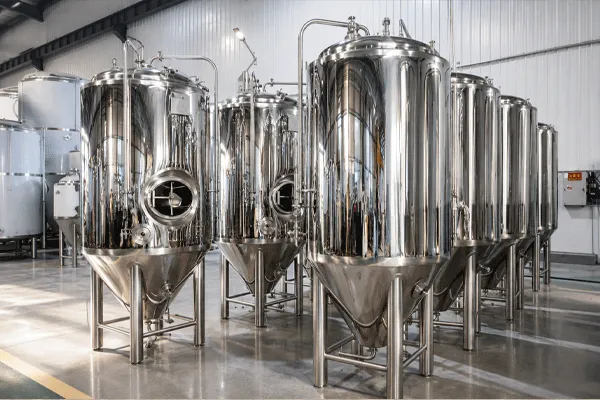
Where the 5 BBL system is the better buy
Against the direction of the argument so far, four situations favor 5 BBL:
- The room genuinely cannot take 7 BBL.Ceiling height is the usual blocker. A 3.4 m clearance accommodates a 5 BBL fermenter with manway access; 7 BBL wants 3.6 m, and once sprinklers and ductwork are subtracted, many retrofit spaces sit between those two numbers.
- Electrical service is capped.If the building delivers 60 kW three-phase and no more, an electric 7 BBL brewhouse plus HLT is at or past the limit while 5 BBL fits with headroom. Upgrading service in a leased retail unit is often slower and more expensive than choosing the smaller system.
- A rotating, high-variety tap program.A venue running 14 taps on constant rotation benefits from smaller batches: 10 kegs of a given beer sells through before it loses freshness, where 14 kegs of the same beer may not.
- The 5 BBL system is intended as a future pilot.If the business plan already anticipates a separate production brewery within three years, buying 5 BBL now and redeploying it as a pilot and small-batch rig later is a coherent strategy — provided it is specified for that role, covered below.
Outside those four cases, the throughput and labor arithmetic favors 7 BBL.
The cost of outgrowing 5 BBL in two years
This is the scenario buyers underweight. Growth from an opening 8 BBL weekly to 18 BBL weekly over 24 months is unremarkable for a taproom that succeeds, and it puts a 5 BBL system in an awkward position.
The available responses and what each costs:
Add fermenters. Cheapest option, and it works up to a point. Reaching 18 BBL weekly at a 14-day turn needs eight 5 BBL fermenters and 3.6 brew days a week. It fits, but the labor cost from the earlier table applies permanently, and the fermenter row consumes 8–10 m² more floor area than the 7 BBL equivalent would have.
Add a third brewhouse vessel for double-batch days. Lets you brew twice in a shift, halving brew days. Costs a vessel, added floor area, and re-piping of the existing brewhouse. Retrofit piping work in a running brewery means downtime.
Replace the brewhouse. A full second purchase inside two years. The 5 BBL system either becomes a pilot rig or gets sold, typically at a substantial discount to what it cost.
Cap output and stay at 5 BBL. A legitimate choice, but it means declining keg accounts and forgoing the packaging program.
None of these is a disaster, and none is free. The question worth asking before purchase is not “what can we sell today” but “what does the plan look like at month 24.” If that number is above 15 BBL weekly, the 7 BBL system is cheaper across the period even at a higher purchase price, because it avoids buying twice.
Utility and site requirements compared
Electric kettle sizing. Two calculations, both answerable before a site visit:
kWh to reach boil = (litres × 4.186 × ΔT °C) ÷ 3,600 kW to sustain boil = (litres × boil-off rate L/hr × 2,257 kJ/L) ÷ 3,600
Raising 587 L by 30 °C takes 20.5 kWh; over 45 minutes that is a 27 kW element. Sustaining a 7%/hour boil on 587 L evaporates 41 L/hour, needing about 26 kW continuous. For 822 L the same figures become 28.7 kWh, a 38 kW element, and 36 kW to hold the boil. Add HLT heating and total three-phase demand lands at 45–60 kW for 5 BBL and 60–80 kW for 7 BBL. Steam heating shifts this load to gas or oil but adds boiler room requirements, water treatment, periodic inspection, and in many jurisdictions a licensed operator.
Glycol load. Peak simultaneous demand sets chiller size, not tank volume:
Cooling kW = (litres × 4.186 × ΔT) ÷ (hours × 3,600)
Crashing 587 L from 20 °C to 2 °C over 12 hours requires 1.02 kW; 822 L over the same period requires 1.43 kW. Add 0.4–0.7 kW for fermentation exotherm on a parallel tank, then line and ambient losses, which rise if the chiller sits outdoors. Sizing against average load rather than peak produces a system that holds temperature in winter and misses crash targets in August.
Floor loading.
Full vessel weight ≈ (working volume L × 1.05 kg/L) + tare weight Distributed load = full weight ÷ vessel base area
Liquid alone is 616 kg in a 5 BBL fermenter and 863 kg in a 7 BBL. Request tare weight from the supplier rather than estimating it. Distributed load in both cases exceeds 1,000 kg/m², inside most ground-floor slab ratings and outside many suspended-floor ratings. Anything not on grade needs a structural engineer’s sign-off before the order.
High-gravity limit. Both systems are advertised at a standard-gravity assumption no supplier states. A 5 BBL mash/lauter tun holding roughly 735 L handles a 115 kg grain bill at 2.8 L/kg comfortably. At 1.100 OG the grain bill reaches about 225 kg, requiring 630 L of strike water plus 150 kg of grain displacement — 780 L in a 735 L vessel. The 7 BBL equivalent hits the same wall proportionally. If imperial stouts or barleywines are central to the lineup, specify a mash/lauter tun one size above the kettle at order rather than discovering the constraint after installation.
Specifying either system so it survives expansion
Most buyers at this scale expand within three to five years. Five decisions at purchase determine whether the system becomes a useful pilot rig or an asset sale at a loss:
- Tri-clamp fittings throughout, in sizes matching what a future production brewery will use, so hoses, pumps, gaskets, and CIP connections are shared rather than duplicated.
- Jacketed vessels on brewhouse and fermenters, without exception. Retrofitting a jacket is not economically sensible; specifying it at fabrication costs comparatively little.
- Pressure-rated fermenterscapable of spunding, so finished beer can leave the fermenter without a réservoir brillant when tank slots are tight.
- Spare control panel channels.Adding two fermenters in year two is cheap. Rebuilding a control panel is not.
- EN 10204 3.1 material certificateson pressure-bearing components. Undocumented steel becomes expensive at a border crossing, a resale, or a local pressure-vessel inspection.
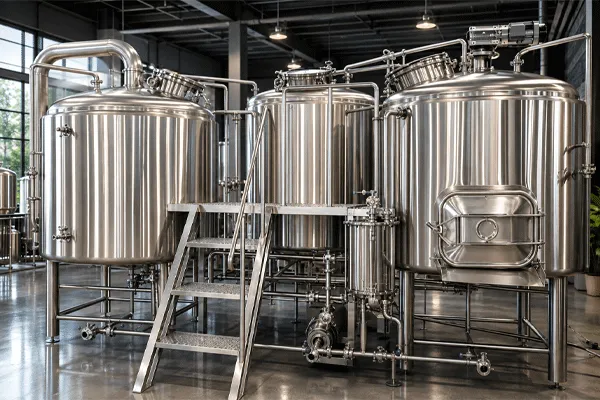
ZPET 5 BBL and 7 BBL systems
A 5 BBL system sits at the top of our Équipement de nanobrasserie range; 7 BBL is the entry point to Microbrewery Equipment. Both are built on the same Systèmes de brassage platform, in 2-vessel to 5-vessel configuration.
| Paramètre | 5 BBL | 7 barils |
| Volume de travail | 587 L | 822 L |
| Product line | Nanobrewery Equipment (1–5 BBL) | Équipement de microbrasserie (7–30 BBL) |
| Line positioning | Small-batch experimentation; space-saving modular design | High-efficiency wort production; scalable cellar expansion; batch-to-batch consistency |
| Configurations des salles de brassage | 2-vessel to 5-vessel | 2-vessel to 5-vessel |
| Heating | À vapeur / électrique / à feu direct | À vapeur / électrique / à feu direct |
| Matériaux | SS304 ou SS316L, qualité sanitaire | SS304 ou SS316L, qualité sanitaire |
| Interior finish | polissage miroir à 0,4 μm | polissage miroir à 0,4 μm |
| Refroidissement des cuves de fermentation | Enveloppe de refroidissement à alvéoles | Enveloppe de refroidissement à alvéoles |
| Accès au réservoir | Trou d'homme supérieur de série ; trou d'homme latéral en option | Trou d'homme supérieur de série ; trou d'homme latéral en option |
| Soudage | TIG / double-sided argon arc; welding robots; CNC laser-cut plate | Same |
| Vérification des matériaux | Analyse par spectromètre de l'acier inoxydable à l'arrivée | Same |
| Essais de pression | Essai de maintien de la pression pendant 24 heures | Same |
| Contrôle des soudures | X-ray inspection; 5-step QC sequence | Same |
| Operating platform | Ergonomic, designed to vessel height | Ergonomic, designed to vessel height |
| Garantie structurelle | 10 ans | 10 ans |
| Conformité en matière d'exportation | Engineered to meet PED (CE), UL/cUL, AS1210 | Engineered to meet PED (CE), UL/cUL, AS1210 |
| Pre-order deliverable | 3D layout, technical drawings, process flow chart | 3D layout, technical drawings, process flow chart |
Two notes on that table.
The construction and QC specification is identical across both sizes, which is deliberate: the 7 BBL system is not a different grade of equipment, only a larger one. What changes with size is vessel geometry, jacket area, pump sizing, and utility connection — all set per order against the building rather than fixed to a catalogue.
“Engineered to meet PED (CE), UL/cUL and AS1210” means vessels and control panels are designed against the requirements of those standards. That is a different statement from holding a third-party certificate for a specific unit, and any supplier should be able to tell you which of the two they are offering and show you the document. The 0.4 μm figure is interior surface roughness, the property ASME BPE addresses in its hygienic surface finish designations, and the one that determines whether cleaning-in-place removes soil or merely wets it. Ask for it in μm Ra rather than by polish grade name, since grade nomenclature varies between fabricators.
Because both sizes go into buildings that were not designed as breweries, we produce the 3D layout against your measured floor plan, drain positions, lowest overhead obstruction at each vessel position, and available electrical service before fabrication starts. At 7 BBL the delivery path becomes a real constraint: a 1.15 m diameter kettle plus skid does not pass through a 1.0 m door at any angle, and this is worth checking before the size decision rather than after.
Compared with the converted second-hand dairy and food-industry tanks sometimes offered as a lower-cost route into this capacity band, purpose-built brewing vessels differ in four specific respects: jacket coverage sized to la fermentation heat load rather than product holding, conical bottom geometry for yeast harvest, a pressure rating permitting spunding, and documented material traceability. The converted tanks cost less per litre. The brewery assembled from them usually does not.
Foire aux questions
Q: Is a 5 BBL or 7 BBL brewhouse better for a taproom?
A: Below about 9 BBL weekly demand, 5 BBL. Between 9 and 20 BBL weekly, 7 BBL, because it needs two to three fewer fermenters and roughly 330 fewer brewing hours a year to reach the same output. Above 22 BBL weekly, 5 BBL is no longer a balanced configuration.
Q: How many kegs does each system produce per batch?
A: Ten US half-barrel kegs from a 5 BBL batch (587 L) and fourteen from a 7 BBL batch (822 L), before losses. Budget 5–10% loss through trub, yeast, and transfer.
Q: How many fermenters do I need with a 5 BBL brewhouse?
A: Multiply target batches per week by your realistic turn days and divide by seven. For 15 BBL weekly at a 14-day turn: six. The same target on a lager program at 35 days needs fifteen, which is the point at which the brewhouse is the wrong size.
Q: How much floor space does each need?
A: A working brewery with six fermenters, glycol, CIP, grain handling, and keg logistics runs 60–80 m² at 5 BBL and 75–100 m² at 7 BBL, excluding taproom and packaging.
Q: What ceiling height is required?
A: 3.4 m practical minimum for 5 BBL, 3.6 m for 7 BBL, measured to the lowest obstruction over each vessel position rather than to the structural slab. Sprinklers, ductwork, and lighting all reduce usable height.
Q: What happens if I outgrow a 5 BBL system?
A: Four options: add fermenters and accept the permanent labor cost, add a third brewhouse vessel for double-batch days, replace the brewhouse and redeploy or sell the old one, or cap output. If your month-24 plan exceeds 15 BBL weekly, buying 7 BBL initially is generally cheaper across the period.
Q: Can a 5 BBL system be reused as a pilot brewery later?
A: Yes, if specified for it: tri-clamp fittings matching the future plant, jacketed vessels, pressure-rated fermenters, spare control channels, and EN 10204 3.1 material certificates. Without those five, systems tend to be sold rather than redeployed.