Buying tanks without a clear production plan can leave a new brewery short of fermentation space, cooling power, or packaging capacity. These mistakes delay production and raise costs. A properly designed microbrewery equipment plan connects every vessel, utility, workflow, and future expansion requirement before manufacturing begins.
A microbrewery needs a grain mill, brewhouse, hot and cold liquor tanks, heat exchanger, cuves de fermentation, brite tanks, glycol cooling system, pumps, controls, CIP equipment, water treatment, and a kegging, canning, or bottling system. The exact equipment needed depends on batch size, annual output, beer styles, packaging format, available space, and planned production growth.
Microbrewery Equipment List at a Glance
The following table provides a practical list of essential equipment for most small breweries.
| Production Stage | Main Equipment | Fonction principale | Priority |
|---|---|---|---|
| Raw material preparation | Grain mill and malt handling system | Crushes malt before mashing | Essential |
| Brewing | Mash tun, lauter tun, kettle and whirlpool | Produces and separates wort | Essential |
| Water preparation | Hot liquor tank and cold liquor tank | Stores brewing and cooling water | Essential |
| Wort cooling | Sanitary plate heat exchanger | Cools hot wort before fermentation | Essential |
| Fermentation | Jacketed fermentation tank or unitank | Controls yeast fermentation | Essential |
| Beer conditioning | Brite tanks | Clarifies, carbonates and stores finished beer | Recommended |
| Refroidissement | Glycol chiller, piping and control equipment | Maintains tank and process temperatures | Essential |
| Nettoyage | CIP cart, chemical tanks and spray devices | Cleans vessels and process lines | Essential |
| Product transfer | Sanitary pumps, valves, hoses and piping | Moves water, wort and beer | Essential |
| Packaging | Keg washer and filler, canning or bottling line | Prepares finished products for sale | Essential |
| Quality control | Hydrometer, pH meter and laboratory tools | Checks product consistency | Essential |
| Services publics | Boiler or electric heating, air compressor and CO₂ system | Supports heating, controls and packaging | Essential |
| Automation | Control panel, sensors and software | Manages temperatures, pumps and valves | Optional to advanced |
| Safety | Ventilation, gas monitoring and protective equipment | Protects workers and visitors | Essential |
This equipment list is only a starting point. The correct size and configuration must match your production schedule. A 5-barrel brewpub and a 30-barrel regional brewery may use similar categories of machinery, but their tank quantities, automation level, packaging speed, and utility demand will be very different.
What Equipment Do You Need to Start a Microbrewery?
The main equipment you need to brew commercial beer can be divided into six connected systems:
- Raw material handling
- Brewhouse system
- Fermentation and conditioning
- Cooling and utilities
- Cleaning and sanitation
- Packaging and storage
The stages of the brewing process are closely linked. The grain mill affects the mash. The mash affects wort extraction. The heat exchanger controls how quickly the wort reaches the desired yeast-pitching temperature. Fermentation capacity then determines how frequently the brewer can use the brewhouse.
This is why setting up a brewery should begin with a production model rather than a tank catalogue. We normally ask buyers about expected annual volume, brew frequency, beer styles, fermentation time, sales channels, available utilities, ceiling height, door dimensions, drainage, and future expansion before recommending any micro brewing equipment.
How Should You Choose the Right Brewhouse System?
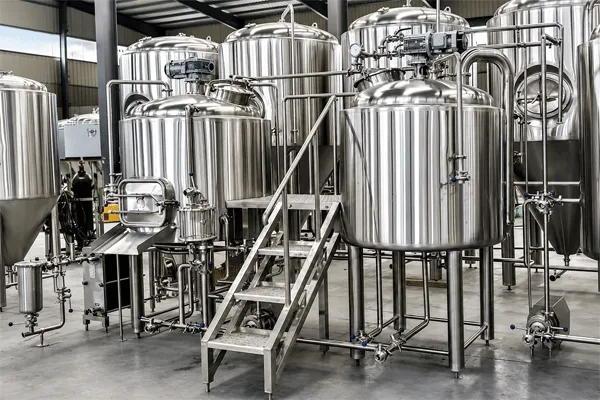
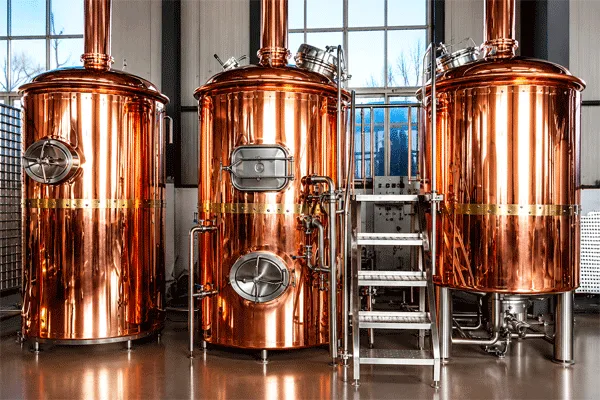
The brewhouse is the production center of a brewery. It usually includes a mash tun, lauter tun, brew kettle, whirlpool, pumps, working platforms, piping, valves, heating elements, and a control panel.
Several brewhouse configurations are available:
| Configuration de la salle de brassage | Typical Application | Main Advantage |
|---|---|---|
| Two-vessel system | Brewpubs and startup breweries | Lower investment and compact layout |
| Three-vessel system | Growing microbreweries | Better separation of processes |
| Four-vessel system | High-output breweries | Supports overlapping batches |
| Combined mash/lauter vessel | Small breweries | Reduces footprint and cost |
| Separate mash and lauter vessels | Higher-volume production | Improves brewing flexibility |
| Chauffage électrique | Small systems and limited steam access | Simple installation |
| Chauffage à la vapeur | Medium and larger equipment | Even heating and faster production |
| Direct-fire heating | Selected brewpub applications | Familiar operation and distinct heating response |
During mashing, crushed malt is mixed with heated water so enzymes can convert grain starches into fermentable sugars. The liquid then passes through lautering, where the grain bed helps separate the wort from the spent grain.
The wort enters the kettle for boiling and hop additions. It then moves into the whirlpool, where solids settle before cooling. The correct vessel arrangement reduces waiting time between these steps and allows the brewery to complete more brew cycles each day.
When we design customized stainless steel brewing systems, we calculate vessel working volume, headspace, heating surface, pump flow, pipe diameter, platform access, cleaning coverage, and control requirements together. A brewhouse should operate as one coordinated system—not as several unrelated tanks.
Why Are Fermentation Tanks So Important?
A brewery can often produce wort faster than it can ferment beer. For that reason, fermentation capacity frequently becomes the real limit on production.
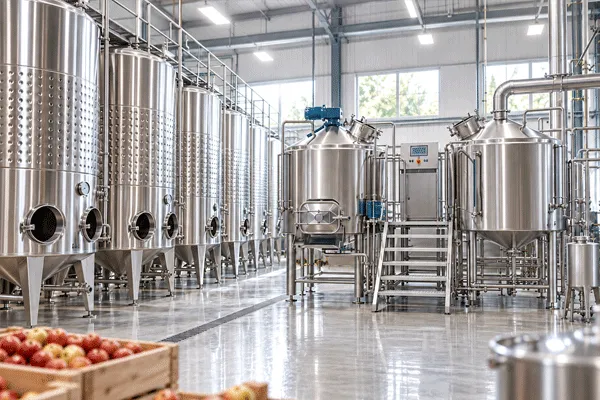
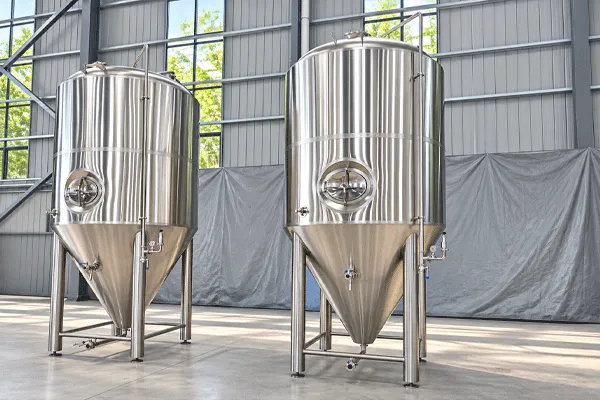
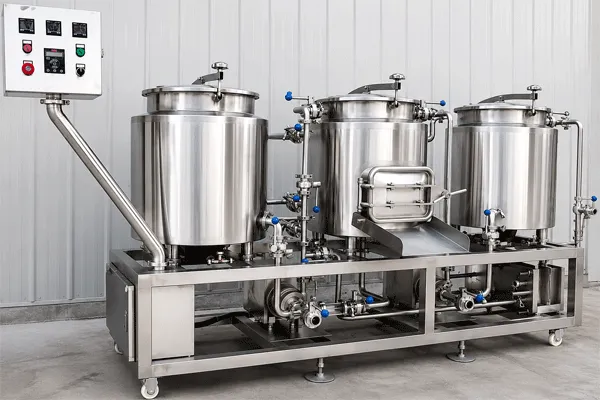
A jacketed fermentation tank controls temperature while yeast converts fermentable sugar into alcohol, aroma compounds, and carbon dioxide. Most modern microbrewery equipment projects use cylindroconical fermenters or unitanks because they support yeast collection, cooling, pressure control, carbonation, and product transfer.
Key fermenter features may include:
- Sanitary stainless steel construction
- Dimple or channel cooling jackets
- Insulation and external cladding
- Pressure and vacuum protection
- CIP spray device
- Vanne d'échantillonnage
- Temperature sensor
- Carbonation port
- Adjustable feet
- Dry-hop port
- Bras de rayonnage
- Yeast discharge outlet
Temperature control is especially important because each recipe may require a different fermentation profile. Jacket design, glycol flow and sensor placement all influence how evenly the tank cools.
As a practical rule, a growing brewery should invest in enough cellar capacity to keep the brewhouse productive. Buying a large brewhouse with too few fermenters may create an expensive system that remains idle for much of the week.
How Many Fermenters Does a Microbrewery Need?
There is no single correct number. The quantity depends on batch size, fermentation duration, conditioning time, brew frequency and sales demand.
Use this simplified planning formula:
Required fermenters = Weekly brewhouse batches × Average tank occupancy in weeks
For example, suppose a brewery completes four batches each week and a typical product occupies its fermenter for three weeks:
4 batches × 3 weeks = 12 fermenters
A safety margin should then be considered for seasonal products, delayed fermentation, cleaning, maintenance and unexpected demand. In this example, 13 or 14 tanks may provide a more practical operating buffer.
Another option is to brew two batches into one larger fermenter. A 10-barrel brewhouse can fill a 20-barrel tank with two turns. This arrangement can increase cellar efficiency, but it requires careful scheduling. The second batch must arrive within an acceptable period, and the brewhouse must support consistent back-to-back production.
Our capacity planning work therefore compares:
- Number of batches per week
- Taux d'occupation moyen des réservoirs
- Number of beer varieties
- Percentage sold through the taproom
- Percentage sent to distribution
- Seasonal demand
- Future volume of beer
- Space available for additional tanks
This calculation helps investors avoid both underbuying and unnecessary early spending.
Do You Need Brite Tanks for Beer Production?
Brite tanks hold beer after fermentation. They can support clarification, carbonation, maturation, storage, quality checks, and final transfer to a packaging system.
A unitank can sometimes perform both fermentation and conditioning. This may reduce the initial pieces of equipment required by a small startup. However, keeping finished beer inside a fermenter also prevents that fermenter from receiving the next brew.
Brite tanks offer several operational benefits:
- They release fermenters for the next production cycle.
- They create a controlled buffer before packaging.
- They help maintain stable carbonation.
- They can supply several packaging formats.
- They can feed taproom serving lines in some layouts.
- They simplify final quality checks before release.
A small brewpub with strong tank-to-tap sales may use serving tanks instead. A distribution-focused operation may need more brite capacity because its canning, bottle filling, and kegging schedules may not match the completion date of each beer.
The best arrangement depends on the business model rather than a universal tank ratio.
What Cooling and Temperature-Control Equipment Is Needed?
A glycol cooling system removes heat from fermentation tanks, brite tanks, cold liquor storage and other process equipment. It normally includes a glycol chiller, reservoir, circulation pumps, insulated piping, valves, tank jackets, sensors and individual temperature controllers.
The chiller should not be selected only by the total number of tanks. Engineers also need to calculate peak cooling load. Several tanks may require cooling at the same time, especially after yeast activity increases or when warm wort enters a fermenter.
The brewery will also need a sanitary plate heat exchanger to cool hot wort before it reaches the cellar. Depending on the water supply and target temperature, the system may use a single-stage or two-stage configuration. Efficient wort cooling can reduce transfer time, support controlled fermentation and recover warm water for later use.
Plate heat exchangers are widely used in beverage processing because they provide efficient heat transfer in a compact unit. Correct plate selection, flow rate, gasket compatibility and cleaning access remain important for reliable operation.
What Water, Heating and Utility Equipment Does a Brewery Need?
Water affects every part of producing beer. It is used as an ingredient, for heating, wort cooling, rinsing, cleaning, packaging and general plant operations.
Depending on the local water analysis, the filtering system may include:
- Sediment filtration
- Activated carbon treatment
- Water softening
- Reverse osmosis
- Mineral adjustment
- UV disinfection
- Storage and distribution equipment
The water system must provide both sufficient quality and adequate flow. A treatment unit may produce suitable water but still fail operationally if it cannot refill the hot liquor tank fast enough between batches.
The brewhouse also requires a heating source. Common choices include electric heaters, steam boilers and direct-fire burners. Steam is often preferred for larger systems because it can provide even heating and support other plant processes. However, it requires boiler space, piping, local approvals, water treatment and trained operation.
Other utilities can include:
- Food-grade compressed air
- Carbon dioxide or nitrogen supply
- Electrical distribution
- Floor drainage
- Ventilation
- Hot water circulation
- Cold-water storage
- Boiler feedwater treatment
- Backup power for critical controls
These supporting systems may not look as impressive as the brewhouse vessels, but they determine whether the brewery can run reliably every day.
Why Are CIP and Sanitary Stainless Steel Equipment Essential?
CIP means clean-in-place. A CIP system circulates water and cleaning chemicals through the inside of a tank, pipe or process component without requiring major disassembly.
A basic CIP cart may include one or more chemical tanks, a sanitary pump, heating, hoses, valves and a control unit. Larger breweries may use automated CIP stations with separate caustic, acid, sanitizer and recovery tanks.
The Brewers Association describes CIP as an essential part of the brewing process because it allows internal equipment surfaces to be cleaned without major disassembly. It also emphasizes that sanitation extends beyond CIP and must cover the entire brewery environment. provide additional guidance.
For product-contact equipment, we focus on hygienic fabrication, smooth internal finishing, suitable weld treatment, drainability, cleanable fittings and minimal product traps. Stainless steel is commonly used in food and beverage processing because of its durability, corrosion resistance and cleanability. Hygienic design principles should also address foreign-material risk, inaccessible areas and surfaces that cannot drain properly.
High-quality equipment should therefore be evaluated from the inside, not only by its polished exterior.
What Packaging Equipment Should a Craft Brewery Buy?
Packaging choices should follow the brewery’s sales model. A taproom may sell most of its output in reusable kegs, while a distribution-focused business may depend on cans or bottles.
Kegging equipment
A basic kegging setup may include:
- Keg washer
- Keg filler
- Keg spear tools
- Product hoses
- CO₂ supply
- Keg storage racks
- Cleaning chemicals
- Pressure testing equipment
Manual equipment may be suitable at low output. Semi-automatic or automatic keg equipment becomes more valuable as labor requirements increase.
Canning equipment
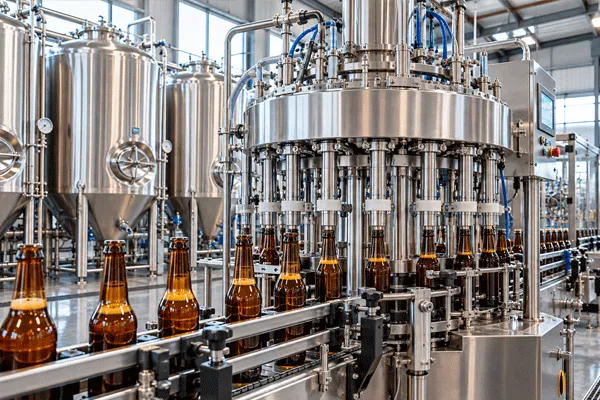
A small canning line may include a depalletizing table, rinsing station, filler, seamer, date coder, labeler, accumulation table and packaging area. Dissolved oxygen control, stable carbonation, product temperature and correct seam adjustment are critical operating considerations.
Bottling equipment
Bottle packaging may require rinsing, filling, capping, labeling, coding and case packing. The brewery must also plan storage for empty containers and finished products.
Selecting packaging equipment based only on its rated speed can create problems. The brewery must also confirm whether upstream beer supply, staffing, labeling, quality checks and downstream packing can support that speed.
The right packaging equipment should match normal daily production rather than an unrealistic maximum number printed in a brochure.
What Automation and Control Equipment Should You Select?
Automation can range from simple digital temperature controllers to a fully integrated brewery system with recipe management, automatic valve sequences and production records.
A basic control panel may manage:
- Vessel temperatures
- Heating stages
- Pump operation
- Agitator speed
- Glycol valves
- Tank cooling
- Liquid levels
- Alarm conditions
More advanced automation can include programmable recipes, variable-frequency drives, touchscreen controls, remote support, batch reports and automated CIP sequences.
The best level depends on labor availability, recipe complexity, production frequency and budget. Full automation is not always necessary for a startup. However, insufficient control equipment can make repeatability difficult and increase operator workload.
We often recommend a scalable control architecture. A new brewery can begin with the functions it needs today while leaving space for additional tanks, sensors, valves and packaging integration later.
What Safety Equipment Does a Microbrewery Need?
Safety equipment must be included in the original project budget. It should not be treated as an optional purchase after installation.
Important items may include:
- Carbon dioxide monitors
- Mechanical ventilation
- Emergency stop controls
- Pressure and vacuum relief devices
- Chemical-resistant gloves and eye protection
- Safety showers and eyewash stations
- Machine guards
- Lockout and tagout provisions
- Non-slip flooring
- Heat-resistant protection
- Warning signs
- Safe working platforms and stairs
- Fire protection
- Confined-space procedures
Fermentation generates carbon dioxide, and CO₂ is also used for carbonation, product transfer and dispensing. Because it is colorless and odorless, workers should not rely on smell to detect it. The Brewers Association recommends calibrated gas monitoring, while OSHA notes that carbon dioxide and other gases may accumulate in enclosed or confined areas.
Tank entry creates additional risks. Powered components, cleaning chemicals, restricted access and oxygen-deficient atmospheres can all be present. The Brewers Association provides brewery-specific guidance on confined-space management and equipment procedures.
Local safety, electrical, pressure-vessel, boiler, building, food-processing and alcohol-production requirements must be reviewed before equipment is ordered.
How Should You Plan a Complete Microbrewery Layout?
A good layout creates a clear product path:
Malt storage → milling → brewhouse → wort cooling → fermentation → conditioning → packaging → finished storage
Operators, ingredients, waste and finished products should move through the facility with as little crossing and backtracking as possible.
The equipment supplier should evaluate:
- Building length, width and ceiling height
- Tank installation route
- Door and loading-bay dimensions
- Column positions
- Floor load capacity
- Drain locations and floor slope
- Electrical service
- Boiler or heating area
- Chiller location
- Ventilation routes
- Chemical storage
- Laboratory area
- Packaging workflow
- Cold storage
- Taproom connection
- Future tank expansion
One common planning mistake is placing every tank close together to save floor space. Operators still need room to access valves, open manways, connect hoses, remove pumps and service cooling components.
Illustrative capacity-planning example
Consider a startup planning the following:
- 10-barrel brewhouse
- Two brew turns per production day
- Three brewing days each week
- Average three-week fermentation cycle
- Keg and can sales
- Planned growth during the second year
The brewhouse can produce up to six batches per week.
6 weekly batches × 3 weeks = 18 batch positions
The buyer could install eighteen 10-barrel fermenters, nine 20-barrel fermenters filled with double batches, or a mixed tank configuration. A mixed design may provide greater flexibility for core products, seasonal recipes and limited releases.
The right answer depends on sales forecasting and recipe scheduling. The calculation gives the engineering team a rational starting point.
How Do You Select a Reliable Brewery Equipment Supplier?
A capable equipment supplier should do more than quote individual tanks. The supplier should help connect capacity, utilities, layout, fabrication, shipping, installation, commissioning and long-term service.
Before sourcing equipment, ask for:
- Detailed vessel drawings
- Material specifications
- Welding and surface-finish information
- Working and design pressures
- Cooling-jacket calculations
- Heating method and required utility loads
- Pump specifications
- Valve and instrument lists
- Control-system descriptions
- Layout drawings
- Installation responsibilities
- Testing and inspection procedures
- Spare-parts recommendations
- Warranty terms
- Remote and on-site support options
The lowest initial quotation may exclude important pieces you’ll need, such as platforms, piping, controls, insulation, valves, freight preparation, commissioning or spare parts.
When selecting equipment, compare the complete project scope instead of the price of a single tank.
As a professional brewery and beverage equipment manufacturing plant, we provide customized brewhouses, fermentation tanks, cellar systems and turnkey brewery solutions for global B2B customers. Our engineering process can cover equipment sizing, production layout, utility coordination, stainless steel fabrication, control integration, factory testing, installation guidance and after-sales support.
The same manufacturing approach can also support kombucha, cider, wine, distilled beverages and cold brew coffee projects, with appropriate changes to the process, tanks, temperature requirements and sanitary configuration.
Foire aux questions
How much space is needed to start a microbrewery?
The required space depends on production capacity, tank quantity, packaging format, storage requirements and whether the property includes a taproom. Do not calculate only the physical footprint of the tanks. Include operating aisles, maintenance access, raw-material storage, finished-goods storage, cold rooms, utility areas, chemical storage, drainage and future expansion.
Can a microbrewery start with only a brewhouse and fermenters?
No. The brewhouse and fermenters are the most visible items, but they cannot operate alone. The brewery also needs cooling, heating, water supply, pumps, piping, controls, cleaning equipment, quality-control tools, safety systems and a method of packaging or serving the beer.
Should I buy new or used brewery equipment?
Used brewery equipment can reduce the purchase price, but buyers should inspect vessel condition, welds, cooling jackets, controls, pressure ratings, fittings and replacement-part availability. Moving and modifying used equipment may also add hidden costs. New customized equipment offers better control over capacity, layout, utilities and future integration.
What size brewhouse is best for a startup brewery?
Many startup projects consider systems between 3 and 20 barrels, but the right size depends on the business plan. A brewpub with direct on-site sales may operate successfully with a smaller system. A brewery supplying distributors may need larger batches, more cellar capacity and faster packaging.
Calculate expected weekly sales, brew days, turns per day and tank occupancy before choosing the brewhouse.
Is a two-vessel or three-vessel brewhouse better?
A two-vessel system costs less and uses less space, making it suitable for many startups. A three-vessel system separates more brewing steps and can improve scheduling and daily output. The better option depends on how often you plan to brew, the number of daily turns and your expected growth.
How early should brewery equipment planning begin?
Begin planning before finalizing the building. Tank height, drainage, electrical supply, steam, ventilation, water treatment, glycol piping and installation access can affect property selection and construction costs.
In the United States, breweries must also complete applicable federal, state and local qualification processes. TTB maintains brewery application and operating guidance, including production-record requirements.
Final Microbrewery Equipment Checklist
Before opening a brewery, remember these key points:
- Start with the production plan. Define annual output, batch size, beer styles and sales channels before buying machinery.
- Balance the brewhouse and cellar. More brew capacity is not useful without enough fermentation space.
- Plan the utilities early. Confirm water, heating, electricity, glycol, compressed air, drainage and ventilation.
- Protect product quality. Choose sanitary, cleanable and properly designed product-contact equipment.
- Include CIP from the beginning. Cleaning systems are central to consistent beer and efficient operation.
- Match packaging to the market. Choose kegs, cans, bottles or a combination based on real sales demand.
- Design for safe operation. Include gas monitoring, pressure protection, ventilation and safe chemical handling.
- Leave room for growth. Reserve space, utility capacity and control-system connections for future tanks.
- Compare complete project scope. Review drawings, specifications, installation, testing, service and spare parts—not only price.
- Choose an experienced partner. A reliable supplier can coordinate the entire project and reduce technical, installation and startup risks.
A successful brewery does not come from buying the largest available tanks. It comes from building a balanced production system in which every vessel, pump, utility, control and packaging machine supports the same business goal.
By planning the right equipment you’ll need from the beginning, you can protect the quality of your beer, reduce avoidable downtime and create a brewery that grows with your market.
For a customized brewery equipment proposal, prepare your target batch size, expected annual capacity, product types, packaging formats, building drawing and preferred automation level. These details allow our engineering team to develop a practical brewhouse, fermentation, utility and packaging solution around your actual production requirements.