Starting a brewery sounds exciting, but large equipment, high rent, and unused capacity can turn a good beer idea into an expensive project. A nano brewery lowers the entry scale, letting brewers test recipes, build a local market, and grow production with less equipment and space.
A nano brewery is a very small commercial brewery that produces beer in small batches, often using a salle de brassage of about 1–3 barrels. There is no universal legal definition of “nano brewery,” so production limits vary by location. Nano breweries are generally smaller than microbreweries and often sell craft beer directly through taprooms, brewpubs, local bars, restaurants, or limited keg distribution.
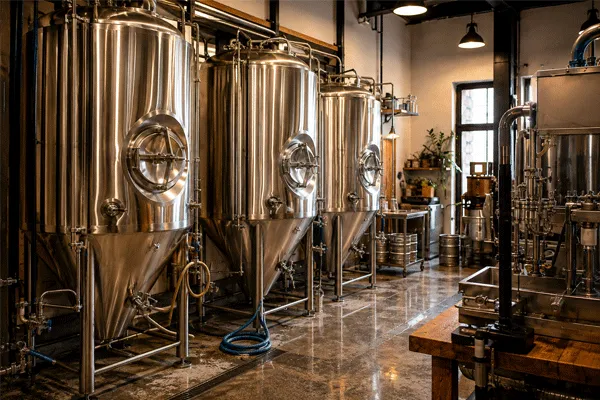
If you are a home brewer planning your first commercial project, a beverage startup testing a market, or an investor comparing brewery sizes, the word nano can be confusing.
How small is small? Is a nanobrewery legally different from a microbrewery? How many tanks do you need? Can such a tiny brewery actually make money?
As a professional brewery and beverage equipment manufacturing plant, we work with customers planning everything from compact nano breweries to larger commercial breweries. In our experience, the best project does not start by asking, “What is the biggest brewing system I can afford?”
It starts with:
How much beer can I realistically sell, and what brewery size supports that sales plan?
That question changes everything.
What Is a Nano Brewery?
A nanobrewery is a very small commercial brewery built around low production volumes and small batch brewing.
There is no single worldwide production limit that makes a brewery “nano.” In everyday craft brewing, the term usually describes a brewery that is smaller than a conventional microbrewery and often uses a compact salle de brassage, commonly around one to three barrels per brew cycle.
That equipment range is an industry practice, not a universal legal rule.
A U.S. beer barrel equals 31 U.S. gallons, according to the Alcohol and Tobacco Tax and Trade Bureau.
So, as a simple example:
| Brewhouse Size | Approx. Wort per Full Batch |
|---|---|
| 1 baril | 31 gallons |
| 2 barils | 62 gallons |
| 3 barils | 93 gallons |
| 5 BBL | 155 gallons |
| 7 barils | 217 gallons |
Actual finished beer produced will usually be lower than the theoretical vessel volume because of losses during transfers, trub removal, fermentation, packaging, and cleaning.
The main idea is simple: nanobreweries are small commercial operations that use compact brewing equipment to produce limited amounts of beer.
They sit somewhere between serious home breweries and larger professional production breweries.
Is “Nano Brewery” an Official Legal Brewery Classification?
Usually, no.
The word nano is widely used in the brewing industry, but regulators do not apply one universal definition across every country or even every U.S. state.
At the U.S. federal level, the TTB focuses on whether you commercially produce beer, not whether your marketing description says nano or micro. If you intend to brew beer for sale, you generally need to qualify with TTB through a Brewer’s Notice before starting operations.
State rules can be different.
For example, New Hampshire law specifically created a nano brewery license for businesses producing no more than 2,000 barrels of beer annually. That is a state-specific legal definition, not a national standard.
This is important if you plan on opening a nanobrewery.
Never assume that because another brewery calls itself nano, the same licensing, production, tasting-room, distribution, or off-site sales rules apply to your location.
Before equipment purchasing, confirm:
- Federal requirements
- State or provincial licenses
- Local zoning
- Building and fire codes
- Health department requirements
- Wastewater rules
- Alcohol distribution rules
- Taproom permissions
- Packaging and labeling requirements
The brewery may be tiny.
The legal work is still commercial.
What Is the Difference Between a Nano Brewery and a Microbrewery?
The main difference between nano brewery and microbrewery operations is scale.
A nano brewery normally operates at the smallest commercial level. A microbrewery has more production capacity, more fermentation volume, and often a wider distribution network.
In the United States, the Brewers Association currently defines a microbrewery as a brewery that produces less than 15,000 barrels per year and sells 75% or more of its beer off-site.
Compare that with the practical nano model:
| Facteur | Nano Brewery | Microbrasserie |
|---|---|---|
| Typical scale | Very small | Small to medium |
| Typical brewhouse | Often 1–3 BBL, sometimes larger | Often larger systems |
| Batch frequency | High relative to capacity | More volume per batch |
| Main market | Taproom/local | Local + distribution |
| Staff | Very small team | Larger production team |
| Capital need | Inférieur | Plus élevé |
| Recipe flexibility | Very high | Élevé |
| Distribution | Limited | Often more developed |
| Expansion need | Can come quickly | More initial capacity |
The key phrase is smaller than micro.
However, a nano brewery is not simply a miniature microbrewery. Its business model often works differently.
A microbrewery can send substantial quantities to wholesalers, retailers, and restaurants.
A nano operator may depend much more on selling directly to consumers, where each pint can demand a higher price than beer sold wholesale.
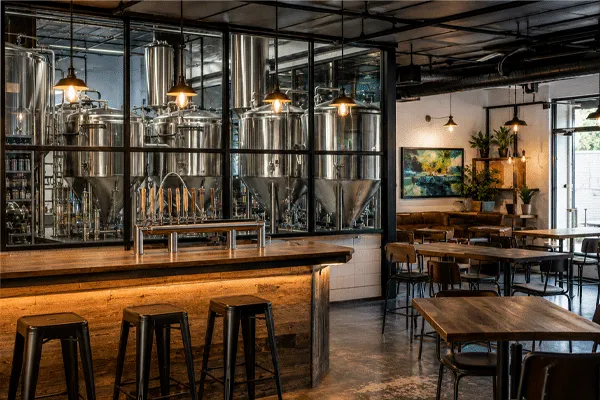
Is a Nano Brewery the Same as a Brewpub?
No, although the two models can overlap.
A brewpub combines beer production with a restaurant or substantial food-service operation. The Brewers Association defines a brewpub as a restaurant-brewery that sells 25% or more of its beer on-site and operates significant food services.
A nano brewery describes production scale.
A brewpub describes more of a business model.
That means you could have:
- A nano brewery with a small taproom
- A nano-scale brewpub with food
- A production nanobrewery supplying local accounts
- A microbrewery with a taproom
- A larger brewpub with significant production
Many small operators choose a taproom-focused model because direct sales can improve margins.
Instead of sending every keg through wholesale distribution, the brewer can sell their beer directly by the glass.
That can be attractive—but the brewery must then operate two businesses at once:
Beer manufacturing + hospitality
Do not underestimate the second part.
Why Do Brewers Start Nano Breweries?
The biggest advantage is not simply lower equipment cost.
It is controlled risk.
A startup rarely knows exactly how much demand it will have in year one.
A compact nano brewing system lets the team enter the market, collect customer feedback, and refine recipes before committing to much larger production equipment.
Common reasons include:
- Lower initial capital
- Smaller building requirement
- More frequent recipe changes
- Easier local sales strategy
- Direct interaction with customers
- Lower inventory risk
- Ability to experiment with different beer styles
- Gradual transition from home brewing to commercial brewing
This is particularly useful for home brewers who already know how to make good beer but have not yet proven that customers will buy it consistently.
A hobby brewer may enjoy making 10 different recipes.
A commercial brewer must ask a harder question:
Which three beers sell fast enough to pay the rent?
Nano scale gives you room to learn.
How Does the Nano Brewing Process Work?
The basic brewing process is the same process used by many larger breweries.
Scale changes.
The science does not.
A typical process looks like:
Malt → Milling → Mashing → Lautering → Boiling → Whirlpool → Cooling → Fermentation → Conditioning → Packaging
1. Milling and mashing
The brewer crushes malt and mixes it with heated brewing water.
During mashing, enzymes convert grain starches into fermentable sugars.
2. Lautering
The brewer separates sweet liquid from the grain.
This liquid is called wort.
3. Ébullition
The wort is boiled and hops are added according to the recipe.
Boiling also helps sterilize the wort and drive off unwanted volatile compounds.
4. Whirlpool and cooling
After boiling, solids are separated and the hot wort must be cooled rapidly to the correct yeast-pitching temperature.
5. Fermentation
The cooled wort enters a sanitary stainless steel fermenter.
Yeast converts fermentable sugars into alcohol, carbon dioxide, and many flavor compounds.
6. Conditioning and packaging
Depending on the type of beer, conditioning may take place in the fermenter, brite tank, or another vessel.
The finished beer may then go into:
- Kegs
- Boîtes
- Bottles
- Serving tanks
An ale may move through production relatively quickly.
A lager may need more tank time.
That affects equipment sizing far more than many first-time owners expect.
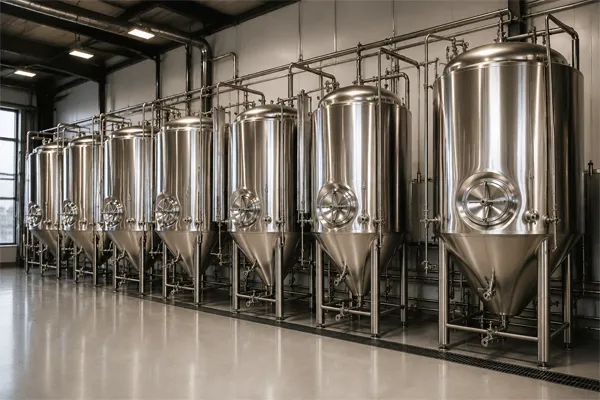
What Brewing Equipment Does a Nanobrewery Need?
A tiny brewery still needs real sanitary commercial equipment.
Reducing vessel size should not mean reducing process quality.
A practical nano system may include:
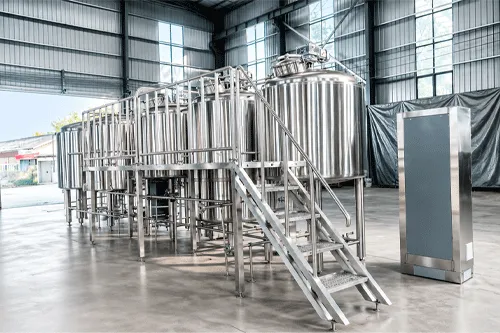
Brasserie
A compact brewhouse may combine several functions into two or three vessels.
Common configurations include:
- Mash/lauter tun + kettle/whirlpool
- Mash/kettle + lauter tun
- Three-vessel systems for more operational flexibility
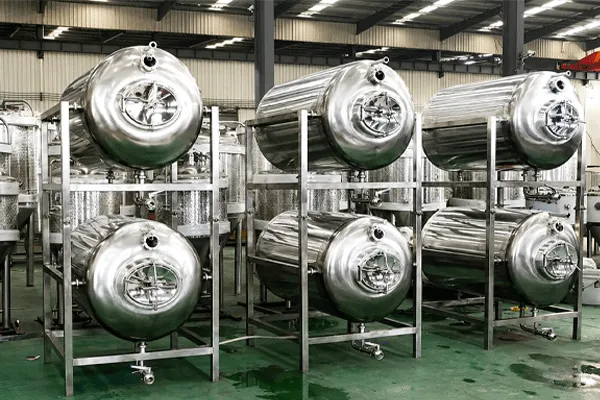
Cuves de fermentation
Your fermentation capacity often limits production before the brewhouse does.
A brewery that can brew every day but has nowhere to put the wort cannot increase output.
Supporting equipment
A complete system may also need:
- Hot liquor tank
- Cold liquor tank
- Glycol chiller
- Échangeur de chaleur
- Pumps
- Hose sets
- CIP equipment
- Water treatment
- Keg washer
- Filling equipment
- Controls
- Laboratory tools
- Compressed gas system
Simplified equipment flow
| Scène | Main Equipment |
|---|---|
| Grain handling | Mill |
| Écrasement | Mash vessel |
| Filtration | Lauter tun |
| Ébullition | Kettle |
| Whirlpool | Whirlpool vessel |
| Refroidissement | Plate heat exchanger |
| Fermentation | Cuves de fermentation |
| Refroidissement | Glycol system |
| Conditioning | Fermenter or brite tank |
| Packaging | Keg/can/bottle equipment |
| Sanitation | Système CIP |
As an equipment manufacturer, we often spend more time discussing fermentation capacity than explaining the shiny brewhouse.
Why?
The tanks determine how much beer your brewery can keep in process at one time.
That can control the true production capacity.
How Many Fermentation Tanks Does a Nano Brewery Need?
There is no fixed answer.
You need to work backward from your expected sales.
Suppose a brewer uses a 3-BBL brewing system.
If the brewery produces one full batch at a time but owns only two fermenters, the production calendar becomes tight very quickly.
Now imagine six fermentation tanks.
The brewer has much more flexibility to:
- Keep core beer available
- Rotate seasonal beer
- Test recipes
- Allow longer fermentation
- Brew several times per week
This is why tank planning should consider:
sales volume × fermentation time × brewing frequency
Not just brewhouse size.
For example, producing an IPA, wheat beer, stout, and lager may require very different tank schedules.
The amount of beer sold per week should therefore guide the number and size of fermenters.
If sales are 5 BBL per week but your brewery can only release 3 BBL, you have a production problem.
If sales are 2 BBL per week and the facility makes 10 BBL, you have an inventory problem.
Neither is ideal.
How Much Beer Can a Nano Brewery Produce?
Production varies enormously.
A small brewhouse does not automatically mean low annual output because breweries can perform multiple brew cycles.
A 3-BBL system brewed once per week has very different annual potential from the same system brewed twice per day, several days per week.
A useful planning equation is:
Batch size × brews per week × operating weeks = theoretical annual volume
But theoretical capacity is not real capacity.
Actual output is constrained by:
- Cuves de fermentation
- Style de bière
- Labor
- Cleaning time
- Packaging speed
- Raw material storage
- Cold storage
- Sales
- Local operating hours
Remember that one U.S. beer barrel equals 31 gallons.
If a local rule limits a brewery to a certain number of barrels per year, use the regulatory definition rather than your equipment’s nominal capacity.
For example, New Hampshire’s nano license uses a maximum of 2,000 barrels of beer per year.
That does not mean every nanobrewery around the world makes 2,000 barrels of beer annually.
Many produce far less.
Can a Nano Brewery Be Profitable?
Yes, but small equipment does not automatically create a profitable business.
A nano brewery has lower production volume, so the margin on each unit of beer matters greatly.
This is why direct sales can be important.
Compare two simple models:
Model A: Mostly wholesale
The brewery produces beer and sells kegs to bars and restaurants.
Advantages:
- Wider market
- Less taproom operation
- Potential brand visibility
Challenges:
- Lower revenue per unit
- Distribution cost
- More packaging
- Higher logistics effort
Model B: Mostly direct taproom sales
Customers drink beer at the brewery.
Advantages:
- Higher revenue per volume
- Direct customer feedback
- Strong local brand
- Less external distribution
Challenges:
- Hospitality labor
- Rent in a customer-friendly location
- Furniture and taproom investment
- Marketing
- Longer opening hours
The better model depends on local demand.
A solid business plan should calculate beer volume first, then work backward to equipment.
Do not buy equipment and then hope customers appear.
How Much Capital Do You Need to Start a Nano Brewery?
There is no useful universal price.
The amount of capital needed depends on far more than the brewing tanks.
Your budget can include:
- Brewing equipment
- Fermenteurs
- Cooling system
- Packaging
- Building renovation
- Drainage
- Electrical service
- Steam or electric heating
- Water treatment
- Cold room
- Taproom
- Permits
- Professional services
- Livraison
- Installation
- Raw materials
- Working capital
This is where many startup budgets fail.
The founder asks for the price of a 3-BBL brewing system and assumes that figure represents the project budget.
It does not.
The brewing system may be only one part of the investment.
A good business plan should separate:
Equipment CAPEX + building CAPEX + startup expenses + operating cash
That gives a much clearer picture.
What Facility Layout Works Best for a Nano Brewery?
A small brewery needs good layout even more than a large brewery.
Why?
Because every square foot matters.
A badly placed fermenter can block a walkway. A poorly located drain creates cleaning problems. Long hose runs slow down transfers.
A practical layout should consider:
- Raw material entry
- Grain milling
- Brewhouse position
- Fermenteurs
- Cold storage
- Packaging
- Finished beer storage
- Chemical storage
- CIP
- Drainage
- Staff movement
- Customer separation
- Développement futur
The product flow should feel natural:
Raw material → Brew → Ferment → Condition → Package → Store → Sell
Try to avoid crossing clean and dirty flows.
This is especially important during cleaning and sanitizing.
Sanitary stainless steel tanks are valuable, but sanitation depends on the complete process—not the tank surface alone.
Nano Brewery vs Larger Brewery: Which Is Right for You?
Do not assume smaller is always safer.
Nano scale has clear advantages, but very small systems require more labor for every barrel produced.
Imagine producing 30 BBL in a week.
With a 3-BBL system, that may require many brew cycles.
A 15-BBL system can produce the same volume of beer with far fewer cycles.
That is why larger breweries gain labor efficiency.
Nano advantages
- Lower startup scale
- Flexible recipes
- Less inventory exposure
- Easier market testing
- Direct community connection
Nano disadvantages
- High labor per barrel
- Limited tank capacity
- Small packaging runs
- Growth can quickly exceed capacity
- Wholesale economics can be difficult
Larger brewery advantages
- More efficient production
- Lower labor per unit
- Better distribution capacity
- Greater packaging efficiency
Larger brewery disadvantages
- Higher capital
- More space
- More working capital
- Greater sales pressure
There is a reason commercial breweries operate larger systems.
But there is also a reason nano breweries continue to exist.
The right scale depends on the business.
How Is a Nano Brewery Different From Craft Breweries in General?
“Craft” is not a synonym for “nano.”
The Brewers Association currently defines an American craft brewer as small and independent, with “small” meaning annual production of 6 million barrels of beer or less.
That is an enormous range.
A tiny 2-BBL local nanobrewery and a company producing hundreds of thousands of barrels may both fit within the broad craft category if they meet the applicable definition.
So:
Craft = business/industry classification
Nano = very small production scale
A nano brewery can be a craft brewery.
But most craft breweries are not nano breweries.
Likewise, the Brewers Association has separate market segments for microbreweries, brewpubs, taproom breweries, regional breweries, contract brewing companies, and alternating proprietors.
This reinforces an important point:
Do not choose equipment based on the label you give your brewery. Choose it based on production and sales.
What Should You Know Before Starting a Nanobrewery?
If you want to start a nano brewery, begin with the market.
Not the tanks.
We recommend answering these questions first:
- How many barrels can you realistically sell per month?
- What percentage will sell on-site?
- Will you distribute?
- How many styles of beer will you keep available?
- How long will each style occupy a fermenter?
- How many brewing days can your team manage?
- What is your available floor area?
- What utilities are available?
- What licensing applies?
- Where will expansion equipment go?
Then select the equipment.
For starting a nanobrewery, we normally build the production model around three numbers:
Batch size + monthly sales + fermentation time
These numbers help determine:
- Brewhouse capacity
- Nombre de fermenteurs
- Brite tank size
- Chiller load
- Hot-water demand
- Packaging requirements
That is much safer than ordering a standard equipment package because another local brewery uses it.
A Practical Nano Brewery Equipment Planning Example
Consider a startup with a small taproom.
The owners expect to sell several core beers plus rotating seasonal batches.
They want a compact 3-barrel brewhouse.
Instead of simply supplying the brewhouse, we would ask:
- How many brew days per week?
- How many beers on tap?
- What is expected weekly consumption?
- Will double-batching be needed?
- Will beer be served from kegs or brite/serving tanks?
- Will any beer go off-site?
- Do you plan to expand?
The final project might require more fermentation capacity than the founders expected.
This is common.
A good nano project should have room to grow without forcing the owner to replace the entire brewery after one successful year.
As a professional stainless steel brewery equipment manufacturer, this is where customized planning adds value. We can adapt:
- Tank dimensions
- Brewing capacity
- Méthode de chauffage
- Fermenter quantity
- Controls
- Pipe routing
- CIP configuration
- Mise en page
- Packaging interface
A nano system should be small.
It should not be short-sighted.
FAQs About Nano Breweries
How small is a nano brewery?
There is no universal size definition. In industry practice, many nano breweries operate very small brewhouses, often around 1–3 BBL, although some use larger systems. Local laws may define nano differently.
Is a nano brewery smaller than a microbrewery?
Yes, in common industry usage. A nano brewery generally operates below typical microbrewery production scale. The Brewers Association defines a U.S. microbrewery as producing less than 15,000 barrels annually while selling at least 75% of its beer off-site.
Can a nano brewery sell beer commercially?
Yes, if it has the required approvals and licenses. In the U.S., businesses producing beer for sale generally must qualify with TTB through a Brewer’s Notice and comply with state and local requirements.
How many barrels does a nano brewery produce?
There is no universal limit. Production can range from very small volumes to hundreds or more barrels per year. Some jurisdictions create their own rules; New Hampshire, for example, uses a 2,000-barrel annual limit for its nano brewery license. e different beer styles?
Yes. Small systems are especially useful for brewers who want to create a range of beers, test seasonal recipes, and make small batches of beer. The main constraint is fermentation and tank availability.
Is nano brewing a good step for home brewers?
It can be, but commercial brewing is very different from home brewing. A professional brewery must manage licensing, sanitation, taxes, production records, safety, sales, packaging, and business operations in addition to making good beer.