





David Zhang | Founder & CEO, ZPET | Published August 21, 2026
What Is a Bright Tank, Exactly?
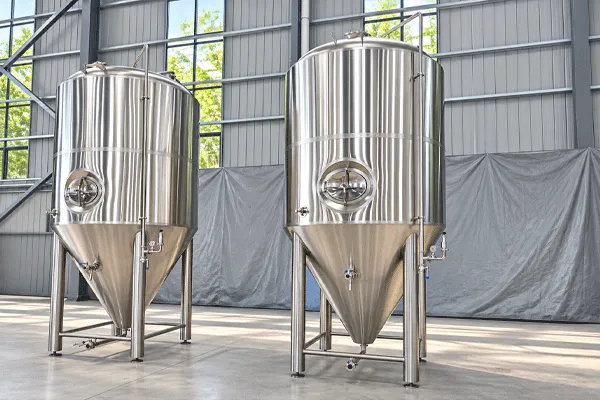
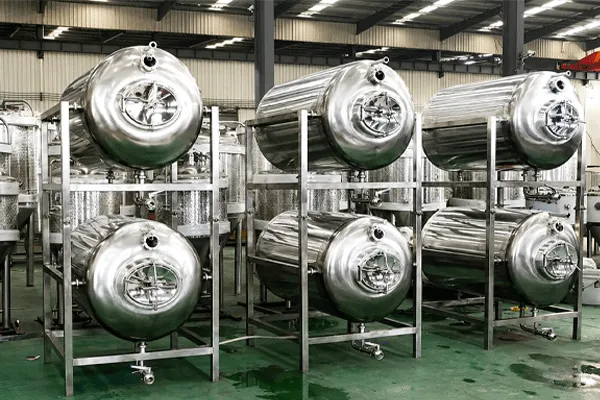
A bright tank — also called a brite tank or BBT — is the pressure-rated stainless vessel where beer goes after fermentation and filtration: carbonating, clarifying, and holding cold until it’s ready for kegs, cans, or bottles. It isn’t a second fermenter. It’s a holding and finishing stage most breweries above nano scale eventually add.
The beer arrives from the fermenter already through primary (and sometimes secondary) fermentazione, with most of the active yeast work done. From there it typically passes through a plate or centrifugal filter, or simply settles, before landing in the bright tank. Inside, three things happen more or less at once: dissolved CO2 comes up to the target carbonation level, remaining haze particles and trub drop out of suspension, and the beer sits at serving temperature long enough for flavor to settle. None of that requires the tank to do biological work, which is the main reason bright tanks don’t need the cone geometry, larger headspace, or blow-off provisions that fermenters do.
Bright Tank vs. Fermenter: Where the Line Actually Sits
The two vessels look similar from across the room, and that’s where a lot of confusion starts. The differences that actually matter for sizing and spec decisions are narrower than most guides suggest.
| Dimension | Fermenter | Serbatoio luminoso |
| Primary job | Convert sugar to alcohol via active yeast | Carbonate, clarify, hold at serving temperature |
| Typical dwell time | 1–3 weeks, style-dependent | 1–5 days |
| Internal pressure | Low during active fermentation, spunded only if used for carbonation | Rated for carbonation pressure throughout |
| Bottom geometry | Steep cone, sized for yeast harvest | Shallow dish, sized for trub, not biomass |
| Cooling load | Peaks during active fermentation, then tapers | Steady, tied to serving temperature |
Because the bright tank’s job is shorter and less variable, one bright tank commonly serves several fermenters in rotation. A batch that spends two to three weeks fermenting might clear and carbonate in a bright tank in two to five days, depending on style and CO2 target. That turnover gap is the practical reason craft breweries usually run more fermenters than bright tanks on the floor.
Skipping the Bright Tank: When It’s a Reasonable Call
Not every brewery needs one. Nano operations packaging directly into growlers, and brewpubs serving beer on-premise, sometimes condition and carbonate in the same vessel they fermented in, using a shortened cold crash and in-line carbonation instead of a dedicated finishing tank. Hazy or unfiltered styles — some New England IPAs, a handful of farmhouse ales — are sometimes packaged with visible yeast still in suspension, which removes part of the case for a clarification step altogether.
The trade-off is throughput and consistency, not quality. Skipping the bright tank ties up a fermenter for longer per batch cycle, and batch-to-batch carbonation control tends to drift more without a dedicated pressure-rated finishing stage. For a one-BBL brewpub pouring three beers a week, that’s rarely a problem. For a production brewery filling cans on a fixed schedule, it usually becomes one.
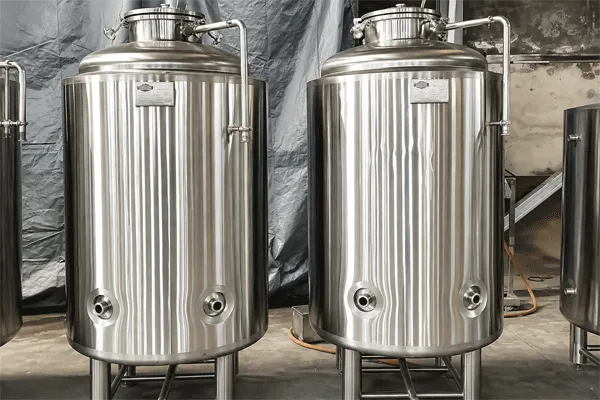
Sizing a Bright Tank in Four Steps
Sizing gets treated as a lookup-table exercise more often than it should. It’s closer to a scheduling problem.
- Confirm your packaging cadence.How much volume do you package per cycle, and how often — daily, twice weekly, weekly?
- Set your bright-tank dwell time.Carbonation plus cold conditioning typically runs 2–5 days depending on beer style and CO2 target; lagers and highly carbonated styles sit at the longer end.
- Calculate concurrent volume.Multiply your packaging volume per cycle by the dwell time in days, then divide by the cycle length in days. A brewery packaging 2,346 L (approx. 20 BBL) every 7 days with a 3-day average dwell needs roughly 1,006 L (approx. 8.6 BBL) of bright tank capacity in the system at any point. (Capacity figures here follow the Brewers Association’s standard BBL conventions used across the craft segment.)
- Round up and check headspace.Standard tank sizes rarely land on the exact number from step 3 — round up to the next available size, and leave headroom for CO2 backpressure rather than filling to the brim.
This produces a working capacity figure, not a shopping-cart size. Buffer for growth, seasonal spikes, or a second product line gets added on top, not folded into the base calculation.
ZPET Bright Beer Tank Construction and Spec Sheet
Most bright tank guides stop at explaining carbonation and clarification in general terms, without listing what’s actually inside the vessel wall. That’s the gap a spec sheet is supposed to close.
| Spec | ZPET Bright Beer Tank |
| Shell material | SS304 / SS316L per uso sanitario |
| Finiture interne | Lucidatura a specchio da 0,4 μm |
| Raffreddamento | Camicia di raffreddamento a fossette |
| Access | Optional side manway |
| Welding method | TIG / double-sided argon arc welding, CNC laser-cut components, automatic welding robots on shell seams |
| Pre-shipment testing | 24-hour pressure hold test, X-ray weld inspection, spectrometer material verification, 5-step QC |
| Garanzia strutturale | 10 anni |
| Compliance | Engineered to meet PED (CE), UL/cUL (control panels), and AS1210 (Australia) requirements |
| Risposta tecnica | Within 24 hours / 1 working day |
The 0.4 μm figure sits at the smoother end of the surface-finish ranges referenced in ASME BPE’s hygienic-piping framework, the standard most sanitary vessel fabricators build interior polish specs against. It matters less as a marketing number and more as something you can actually verify: ask any supplier for their Ra measurement method, not just the μm figure on a brochure.
ZPET builds bright tanks to this same construction standard as its serbatoi di fermentazione, across 200+ installations in 40+ countries, mostly for buyers in North America, Europe, and Australia. Fabrication happens at a 5,000 m² facility staffed by 20+ senior engineers and brewmasters.
Five Mistakes That Show Up After Installation
- Matching bright tank volume to fermenter volume, one to one.This ignores the dwell-time gap between the two vessels and usually leaves a bright tank oversized while the bottleneck shows up somewhere else in the line.
- Dropping the side manway to save on cost.Cleaning and inspecting a tall bright tank through the top manway alone gets awkward fast, especially once dimple jackets and insulation are in place.
- Treating “0.4 μm polish” as interchangeable across suppliers.The polish figure alone says nothing about the welding method or whether welds were X-ray inspected before the tank shipped. Ask for both.
- Confusing carbonation pressure rating with racking or transfer pressure.A tank rated for steady carbonation pressure isn’t automatically rated for the pressure spikes of a fast transfer through a small-diameter line.
- Assuming the structural warranty covers everything bolted to the tank.Jacket, valves, and instrumentation typically carry separate component warranty terms. Get those in writing at quote stage, not after delivery.
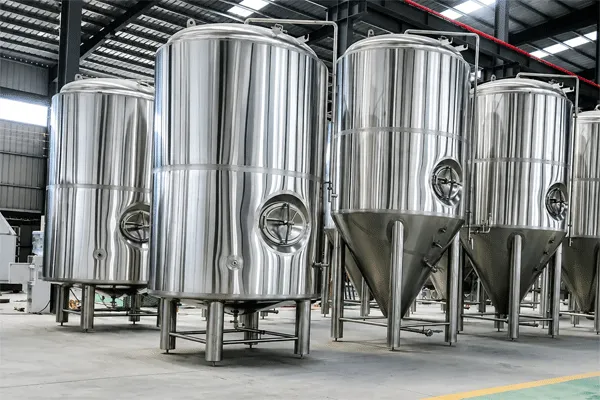
Compliance and the 10-Year Warranty: What “Engineered to Meet” Actually Means
“Engineered to meet PED (CE)” and “PED certified” are not the same claim, and the difference has legal weight. Certification means a third-party body has issued a certificate against a specific standard. Engineered to meet means the design and fabrication follow that standard’s requirements without a third-party certificate attached. ZPET’s bright tanks are built to meet PED (CE), UL/cUL, and AS1210 requirements. Buyers who need a certificate rather than a compliant design should confirm which one they’re actually asking for before signing a contract, since the two aren’t interchangeable on customs paperwork.
The 10-year structural warranty follows the same logic: it’s backed by the welding method, material grade, and pre-shipment pressure testing listed above, not issued as a standalone promise. A warranty claim on a tank built with single-pass welding and no pressure hold test is a different conversation than one built with double-sided TIG welding and a documented 24-hour hold.
Trade-offs Worth Weighing Before You Buy
A dedicated bright tank buys shorter fermenter turnaround, steadier carbonation, and a shorter path to packaging-ready beer. It also adds a vessel, a CIP cycle, a glycol or refrigerant load, and a floor footprint that a smaller brewery might not have room for. For a brewpub running under five barrels a week, that added infrastructure sometimes costs more in floor space and cleaning time than it saves in fermenter availability. For a brewery packaging on a fixed weekly schedule, the calculation usually flips the other way once volume crosses roughly 15–20 BBL a week, since fermenter availability starts constraining how many recipes can run in parallel.
What a Bright Tank Costs
ZPET doesn’t publish a price list for bright tanks, or for any product line, and neither do most manufacturers selling direct. Tank cost moves with shell diameter, jacket configuration, manway placement, insulation, and whether automation (PLC/HMI control) is specified, so a single number on a webpage would be misleading either way. What does hold across quotes is the pricing structure: factory-direct pricing without a distributor markup between the fabrication shop and the buyer, with material and labor costs quoted against the actual spec sheet rather than a size chart. Getting an accurate number means sending the packaging cadence and target capacity from the sizing steps above to an engineering team directly, not comparing catalog prices across supplier websites.
One variable this piece hasn’t touched: CO2 supply capacity. A brewery scaling up bright tank count without checking bulk CO2 tank size or generator throughput usually just moves the bottleneck instead of removing it — that’s typically the next conversation once bright tank sizing itself is settled.
Domande frequenti
Q: What’s the difference between a brite tank and a bright tank?
A: None. Brite tank, bright tank, and BBT (bright beer tank) all describe the same vessel; the spelling varies by region and supplier, not by function.
Q: How long does beer typically stay in a bright tank?
A: Most batches spend 1 to 5 days in a bright tank, depending on beer style and target carbonation level, compared to 1 to 3 weeks of active fermentation for the same batch.
Q: Can I carbonate and condition beer without a bright tank?
A: Yes. Some nano breweries and brewpubs condition and force-carbonate in the same vessel used for fermentation, at the cost of tying that fermenter up longer per batch and looser carbonation control.
Q: What size bright tank do I need for a brewery packaging 15 BBL a week?
A: Using a 3-day average dwell time, roughly 750 L (approx. 6.4 BBL) of concurrent bright tank capacity, then rounded up to the nearest standard tank size with headroom added for CO2 backpressure.
Q: Does a bright tank need the same pressure rating as a fermenter used for spunding?
A: Not necessarily. A bright tank is rated for steady carbonation pressure throughout its use, while a spunded fermenter is only pressure-rated during the final stage of fermentation, so the two ratings serve different points in the process.
Q: Is ZPET’s 10-year warranty on a bright tank the same as its warranty on a fermenter?
A: Yes, both product lines carry the same 10-year structural warranty, backed by identical materials, welding method, and pressure testing. Component parts like jackets and valves follow separate terms confirmed at order.