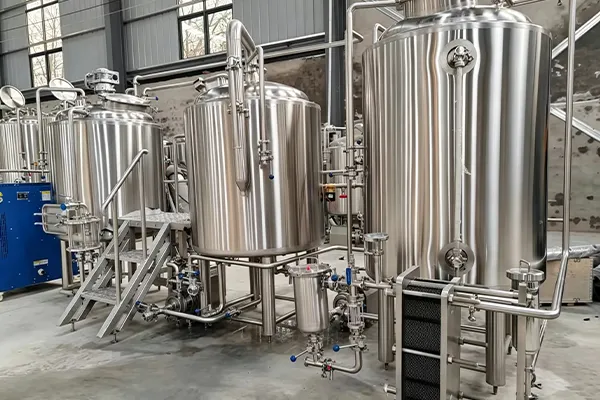
A 10 BBL brewhouse can brew plenty of wort, but production stops quickly when every fermenter is full. Too few tanks create idle brew days. Too many waste money and floor space. The answer comes from matching tank count to your real brewing schedule.
Most 10 BBL breweries may need about 4–10 fermentation tank positions when brewing 2–5 batches per week with roughly a two-week tank cycle. The exact number depends on fermentation time, beer style, tank size, brite tank use, cleaning time, packaging, and spare capacity. Calculate tank positions from weekly brews × total tank occupancy time.
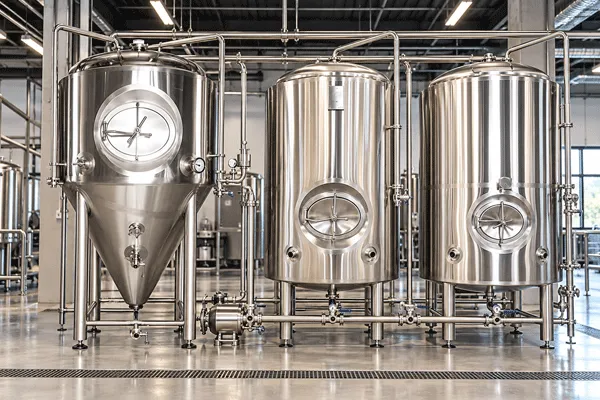
1. How Many Fermentation Tanks Does a 10 BBL Brewery Need?
There is no fixed number of fermentation tanks that every 10 BBL brewery needs. Two breweries can use the same brewhouse but require very different cellar layouts.
A brewpub making two batches per week may operate well with four or five 10 BBL fermenters. A production brewery running five batches every week may need ten or more tank positions if beer stays in each tank for about two weeks.
A useful first calculation is:
Basic fermenter positions = Brews per week × Tank occupancy days ÷ 7
Then round up when needed.
For example:
3 brews/week × 14 days ÷ 7 = 6 fermenter positions
This means six 10 BBL tanks could theoretically support the brewing schedule if each brew fills one fermenter and each tank becomes available exactly after 14 days.
Real breweries are rarely that perfect.
Cleaning may take longer. One beer may need more conditioning. Packaging can be delayed. A yeast problem may keep a batch in the tank for another day or two. For that reason, we normally prefer to discuss usable production capacity plus reserve capacity, rather than the smallest mathematical tank count.
| Brews per Week | 14-Day Tank Cycle | Practical Planning Starting Point* |
|---|---|---|
| 2 | 4 tanks | 4–5 tanks |
| 3 | 6 tanks | 6–7 tanks |
| 4 | 8 tanks | 8–9 tanks |
| 5 | 10 tanks | 10–11 tanks |
*Illustrative planning only. Final requirements depend on the brewery process.
For reference, one U.S. beer barrel equals 31 U.S. gallons, so a true 10 BBL batch equals about 310 gallons or 1,173 liters.
2. How Do You Calculate the Number of Fermenters for a 10 BBL Brewing System?
Start with your production schedule, not with the equipment catalog.
We normally ask four questions before recommending a fermentation system:
- How many times will you brew each week?
- How long will each batch occupy a tank?
- Does one brew fill one tank, or will you combine multiple brewhouse batches?
- Where does finished beer go after fermentation?
The most useful number is total tank occupancy, not primary fermentation time alone.
A tank may remain unavailable during:
- Active fermentation
- Dry hopping
- Conditioning
- Cold crashing
- Quality checks
- Beer transfer
- Packaging delays
- CIP cleaning
- Inspection before the next batch
Suppose your brewer produces four batches per week.
If the average tank cycle is 14 days:
4 × 14 ÷ 7 = 8 tank positions
If the average cycle becomes 21 days:
4 × 21 ÷ 7 = 12 tank positions
Nothing changed on the brewhouse side. Yet the required fermentation capacity increased by 50%.
That is why buying a 10 BBL system without first building a cellar schedule can create a major bottleneck.
3. How Does Fermentation Time Change a 10 BBL Brewery’s Tank Count?
Tank occupancy has one of the biggest effects on the number of fermenters a brewery needs.
The following chart shows the difference clearly.
10 BBL Fermenter Requirement by Brewing Frequency
| Brews per Week | 14-Day Occupancy | 21-Day Occupancy | 28-Day Occupancy |
|---|---|---|---|
| 2 | 4 | 6 | 8 |
| 3 | 6 | 9 | 12 |
| 4 | 8 | 12 | 16 |
| 5 | 10 | 15 | 20 |
These numbers represent occupied tank positions before extra reserve capacity.
The lesson is simple:
Longer tank occupancy increases fermentation capacity requirements much faster than many first-time brewery buyers expect.
A brewery producing mainly fast-turnover ales may therefore operate with fewer fermentation vessels than a brewery specializing in lagers or other beers with longer fermentation and conditioning periods.
However, you should never assume that every ale takes exactly one period and every lager another. Yeast strain, original gravity, fermentation temperature, dry hopping, conditioning targets, and packaging practices all affect the actual cycle.
Use your own beer recipes whenever possible.
If you are planning a new brewery and do not yet have historical production data, build at least three scenarios:
- Fast production schedule
- Normal production schedule
- Long tank-occupancy schedule
That gives the project more protection against under-sizing.
4. Should a 10 BBL Brewhouse Use 10 BBL, 20 BBL, or 30 BBL Fermenters?
Tank count also changes when the fermenter is larger than the brewhouse batch.
A 10 BBL fermenter normally receives one full 10 BBL brew. This is the simplest setup.
A 20 BBL fermenter may receive two compatible 10 BBL brewhouse batches. This is commonly called double batching.
A 30 BBL fermenter may theoretically receive three 10 BBL batches when the process, recipe, fill timing, yeast management, and tank working volume are designed for it.
| Fermenter Size | 10 BBL Brews per Full Tank | Best Planning Use |
|---|---|---|
| 10 BBL | 1 | Maximum recipe flexibility |
| 20 BBL | 2 | Core beers and higher-volume production |
| 30 BBL | 3 | High-volume repeat production |
| Mixed sizes | 1–3 | Flexible commercial cellar |
ZPET currently lists 7 BBL, 10 BBL, and 15 BBL micro fermenters, as well as 20 BBL, 25 BBL, and 30 BBL production fermenters.
Why 10 BBL fermenters are flexible
With one tank per brew, each beer stays independent.
That helps a brewer manage:
- Seasonal beer
- IPA
- Pale ale
- Stout
- Limited releases
- Recipe testing
- Different yeast strains
This flexibility is especially useful for brewpubs and craft breweries with a wide beer menu.
Why 20 BBL fermenters can improve efficiency
If you regularly brew the same core product twice in close succession, one 20 BBL fermenter may replace two 10 BBL tank positions for that product.
For example:
4 × 10 BBL brews/week × 2-week occupancy = 8 × 10 BBL tank positions
If every two compatible batches are combined into 20 BBL vessels:
8 batch positions ÷ 2 = approximately 4 × 20 BBL fermenters
The actual operating schedule must still be checked carefully. Two fills should follow a defined procedure, and the second brew should not simply be added to a tank at an unsuitable stage of fermentation.
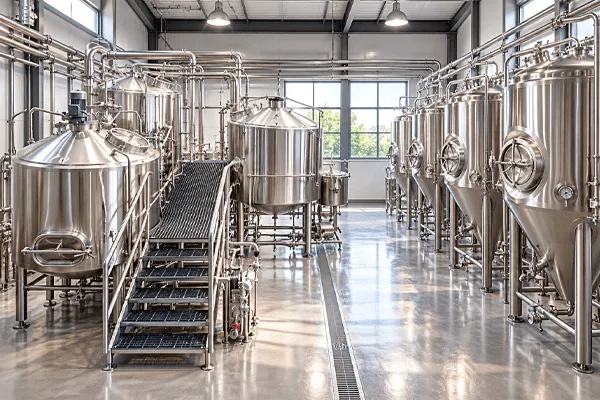
What about using a 30 BBL fermenter?
Using a 30 BBL fermenter with a 10 BBL system can work for a production brewery making a large quantity of the same beer.
But bigger tanks reduce flexibility.
A single 30 BBL fermenter locks approximately three brewhouse batches into one production lot. If sales slow or a recipe changes, that larger batch can become harder to manage.
For many growing breweries, a mixed cellar offers a better balance.
Example:
- 4 × 10 BBL fermenters for rotating beers
- 2 × 20 BBL fermenters for core products
- 1 bright beer tank
- Reserved space for additional tanks
That setup is only an example, but it shows how tank configuration can follow the sales model instead of a one-size-fits-all rule.
5. How Does Beer Style Affect Fermentation Capacity?
Different beer styles create different tank schedules.
Suppose Brewery A and Brewery B both own a 10 BBL brewing system.
Both brew three times per week.
Brewery A: Faster-turnover beer
Average tank occupancy: 14 days
3 × 14 ÷ 7 = 6 tanks
Brewery B: Longer tank occupancy
Average tank occupancy: 28 days
3 × 28 ÷ 7 = 12 tanks
The brewhouse size is identical.
The required fermentation capacity is twice as high.
This becomes important when a brewery produces several beer styles at the same time. One product may leave a fermenter quickly, while another stays for weeks.
Instead of calculating one average fermentation time for the entire brewery, a more accurate method is to divide production into groups.
| Beer Group | Weekly Brews | Tank Occupancy | Tank Positions |
|---|---|---|---|
| Fast-turn products | 2 | 14 giorni | 4 |
| Longer-cycle products | 1 | 28 days | 4 |
| Totale | 3 | — | 8 |
In this example, the brewery needs eight occupied tank positions even though a simple 14-day assumption would suggest only six.
That small difference can decide whether the brewer can keep the brewhouse running.
6. Can a Brite Tank Reduce the Number of Fermenters You Need?
A brite tank does not replace fermentation capacity, but it can improve tank turnover.
If finished beer stays inside a fermenter while waiting for carbonation, packaging, or serving, that fermenter cannot receive fresh wort.
Moving suitable finished beer into a brite tank can release the fermenter earlier.
ZPET’s current bright beer tank range is designed for clarification, carbonation, serving, and packaging, with vertical and horizontal configurations available.
For example:
Without a brite tank:
Fermentation + conditioning + packaging wait = 18-day tank occupancy
With a properly integrated brite tank:
Fermenter occupancy may end earlier, while final holding and carbonation continue in another vessel.
The exact time saved depends on the brewery process.
This can be especially useful when the packaging line runs only on certain days. Without separate finished-beer storage, a fermenter may remain occupied even though fermentation is complete.
A well-balanced 10 BBL cellar may therefore include:
- Vasche di fermentazione
- One or more brite tanks
- Glycol cooling
- Sanitary transfer lines
- Sistema CIP
- Packaging connection
Do not count the brite tank as another fermenter in your basic fermentation calculation. Instead, use it to improve the flow between fermentation and packaging.
7. How Do Glycol, CIP, and Automation Limit the Number of Tanks You Can Use?
Installing more fermenters does not automatically increase production.
Supporting equipment must keep up.
Glycol cooling
Every active fermenter adds cooling load.
Your glycol system may need to manage several tanks that are:
- Fermentazione
- Cold crashing
- Holding cold beer
- Cooling after transfer
A system that can cool four tanks may struggle when eight tanks request cooling at the same time.
ZPET’s current fermenter designs use glycol cooling jackets and temperature-control options across its micro and production fermenter ranges.
When planning expansion, calculate cooling load rather than simply counting tanks.
CIP capacity
More tanks also mean more cleaning.
A brewer may finish one fermentation cycle while another brew day is already starting. If the CIP system cannot clean the available tank in time, the brewhouse may still have to wait.
Typical sanitary equipment considerations include:
- CIP spray ball
- Sample valve
- Dump valve
- Valvola di sicurezza
- Temperature probe
- Glycol inlet and outlet
- Sanitary transfer connections
ZPET’s fermentation tanks currently include CIP and sanitary fitting options designed for commercial cellar operation.
Automation
As the number of cellar tanks grows, manual monitoring becomes more demanding.
Temperature sensors, automatic glycol valves, tank controls, alarms, and PLC integration can reduce operator workload.
Automation does not create fermentation capacity by itself. It helps the brewer manage that capacity more consistently.
8. How Much Reserve Fermentation Capacity Should a Brewery Plan?
Running every tank at 100% theoretical utilization leaves very little room for problems.
Imagine a brewery with six tanks.
Its schedule requires all six every week.
Then one batch needs three extra days.
Now there is no empty fermenter for the next brew.
This is why we often discuss a reserve tank position during brewery planning.
For a small 10 BBL operation, one additional fermenter may provide meaningful flexibility. A larger production brewery may prefer a reserve percentage based on its production risk, seasonal peaks, maintenance schedule, and beer portfolio.
Reserve capacity can help when:
- Fermentation takes longer than expected
- A tank needs maintenance
- Seasonal demand rises
- A special beer needs extra conditioning
- A brew must be rescheduled
- Packaging is delayed
- Cleaning takes longer
- A new product is introduced
You do not need to install as many fermenters as possible.
You need enough fermentation capacity to keep production stable.
That difference matters.
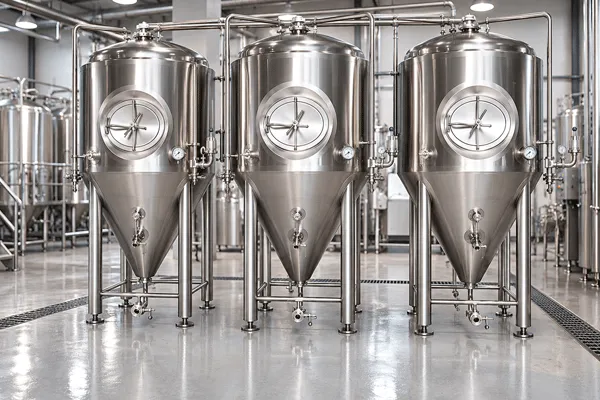
9. How Should You Plan for Future Brewery Expansion?
A brewery expansion often starts in the cellar.
A 10 BBL brewhouse that originally runs two brew days per week may later run three, four, or five.
If the hot side still has available production time, adding fermentation tanks may be more economical than immediately replacing the entire brewing system.
Consider this example.
Stage 1: Startup
Production target: 2 brews/week
14-day occupancy:
2 × 2 = 4 tank positions
Possible starting concept:
- 4 × 10 BBL fermenters
- 1 reserve fermenter if budget allows
- 1 brite tank
- Glycol and piping sized with expansion in mind
Stage 2: Growth
Production: 3 brews/week
Requirement:
3 × 2 = 6 tank positions
Add two tanks.
Stage 3: Distribution growth
Production: 4 brews/week
Requirement:
4 × 2 = 8 tank positions
At this stage, the brewery may choose additional 10 BBL fermenters or add larger 20 BBL tanks for high-volume brands.
When you plan for future brewery expansion, reserve:
- Floor space
- Ceiling clearance
- Glycol capacity
- Piping connection points
- Drainage
- Electrical capacity
- Control panel capacity
- Tank installation access
- Packaging capacity
An empty spot on the floor is not enough.
If a future fermenter cannot connect to glycol, CIP, drains, or transfer lines, expansion becomes much more expensive.
10. What Do 1000L, 2000L, 3 BBL, and 30 BBL Breweries Need?
The same planning logic works across different bbl systems.
It applies to a 1 BBL pilot system, 3 BBL fermenters, a 5 BBL brewpub, a 7 BBL system, a 10 BBL production brewery, and 15 BBL and larger commercial breweries.
Only the volume changes.
The formula remains:
Weekly brews × tank occupancy time = required fermentation positions
What does a 1000L brewery need?
A 1000L brewery may be marketed near the 7–10 BBL range depending on the supplier’s naming convention.
Do not choose fermentation tanks based only on the advertised model name.
Confirm:
- Actual wort volume per batch
- Tank working volume
- Gross tank capacity
- Required headspace for fermentation
What does a 2000L brewery need?
A 2000L brewery can use one-batch fermenters close to the actual production volume or larger tanks designed for multiple compatible batches.
Again, brewing frequency determines quantity.
Three 2000L brews per week with a two-week tank cycle still require approximately six batch positions.
What about 30 BBL fermenters?
A production brewery may pair smaller brewhouse batches with larger fermentation vessels.
For example, using a 30 BBL fermenter with a 10 BBL brewhouse may allow three compatible brews to form one production batch.
But the brewer must evaluate:
- Fill timing
- Yeast pitch strategy
- Fermentation temperature
- Oxygen control
- Recipe consistency
- Tank working volume
- Headspace
- Production scheduling
A single 30 BBL fermenter is efficient only when the brewery can actually sell and package that quantity of beer.
11. Example 10 BBL Brewery Tank Configurations
The following case studies are illustrative production scenarios, not standard packages.
Case 1: Small 10 BBL Brewpub
Production: 2 brews/week
Average tank cycle: 14 days
Sales: Mostly onsite
Basic tank demand:
2 × 2 = 4 fermenters
Possible concept:
- 4–5 × 10 BBL fermentation tanks
- 1 × 10 BBL brite tank
- Compact glycol system
- Mobile or small CIP system
The extra tank provides useful flexibility for seasonal beer or delayed fermentation.
Case 2: Growing Craft Brewery
Production: 3 brews/week
Average tank cycle: 14 days
Sales: Taproom + local distribution
Basic demand:
3 × 2 = 6 tank positions
Possible concept:
- 6–7 × 10 BBL fermenters
- 1–2 serbatoi di birra luminosi
- Central glycol cooling
- Dedicated CIP
- Space for two future tanks
This is one of the clearest examples of why tank count should follow brew frequency.
Case 3: Brewery With Core and Seasonal Beers
Production: 4 brews/week
Beer mix: Two high-volume core beers plus seasonal releases
Instead of eight 10 BBL fermenters, the brewery may consider a mixed configuration such as:
- 4 × 10 BBL fermenters
- 2 × 20 BBL fermenters
- Brite tank capacity matched to packaging
- Expansion space
The bigger tanks handle repeat production. Smaller tanks protect recipe flexibility.
Case 4: Production Brewery With Long Tank Cycles
Production: 4 brews/week
Tank occupancy: 21 days
Basic demand:
4 × 3 = 12 batch positions
At this point, cellar design becomes a major engineering decision.
The brewery needs to review:
- Total fermentation capacity
- Floor space
- Glycol load
- CIP schedule
- Tank automation
- Packaging line speed
- Labor availability
Adding twelve tanks without upgrading supporting equipment may simply move the bottleneck somewhere else.
FAQs About 10 BBL Brewery Fermentation Tanks
Is six fermenters enough for a 10 BBL brewery?
It can be. Six 10 BBL fermenters can support three brews per week under a roughly 14-day tank-occupancy assumption. If fermentation takes longer, brewing frequency rises, or several tanks are used for conditioning, you may need additional capacity.
Should a 10 BBL brewery use 10 BBL fermenters?
A 10 BBL fermenter is usually the simplest match for one 10 BBL brewhouse batch, provided the stated capacity refers to suitable working volume and enough headspace is available.
Can I use 20 BBL fermentation tanks with a 10 BBL brewhouse?
Yes. A 20 BBL fermenter can be designed to receive two compatible 10 BBL brews. Double batching can improve efficiency for core beers but requires more careful brew scheduling.
Does a brewery specializing in lagers need more fermenters?
Often, yes. If lager production results in longer fermentation and conditioning periods, each tank remains occupied longer. That increases the total fermentation capacity needed for the same number of weekly brews.
Do I need a brite tank in addition to fermenters?
Not every brewery does, but a brite tank can improve cellar workflow by moving finished beer out of the fermenter for clarification, carbonation, holding, or packaging.
Should I buy extra tanks for future growth?
Plan for growth, but do not buy unused capacity without a reason. Reserve floor space, glycol capacity, piping, drainage, controls, and installation access so additional tanks can be added when real sales demand supports them.
Punti chiave
- A 10 BBL brewery does not have one fixed fermenter count.
- Start with brews per week × total tank occupancy time.
- Two brews per week with a 14-day cycle require about 4 basic tank positions.
- Three brews per week require about 6.
- Four brews per week require about 8.
- Five brews per week require about 10.
- Longer fermentation and conditioning periods can increase these numbers quickly.
- 10 BBL fermenters provide maximum recipe flexibility.
- 20 BBL tanks can support efficient double-batch production.
- 30 BBL fermenters may suit larger repeat-production programs but reduce flexibility.
- A brite tank can help release fermenters sooner when packaging or finished-beer storage creates delays.
- Glycol, CIP, automation, floor space, and packaging must grow with fermentation capacity.
- Leave practical reserve capacity instead of planning every tank at 100% utilization.
- Plan future glycol, piping, drainage, electrical, and control capacity before brewery expansion.
At ZPET, we manufacture customized stainless steel brewhouses, fermentation tanks, bright beer tanks, cooling systems, and complete turnkey brewery equipment for global commercial projects.
When we plan a 10 BBL brewery, we do not start by asking, “How many fermenters can fit in the building?” We start with your production target, weekly brew schedule, beer styles, fermentation cycle, packaging method, available floor space, and future growth plan.
Send us those details, and we can help develop a practical fermentation tank configuration that keeps your brewhouse running without overinvesting in unused cellar capacity.