David Zhang | Founder & CEO, ZPET (Shandong ZhongPi Machinery Equipment Co., Ltd.) | Published August 12, 2026
Nano brewery equipment covers brewing systems from 117 to 587 L (approx. 1–5 BBL): a brewhouse, fermentation and bright beer tanks, glycol cooling, CIP, and a control panel. Weekly output is set by fermenter count and turn time, not brewhouse size — a distinction that decides whether the build works.
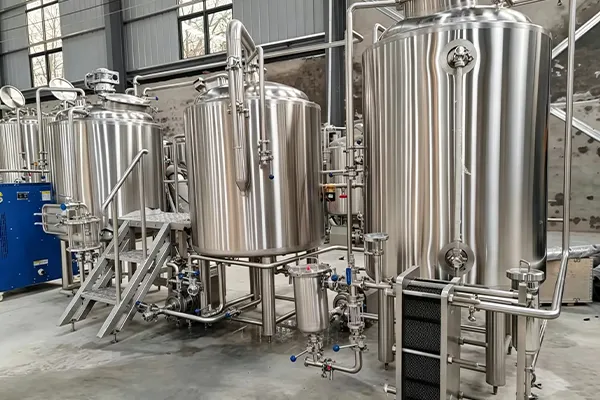
“Nano” is a market term, not a regulatory tier
The Brewers Association (US) defines a microbrewery as a brewery producing under 15,000 barrels per year, with taproom and brewpub categories layered on top of that by sales channel. There is no equivalent official definition for “nano.” In practice, equipment suppliers use it for systems below roughly 5 BBL, and buyers use it for the smallest build that can legally and commercially supply a single venue.
That vagueness matters commercially. A 117 L (1 BBL) electric single-vessel unit and a 587 L (5 BBL) steam-jacketed two-vessel brewhouse with six jacketed fermenters are both marketed as “nano brewery systems,” and they are not comparable purchases. The first is a recipe development tool that happens to make sellable beer. The second is a functioning production brewery for a mid-size taproom.
So the useful question is not “what size is nano.” It is: what does the build have to include, and what weekly volume will it actually sustain once installed?
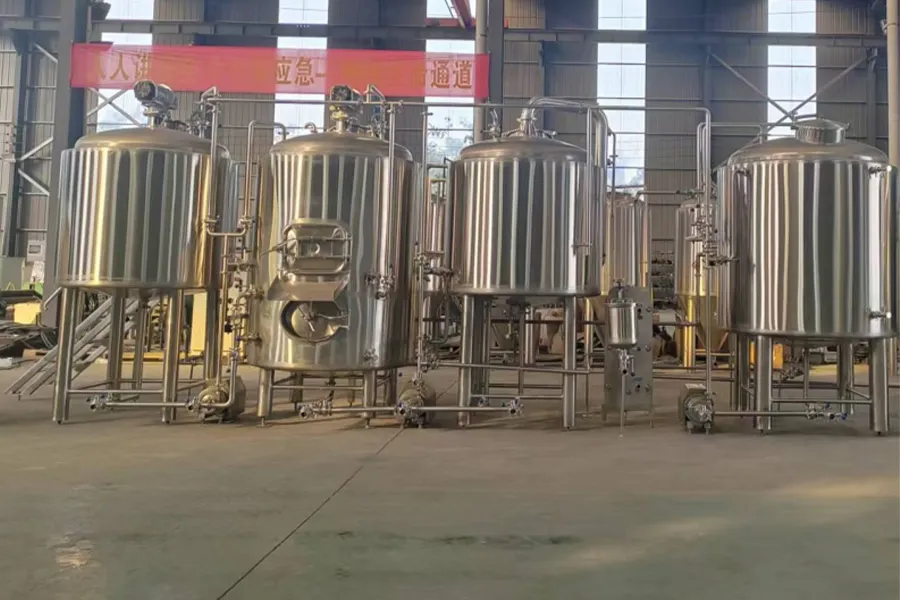
The nano build: 11 items that make up a working system
Quoted “nano brewery kits” vary widely in what they cover. This is the full scope needed to move grain in one end and packaged beer out the other:
- Milling— a two-roller mill and grist case, or a decision to buy pre-milled malt (which shifts cost to your supplier and shortens shelf life).
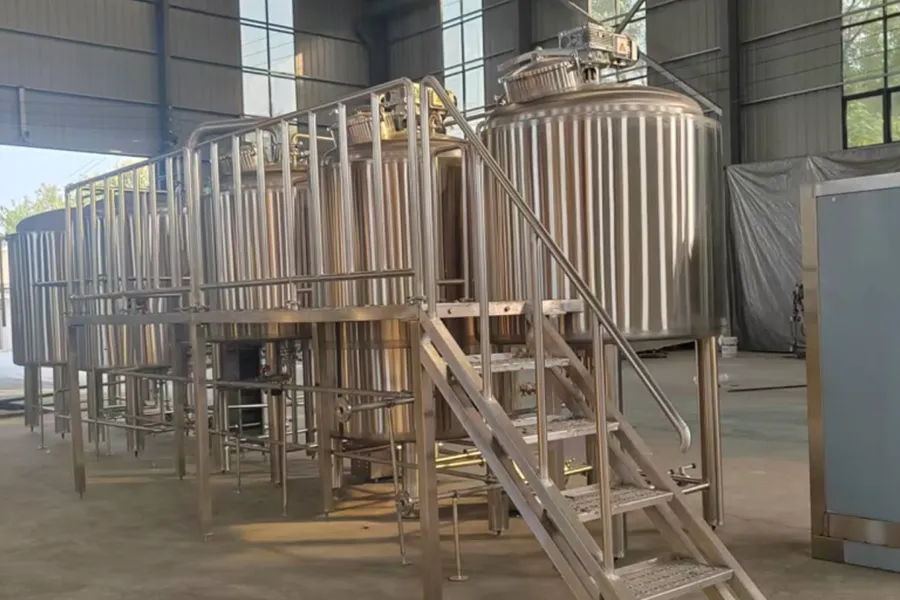
- Brewhouse vessels— mash/lauter tun and kettle/whirlpool at minimum. Configuration options are covered below.
- Hot liquor tank (HLT)— often omitted in the smallest quotes, then added back when the buyer realizes sparge water has to come from somewhere at temperature.
- Wort pump and hoses— sanitary centrifugal pumps, tri-clamp fittings, plus enough hose to reach every connection point without stretching.
- Heat exchanger— single or two-stage plate heat exchanger. Two-stage becomes worth discussing when incoming mains water runs above 20 °C for part of the year.
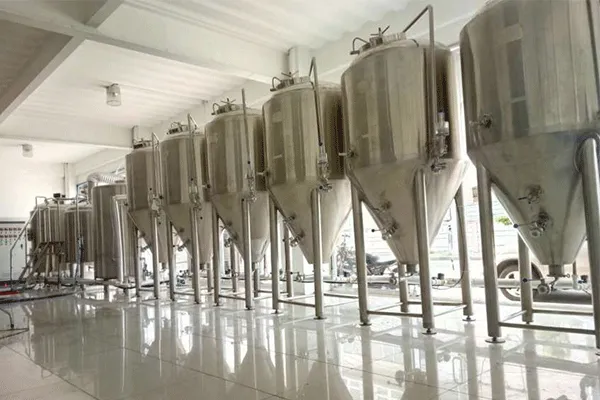
- Fermentation tanks— jacketed, conical, with pressure rating suited to natural carbonation if you plan to skip force-carbing.
- Bright beer tanks— or a decision to serve directly from the fermenter, which costs you a fermenter slot on every batch.
- Glycol chiller and circulation loop— chiller, insulated PVC or copper lines, manifold, pumps, and glycol charge.
- CIP system— even a single 100 L portable CIP cart with a pump and heater. Cleaning by hand at nano scale is possible and it is where labor hours quietly disappear.
- Control panel— temperature controllers for the brewhouse and one channel per fermentation zone.
- Utilities and services— floor drainage, trench grates, steam or electrical supply, water treatment, compressed air (if you use air-actuated valves), and a keg washer.
Items 8, 9 and 11 are the three most frequently left out of a headline “turnkey” price. When comparing two quotes, price them as line items before you compare totals.
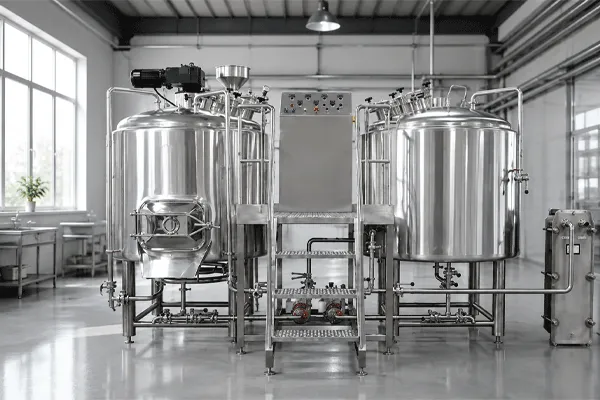
Your fermenter count sets output, not your brewhouse
This is the single most common miscalculation in nano purchasing. A brewhouse can be turned over twice in one day. A fermenter is occupied for two to five weeks.
Take a 352 L (3 BBL) brewhouse with six 3 BBL jacketed fermenters. Weekly ceiling depends entirely on how long beer sits in tank:
| Tank turn time (incl. crash + CIP) | Typical beer style | Batches/week (6 FVs) | Weekly output | Half-barrel kegs/week |
| 10 days | Kettle-soured, fast pale ale, no conditioning | 4.2 | 12.6 BBL (1,478 L) | 25 |
| 14 days | Standard ale program | 3.0 | 9.0 BBL (1,056 L) | 18 |
| 21 days | Ale with dry hop + extended cold crash | 2.0 | 6.0 BBL (704 L) | 12 |
| 35 days | Lager | 1.2 | 3.6 BBL (422 L) | 7 |
Calculation basis: batches/week = (fermenter count ÷ turn days) × 7. One US half-barrel keg = 58.67 L. Conversion: 1 BBL = 117.3 L.
The same brewhouse produces three and a half times as much beer on a fast ale program as on a lager program. If your business plan is built around pilsner, your fermenter count needs to roughly double or your batch size needs to grow.
Now scale the same logic across the nano range, assuming a 14-day average turn and 48 brewing weeks per year:
| Brewhouse size | Fermenters | Weekly ceiling | Annual ceiling |
| 117 L (1 BBL) | 4 × 1 BBL | 2.0 BBL | ~96 BBL |
| 235 L (2 BBL) | 4 × 2 BBL | 4.0 BBL | ~192 BBL |
| 352 L (3 BBL) | 6 × 3 BBL | 9.0 BBL | ~432 BBL |
| 587 L (5 BBL) | 6 × 5 BBL | 15.0 BBL | ~720 BBL |
Against that, a 60-seat taproom pouring 1,000 US pints per week consumes roughly 473 L, or about 4 BBL. A 1 BBL system cannot supply it. A 2 BBL system supplies it with zero margin for a stuck fermentation or a dumped batch. A 3 BBL system supplies it with room to add a guest-free tap list and a small keg account.
Run your own version of this before you choose a size. Take your projected weekly pour volume, divide by 0.5 to get half-barrel keg equivalents, then check it against the tables above with your actual style mix.
2-vessel or 3-vessel below 5 BBL?
At nano scale the vessel-count decision is driven by brew-day length and floor area rather than by throughput, because you are rarely trying to fit multiple brews into one shift.
| 2-vessel (mash/lauter + kettle/whirlpool) | 3-vessel (adds separate HLT or whirlpool) | |
| Footprint | Smallest; fits most retrofit spaces | Roughly 30–40% more floor area |
| Brew day, single batch | 5–7 hours | 5–7 hours (no gain on a single batch) |
| Back-to-back brews same day | Constrained: kettle must clear before next lauter | Practical with separate whirlpool |
| Sparge water | Requires a separate HLT or on-demand heating | HLT integrated in the configuration |
| Trub separation | Whirlpool in kettle; longer knockout | Dedicated whirlpool, faster knockout, tighter cold break |
| Lauter performance | Adequate for standard grain bills | Better for high-gravity and high-adjunct bills |
| Capital cost | Lower | Higher |
For a taproom brewing one batch per brew day, 2-vessel is usually the correct answer, and money is better spent on a seventh fermenter than a third brewhouse vessel. Once you plan two brews in a shift, or once high-gravity beers are a regular part of the lineup, the third vessel starts earning its floor space.
Heating below 5 BBL: electric, steam, or direct fire
Electric. Elements in the kettle and HLT. Simplest to install, no boiler, no boiler operator certification in most jurisdictions. The constraint is electrical supply: bringing sufficient three-phase power to a leased retail unit is sometimes harder than installing a small boiler. Scorching risk on the element surface is real with high-adjunct or dark grain bills and is managed through element watt density and a circulation pump, not through operator care alone.
Steam. A small boiler with jacketed vessels. Cleaner heat distribution, better ramp control, and it scales with you. It adds boiler room requirements, water treatment, periodic inspection, and in many regions a licensed operator. Below 3 BBL, the compliance overhead often outweighs the process benefit.
Direct fire. Gas burners under the kettle. Fast, cheap, familiar to anyone who has homebrewed. Poorest temperature uniformity of the three, and it introduces gas supply, ventilation, and fire suppression into your fit-out.
One practical note that gets missed: if you expect to move to steam later, specify jacketed vessels now even while running electric elements. Retrofitting a jacket onto an unjacketed kettle is not economically sensible; specifying it at fabrication costs comparatively little.
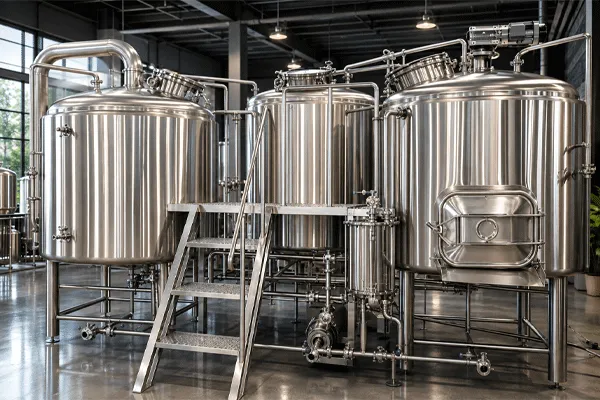
Glycol and CIP: the two systems nano budgets underestimate
Glycol sizing is not proportional to total tank volume. It is driven by peak simultaneous load, and peak load at nano scale usually means one fermenter in active fermentation heat removal while another is being crash-cooled. Sizing a chiller against average load produces a system that holds temperature adequately in winter and fails to hit crash targets in August. Size against the worst realistic simultaneous demand, include line losses if the chiller sits outside, and confirm the glycol concentration matches your lowest ambient temperature.
CIP is where nano operations lose hours. Manual cleaning of six fermenters plus a brewhouse is a genuine part-time job. A single portable CIP cart with a pump, tank and heater changes the labor profile of the whole brewery, and it improves cleaning consistency in a way that matters for hygiene audit trails. The 3-A Sanitary Standards and ASME BPE both address the surface finish and drainability conditions that make cleaning-in-place effective — spray coverage is only useful if the tank interior is smooth and fully draining.
Five specification decisions that determine whether the nano system survives expansion
Most nano buyers expand within three to five years. At that point the nano system either becomes a pilot and small-batch rig alongside the new production brewery, or it becomes an asset sale at a loss. Five decisions at purchase determine which:
- Fitting standard.Specify tri-clamp throughout, in sizes that match what your future production brewery will use. Mixed or proprietary fittings mean the nano system cannot share hoses, pumps, spare gaskets or CIP connections with the larger plant.
- Jacketed vessels, always.Both brewhouse and fermenters. This is what allows the nano brewhouse to run trials with the same temperature control regime as production.
- Pressure rating on fermenters.A fermenter rated for natural carbonation and spunding can produce finished beer without a bright tank. An unrated tank locks you into transferring and force-carbing forever.
- Control panel channel headroom.Specify spare temperature channels. Adding two fermenters in year two is cheap; rebuilding a control panel is not.
- Documented material traceability.EN 10204 3.1 mill certificates on pressure-bearing components. If you ever need to move the vessels across a border, sell them, or satisfy a local pressure-vessel inspector, undocumented steel becomes an expensive problem.
Where nano stops working
Three honest limits, stated plainly because they are the reason some nano purchases fail:
Labor does not scale down.
A 3 BBL brew day takes nearly as many hours as a 15 BBL brew day. Grain-in to clean-down is 6–8 hours either way. Your cost per litre of labor at nano scale is several times that of a 20 BBL brewery, and no equipment specification fixes this. Nano works where the beer commands taproom margins. It rarely works where beer is sold wholesale into distribution.
Packaging is the wall.
A 3 BBL batch fills roughly six half-barrel kegs. Canning that volume through a small mobile or table-top line means high changeover cost per unit. Nano systems that try to build a retail can program usually discover the packaging economics before the brewing economics.
Lager pins you down.
As the turn-time table shows, a lager program cuts a nano system’s output to roughly 40% of its ale-program ceiling. If lager is central to the concept, either specify more fermenters than seems necessary or move up a tier.
A common misconception worth naming: converted second-hand dairy or food-industry tanks are often presented as an equivalent low-cost path to a nano build. Compared with purpose-built brewing vessels, this category of solution typically lacks glycol jacketing sized for fermentation heat load, lacks a conical bottom for yeast harvesting, lacks pressure rating, and lacks material documentation. The tanks are cheaper. The brewery built from them is usually not.
ZPET Nanobrewery Equipment (1–5 BBL): specification detail
Our nano line is positioned for brewpubs and taprooms running small-batch programs with limited floor area and a constrained start-up budget, in a modular layout so vessels can be added without re-plumbing the whole room.
| Parameter | Specification |
| Capacity range | 117–587 L (1–5 BBL) |
| Brewhouse configurations | 2-vessel to 3-vessel |
| Heating options | Steam / electric / direct fire |
| Materials | SS304 or SS316L, sanitary grade |
| Interior surface finish | 0.4 μm mirror polish |
| Fermenter cooling | Dimple cooling jacket |
| Tank access | Top manway standard; side manway optional |
| Welding | TIG / double-sided argon arc; automatic welding robots; CNC laser cut plate |
| Material verification | Spectrometer analysis on incoming stainless |
| Pressure testing | 24-hour pressure hold test |
| Weld inspection | X-ray weld inspection; 5-step QC sequence |
| Structural warranty | 10 years |
| Export compliance | Engineered to meet PED (CE), UL/cUL and AS1210 requirements |
| Pre-order engineering | 3D brewery layout, technical drawings and flow charts issued before fabrication |
Two points on that table deserve expansion. The 0.4 μm mirror polish figure refers to interior surface roughness, the same property ASME BPE addresses in its hygienic surface finish designations — it is the parameter that determines whether CIP spray actually removes soil or merely wets it. And “engineered to meet PED (CE), UL/cUL and AS1210” is deliberate wording: it means the vessels and control panels are designed against those standards’ requirements, which is a different statement from holding a third-party certificate. Ask any supplier which of the two they are offering, and ask to see the document.
The 3D layout step matters more at nano scale than at any other size, because nano systems go into buildings that were not designed as breweries. Drain positions, ceiling height under a hoist point, door widths, and single-phase versus three-phase supply all constrain the design. Producing the layout against your actual building dimensions before fabrication is what prevents a vessel arriving that cannot physically enter the room.
FAQ
Q: What is the smallest nano system that can commercially supply a taproom?
A: For a 60-seat venue pouring around 1,000 US pints weekly (roughly 473 L, or 4 BBL), a 352 L (3 BBL) brewhouse with six fermenters is the smallest configuration with meaningful margin. A 2 BBL system meets the volume on paper but leaves no headroom for a lost batch or a slow-fermenting style.
Q: How many fermenters should I order with a nano brewhouse?
A: Start from your longest planned tank turn, not your shortest. Fermenters needed = (target batches per week × turn days) ÷ 7. A 3 BBL system targeting 9 BBL weekly on a 14-day turn needs six. The same target on a 21-day turn needs nine.
Q: Can nano brewery equipment be used as a pilot system after I expand?
A: Yes, if it was specified for it. Tri-clamp fittings matching your future plant, jacketed vessels, pressure-rated fermenters, spare control channels, and EN 10204 3.1 material certificates are the five conditions. Without them the system usually gets sold rather than redeployed.
Q: Electric or steam heating for a 3 BBL system?
A: Electric in most cases, on installation simplicity and the absence of boiler compliance overhead — provided your building can deliver the electrical supply. Specify jacketed vessels anyway so steam remains available later without refabrication.
Q: Do I need a bright beer tank on a nano system?
A: Not if the fermenters are pressure-rated for spunding and you serve from them. That saves capital but occupies a fermenter for the conditioning period, which reduces weekly output. Run the turn-time calculation both ways before deciding.
Q: What is usually missing from a “nano brewery kit” quotation?
A: Most often the glycol chiller and circulation loop, the CIP system, the hot liquor tank, keg washing, and site-side utility work including drainage. Compare quotes line by line rather than by total.