David Zhang — Founder & CEO, ZPET Published July 30, 2026
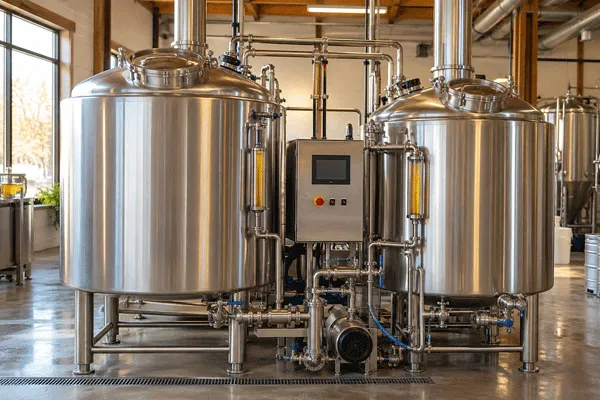
A pilot brewhouse is a 1-5 BBL (117-585 L) system built to test recipes, ingredients, and process changes before a brewery commits tank space and raw materials to a full production run. It shares a capacity range with nanobrewery equipment, but the two aren’t interchangeable: a nano system is sized to sell what it makes, while a pilot system is sized to answer a question.
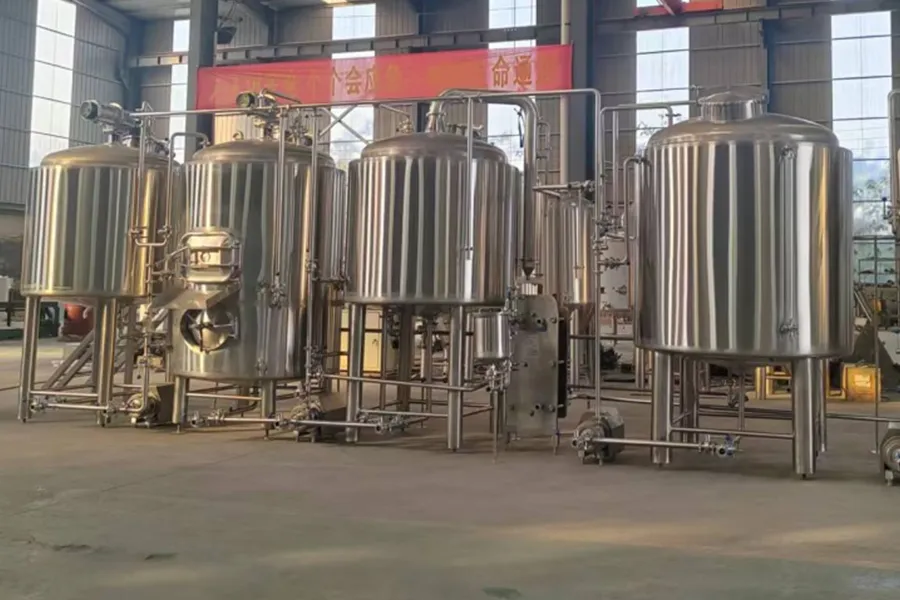
Nano, Pilot, Micro, Commercial: Where the Lines Actually Sit
Equipment catalogs group brewhouses by batch size, and on paper a pilot system and a nanobrewery system occupy the same 1-5 BBL band. The difference is intent, not liters.
- Nano (1-5 BBL):built for a brewpub or taproom that plans to pour what it brews. Batch size is a retail decision — how much beer sells through a tap list before it goes flat.
- Pilot (also 1-5 BBL, sometimes smaller):built to generate data — attenuation, hop utilization, mouthfeel — that a brewer will act on at a larger scale. It may never see a tap.
- Micro (7-30 BBL):production-focused, sized for consistent batch-to-batch output and cellar planning rather than experimentation.
- Commercial (40 BBL and above):PLC/HMI-automated, built for continuous operation rather than one-off trial brews.
One misconception worth naming: the Brewers Association’s “microbrewery” category has nothing to do with batch size at all. It’s a production-volume classification — a brewery producing under 15,000 barrels a year that sells 75 percent or more of its beer off-site. A brewery running a 7 BBL brewhouse and one running a 25 BBL brewhouse can both be a “microbrewery” in that annual sense, regardless of what equipment vendors mean when they label a machine “microbrewery equipment.” Mixing up the volume classification with the batch-size label is a common source of confusion when brewers compare vendor spec sheets against industry statistics.
What a Pilot Batch Is Actually For
Three uses come up more than any others:
- New recipe developmentbefore a limited release or a permanent addition to the lineup.
- Ingredient substitution testing— a new hop lot, a different malt supplier, a yeast strain change — where the brewer needs to see the effect without risking a full commercial batch.
- Pre-scale-up validation, run immediately before a recipe moves onto the main brewhouse, specifically to catch problems while the fix still costs one batch instead of twenty.
A fourth use shows up less often but matters for growing operations: qualifying equipment or process changes — a new heat exchanger, a revised whirlpool rest — on a small system before rolling the change out across production tanks.
The Question Vendor Pages Skip: Does the Pilot Batch Predict the Production Batch?
This is where most pilot brewhouse marketing stops short. Owning a small system doesn’t automatically make its results transferable. Transfer depends on how closely the pilot’s vessel geometry and heat source match the production brewhouse downstream.
The variables that actually move the outcome:
- Height-to-diameter ratio.A tall, narrow kettle boils differently than a short, wide one at the same volume — wort exposed to the heat source, convection pattern, and hot-side surface area all change with the ratio, not just the liters.
- Boil vigor and evaporation rate.A pilot kettle heated by an electric element rarely reproduces the evaporation curve of a steam-jacketed production kettle. Mismatched evaporation shifts final gravity and can shift perceived hop character even with identical hop bill and timing.
- Heat source type.Steam, electric, and direct-fire systems apply heat differently across the kettle surface. A recipe dialed in on an electric pilot kettle will not automatically hit the same numbers on a steam-heated production system, even at proportional batch size.
- Lauter bed depth and grist-to-liquor ratio.Runoff time and extraction efficiency scale with bed depth, not just batch volume, which is why proportionally scaling grain bill alone can under- or over-shoot original gravity on the bigger system.
None of this means pilot brewing is unreliable — it means the pilot system has to be specified against the production brewhouse it feeds, not against batch size alone. A pilot system bought in isolation, without reference to what it will eventually validate for, is the single most common reason breweries report “it worked on the pilot but not at scale.”
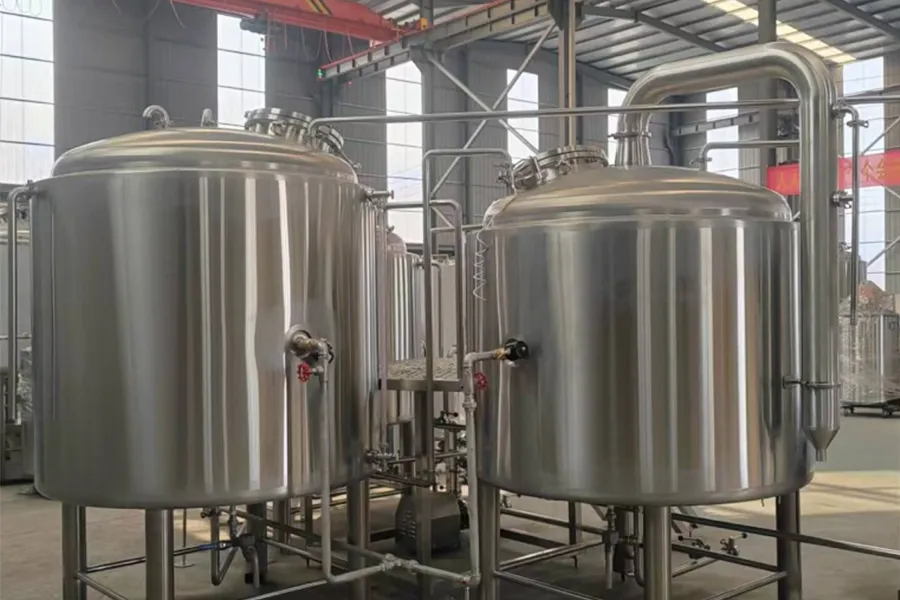
Spec Comparison Across Tiers
| Tier | Batch Range | Typical Vessel Configuration | Heating Options | Primary Use |
| Pilot / Nanobrewery | 1-5 BBL (117-585 L) | 2-vessel to 3-vessel | Steam / electric / direct fire | R&D, recipe validation, taproom-scale retail |
| Microbrewery | 7-30 BBL (821-3,519 L) | 3-vessel to 4-vessel | Steam / electric | Consistent production, distribution-scale output |
| Commercial | 40 BBL+ (4,692 L+) | 4-vessel to 5-vessel | Steam, PLC/HMI-controlled | Continuous, 24/7 operation, turnkey plant integration |
ZPET’s brewhouse systems span 2-vessel to 5-vessel configurations across all three tiers, built in SS304/316L with a 0.4 μm mirror-polish interior finish and covered by a 10-year structural warranty on the vessel work — the same fabrication standard, whether the order is a 3 BBL pilot kettle or a 60 BBL commercial system. Matching heat source and vessel proportions between a pilot order and the production system it’s meant to validate for is a design conversation worth having before either unit is fabricated, not after the pilot arrives.
Sizing a Pilot System to Match Production
- Fix the production vessel count and heat source first.Steam, electric, or direct fire on the eventual production brewhouse should dictate the pilot’s heat source — not the other way around.
- Scale the height-to-diameter ratio down, not just the volume.Ask for a kettle drawing at the pilot’s batch size that preserves the production kettle’s proportions, rather than accepting whatever ratio happens to be standard at that liter count.
- Run at least two paired brews before trusting the transfer.Brew the same recipe on both systems and compare final gravity, color, and perceived bitterness. Treat the first pair as calibration, not proof.
- Log evaporation rate and utilization separately for each system.Once you have real numbers instead of assumed ones, you can build a conversion factor specific to your two brewhouses rather than relying on a generic scale-up rule.
- Confirm vessel count matches your process, not just your batch size.A 2-vessel pilot feeding a 4-vessel production brewhouse introduces workflow differences (combined mash/lauter vs. separate vessels) that show up in timing and extraction, independent of geometry.
Pilot Brewhouse vs. Small Batches on the Production System
Some breweries skip a dedicated pilot altogether and just run a reduced-volume batch on the existing production brewhouse instead. Compared to that approach, a dedicated pilot system trades perfect geometry for schedule flexibility.
Running trial batches directly on the production system guarantees geometric and heat-source matching, since it’s literally the same vessel — there’s no scale-up question at all. The cost is production time: every trial batch occupies a slot on the brew schedule that would otherwise make sellable beer, and most production brewhouses aren’t designed to run efficiently at a fraction of their rated batch size, which can distort the very results the brewer is trying to measure.
A dedicated pilot system frees up the production schedule and allows more frequent, lower-cost experimentation, but only pays off if its geometry and heat source were actually specified against the production system — otherwise a brewery ends up running twice as many trial batches to compensate for a pilot that doesn’t predict outcomes reliably.
For a brewery still in R&D-heavy growth, with a production brewhouse running near capacity, a dedicated pilot system usually wins. For an established brewery doing occasional recipe tweaks with slack capacity on the main system, reduced-batch trials on the production brewhouse can be the more practical choice.
FAQ
Q: What size is a pilot brewhouse?
Most pilot systems fall in the 1-5 BBL (117-585 L) range, though some breweries run pilot trials at sub-1-BBL scale for early-stage recipe screening before moving to a 1-5 BBL system for pre-production validation.
Q: Can a nanobrewery system double as a pilot system?
Yes, physically — a 1-5 BBL nano system and a 1-5 BBL pilot system are often the same hardware. Whether it functions as a useful pilot depends on whether its vessel geometry and heat source were matched to the production brewhouse it’s meant to validate recipes for.
Q: Does scaling a recipe by liters alone work?
Not reliably. Grain bill and hop additions scale by volume, but final gravity, color, and bitterness are also shaped by height-to-diameter ratio, evaporation rate, and heat source — none of which scale linearly with batch size alone.
Q: Does a pilot brewhouse need PLC/HMI automation?
Not typically. PLC/HMI control becomes more valuable at production scale, where consistency across dozens of batches matters more than flexibility. Pilot systems usually prioritize manual control precisely because brewers are actively changing variables batch to batch.