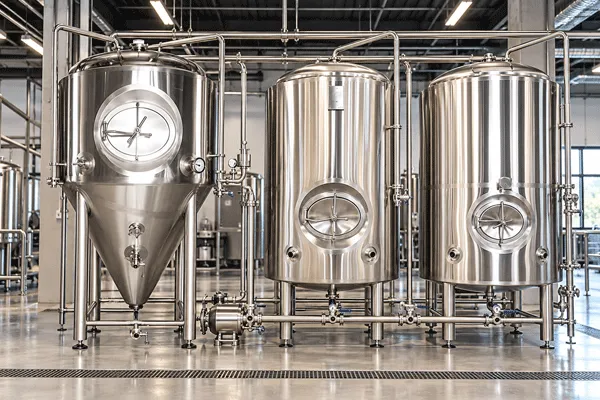
Un sistema de calentamiento subdimensionado o mal diseñado puede ralentizar las jornadas de elaboración, provocar un control irregular de la temperatura y aumentar los costes operativos. Una sala de cocción calentada por vapor ofrece un calor indirecto y controlado, pero la caldera, las camisas, las tuberías, las válvulas y el retorno de condensado deben funcionar conjuntamente.
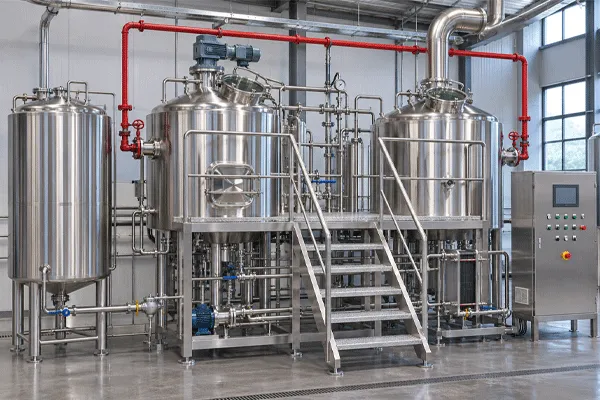
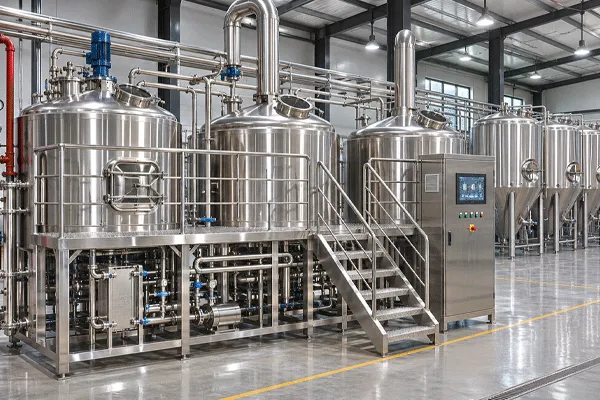
A steam-heated brewhouse uses a boiler or steam generator to produce steam, which travels through insulated pipes into jackets or coils around brewing vessels. As steam condenses, it releases heat through the vessel wall into the mash or wort. Control valves regulate heat input, while steam traps remove condensate.
1. What Is a Steam-Heated Brewhouse?
Una sala de cocción calentada por vapor es un sistema de elaboración cervecera que utiliza vapor como fuente principal de calor para la maceración, el calentamiento del mosto y la ebullición. En lugar de colocar un quemador directamente debajo de la caldera o instalar resistencias de calentamiento dentro del recipiente, el sistema transfiere calor a través de una camisa o serpentín que rodea el tanque de elaboración.
El sistema básico incluye varios componentes:
-
Steam boiler: Produces steam by heating treated water.
-
Tuberías de vapor: transportan el vapor desde la caldera hasta los recipientes de elaboración.
-
Camisas de vapor: proporcionan un espacio cerrado alrededor del recipiente para la transferencia de calor.
-
Válvulas de control: regulan el flujo de vapor según los requisitos de calentamiento.
-
Temperature sensors: Monitor the temperature of the brewing liquid.
-
Purgadores de vapor: eliminan el agua condensada al tiempo que retienen el vapor útil dentro del sistema.
-
Condensate return pipes: Carry collected water back to the boiler system when a return arrangement is used.
Esta disposición permite que la cervecería utilice una fuente central de calentamiento para varios recipientes. Según la configuración del equipo, el vapor puede suministrar calor a una cuba de maceración, a una caldera de cocción o a un tanque de agua caliente (HLT).
Para cervecerías comerciales, the main advantage is not simply high heating power. It is the ability to control heat input across different brewing stages while keeping the heating medium separate from the product.
2. How Does a Steam Boiler or Steam Generator Work?
The steam boiler is the starting point of the heating process. It receives water, applies energy, and produces steam at a designed operating pressure and temperature.
Según la ubicación de la cervecería y la disponibilidad de suministros, la caldera puede utilizar gas natural, GLP, electricidad u otra fuente de energía autorizada. Un generador de vapor eléctrico también puede suministrar vapor a instalaciones más pequeñas. La elección adecuada depende de los suministros disponibles, la producción de vapor requerida, las normativas locales y los costos operativos.
El proceso de funcionamiento básico es el siguiente:
-
El agua entra en la caldera a través de un sistema controlado de agua de alimentación.
-
La fuente de calor eleva la temperatura del agua.
-
El agua se convierte en vapor.
-
El vapor se acumula y se desplaza hacia la tubería de distribución.
-
Requisitos de calentamiento del hervidor y tiempo de calentamiento deseado.
-
Requisitos de ajuste de temperatura del macerado.
-
Tiempo de recuperación del tanque de agua caliente.
-
Número de recipientes que funcionan simultáneamente.
-
Pérdidas en la distribución de vapor.
-
Ampliación de producción prevista en el futuro.
El sistema suministra vapor a los recipientes de elaboración según sea necesario.
La caldera debe suministrar suficiente vapor para cubrir el pico de demanda de calentamiento de la cervecería. Esto es fundamental, ya que varios recipientes pueden requerir calor simultáneamente. Por ejemplo, la cervecería puede estar calentando el agua de maceración mientras otro recipiente se prepara para la ebullición del mosto.
Al calcular la capacidad de la caldera, tenga en cuenta:
La caldera debe seleccionarse en función de la demanda de vapor calculada, y no simplemente del volumen de la sala de cocción. El fabricante del equipo debe proporcionar el consumo de vapor requerido y las condiciones de funcionamiento para que un proveedor local cualificado de calderas pueda dimensionar la unidad correctamente.
3. How Does Steam Heat the Brewing Kettle?
La camisa de vapor es una de las partes más importantes de un recipiente de elaboración calentado por vapor.
Se trata de un espacio cerrado construido alrededor de una parte del hervidor o tanque. El vapor entra en la camisa a través de una conexión de entrada y se distribuye por el área de calentamiento. A medida que transfiere energía a la pared de acero inoxidable del recipiente, se condensa gradualmente en agua.
A continuación, la pared del recipiente transfiere este calor al líquido de su interior.
This is called indirect heat transfer because steam does not normally mix with the wort. The brewing liquid remains inside the product vessel, while steam stays within the separate jacket.
El proceso consta de tres etapas principales:
| Etapa | Qué sucede | Resultado |
|---|---|---|
| Steam supply | Steam enters the jacket | Heating area receives thermal energy |
| Condensation | El vapor libera calor latente y se convierte en agua | La pared del recipiente se calienta |
| Transferencia de calor | Heat passes through the stainless steel wall | Aumenta la temperatura del macerado o del mosto |
Un beneficio importante es la distribución del calor. Una camisa debidamente diseñada proporciona una superficie de calentamiento mayor que una fuente de calor pequeña y concentrada. Esto ayuda a la cervecería a lograr incrementos controlados de temperatura.
The jacket design, heating area, steam pressure, vessel geometry, and liquid circulation all affect performance.
For this reason, the heating system should be designed together with the kettle rather than selected as an independent component.
4. How Do Steam Pressure and Temperature Control Work?
Steam pressure affects its saturation temperature and therefore the available temperature difference for heat transfer. However, higher pressure does not automatically mean better brewing performance.
The vessel jacket, connecting pipes, valves, and safety devices must all be designed for their specified operating conditions.
A typical control process works as follows:
-
A temperature sensor measures the liquid temperature.
-
The controller compares the measured value with the target.
-
A control signal adjusts the steam control valve.
-
More or less steam enters the jacket.
-
The heating rate changes according to the process demand.
For example, during mash heating, the controller can regulate steam input to help reach a target temperature without excessive temperature changes.
During wort boiling, the system can provide the heat needed to maintain the required boiling intensity.
Modern systems may use PLC automation, temperature sensors, and automated valves to manage these operations. Manual or semi-automatic systems can also be suitable depending on production scale and operator requirements.
Important: Operators should never increase steam pressure beyond the approved design limits to speed up heating. Pressure gauges, pressure-reducing valves, relief devices, and other safety controls must match the engineered system.
For professional brewery equipment, temperature control and pressure safety should be considered together.
5. Why Are Condensate Return and Steam Traps Important?
When steam transfers heat through a jacket, it changes back into liquid water. This water is called condensate.
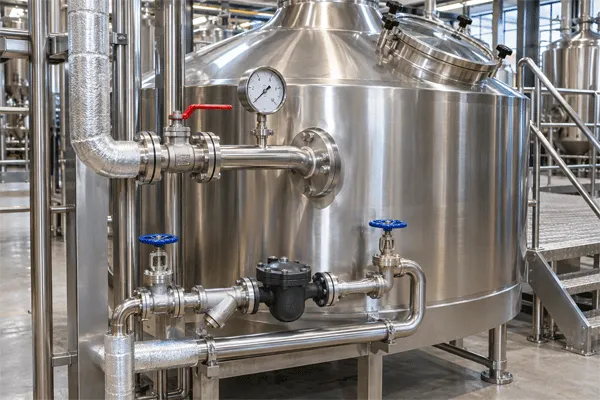
If condensate remains inside the jacket, it can reduce the effective heating area and interfere with heat transfer. Poor drainage can also cause unstable heating and water hammer, which creates noise and potentially damaging pressure shocks in the pipework.
This is why a steam system needs properly selected steam traps.
A steam trap performs three important functions:
-
-
Elimina el condensado de la camisa de vapor.
-
Prevents unnecessary loss of live steam.
-
Helps maintain stable heat transfer.
The condensate can then flow into a collection line and, where the system is designed for it, return to the boiler feedwater circuit.
Una configuración completa puede incluir:
-
Steam supply pipeline
-
Strainer and separator
-
Pressure-reducing valve
-
Steam control valve
-
Jacket inlet
-
Condensate outlet
-
Steam trap
-
Condensate return line
The pipework should also be insulated to reduce heat loss and improve operating conditions.
A well-designed steam system therefore needs more than a boiler and a jacket. The condensate circuit is equally important.
6. Where Is Steam Heating Used During the Brewing Process?
Steam heating can support several stages of the brewing process. Its application depends on the number of vessels and the equipment configuration.
Maceración
During mashing, the brewer mixes crushed malt with hot water. Some mash tuns use steam jackets to adjust the temperature during different mash rests. Controlled heating helps the brewer follow the recipe’s temperature schedule.
Wort boiling
The brew kettle is another major application. Steam enters the kettle jacket and transfers heat through the vessel wall. The system provides the energy needed to bring wort to a boil and maintain the required boiling conditions.
Hot liquor preparation
The hot liquor tank stores heated brewing water. Depending on the system design, steam heating can bring water to the required temperature before it is used for mashing, sparging, or cleaning.
Multiple-vessel operation
In a larger brewery, different vessels may need heat at different times. A central steam boiler can supply several heating points through a properly sized distribution network.
|
Brewing Stage |
Steam Heating Application |
Objetivo principal |
|---|---|---|
| Maceración | Camisa de la cuba de maceración | Ajuste de temperatura |
| Wort boiling | Brew kettle jacket | Bring wort to boiling temperature |
| Preparación del agua | HLT jacket or coil | Calentar el agua de elaboración |
| Cleaning support | Hot water system | Prepare hot cleaning water |
The exact configuration depends on the brewing system. Not every vessel needs a steam jacket, and some breweries use separate heating arrangements for different operations.
7. Steam vs Electric vs Direct Fire: What Are the Differences?
Steam, electric heating, and direct fire are three common heating options for brewery equipment. Each has different installation requirements and operating characteristics.
The best option depends on brewery size, available utilities, production schedule, and investment budget.
| Comparación | Calentamiento por vapor | Calefacción eléctrica | Fuego directo |
|---|---|---|---|
| Fuente de calor | Steam boiler or generator | Electrical power | Gas or other approved fuel |
| Transferencia de calor | Jacket or coil | Elements or designed heating assembly | Quemador y cámara de combustión |
| Control de temperatura | Steam flow and pressure control | Electrical power control | Burner output control |
| Instalación | Boiler and steam distribution | Infraestructura eléctrica | Fuel and exhaust systems |
| Multiple vessels | Can serve several vessels | Depends on electrical system design | Usually requires individual burners |
| Main consideration | Boiler and condensate management | Connected electrical load | Combustion and ventilation safety |
Calentamiento por vapor
Steam heating is commonly used in professional multi-vessel breweries. A central boiler can provide heat to several vessels, and the jacket arrangement supports controlled indirect heating.
However, boiler installation, water treatment, pressure equipment inspection, and steam pipe maintenance add complexity.
Calefacción eléctrica
Electric heating can be suitable for smaller breweries and brewpubs where electrical infrastructure is sufficient.
It avoids the need for a combustion-based boiler, although high-capacity systems may require substantial electrical power and suitable distribution equipment.
Direct Fire Heating
Direct fire uses a gas burner to generate heat beneath or around the kettle through a designed fire box.
El sistema requiere aire de combustión adecuado, ventilación de gases de escape, controles del quemador y protecciones de seguridad. La distribución del calor y la construcción del recipiente deben diseñarse minuciosamente para reducir el sobrecalentamiento localizado.
The term electric vs. steam vs. direct fire should therefore be evaluated from the complete installation perspective, not just the purchase price of the kettle.
ZPET offers customized brewhouse configurations with all three heating options. You can explore the available systems on the Brewhouse Systems product page.
8. What Brewery Utilities and Safety Systems Does Steam Heating Require?
A steam-heated brewery needs more supporting infrastructure than the brewing vessels themselves.
The boiler room should be planned according to the boiler manufacturer’s requirements and local pressure-equipment regulations. The design may need suitable ventilation, combustion air, water treatment, drainage, electrical connections, and maintenance access.
The steam distribution system also needs correct pipe sizing and insulation. Long steam lines can increase heat loss and create additional condensate management requirements.
Entre los componentes clave se incluyen:
| Componente | Función |
|---|---|
| Boiler or steam generator | Produces steam |
| Feedwater treatment | Helps control scale and corrosion |
| Steam header | Distributes steam |
| Pressure-reducing valve | Controls downstream pressure |
| Safety relief valve | Protects equipment against excessive pressure |
| Manómetro | Displays operating pressure |
| Sensor de temperatura | Monitors process temperature |
| Steam trap | Removes condensate |
| Retorno de condensado | Recovers collected water where designed |
Safety is essential because steam systems contain hot fluid under pressure.
The boiler and jacket must meet applicable pressure equipment requirements. Depending on the installation location, local inspection, registration, operator qualification, and periodic maintenance may also be required.
Never treat a standard stainless steel brewing tank as a pressure-rated steam vessel unless its design and documentation specifically support that service.
9. What Do Real ZPET Steam-Heated Brewery Projects Show?
ZPET’s existing brewery projects demonstrate how steam heating can be integrated into different brewing capacities and equipment configurations.
These examples are useful because the heating method is only one part of the complete brewery design.
300L Brewery Equipment Project in the Philippines
The 300L brewery project uses steam-heated brewing vessels with steam inlet and outlet connections. The configuration also includes a hot liquor tank, sanitary pumps, valves, and supporting equipment.
The steam jacket provides indirect heat transfer to support stable wort heating.
Read the 300L Brewery Equipment Project.
500L Two-Vessel Brewhouse Project
This project features a 500L two-vessel brewhouse, a separate hot water tank, and a fermentation area.
The steam heating arrangement is integrated into the brewhouse, while the separate hot water tank supports brewing water preparation.
Read the 500L Two-Vessel Brewing System Project.
Australia 3000L Commercial Brewery Project
For a larger production requirement, ZPET supplied an Australian customer with a 3000L three-vessel brewhouse featuring steam heating and PLC control.
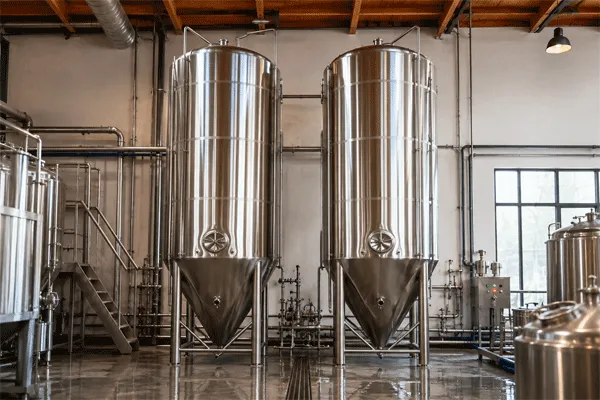
The project also included 3000L stainless steel fermentation tanks with side manways.
This example shows how steam heating can be integrated into a larger automated brewing system with dedicated fermentation capacity.
Read the Australia 3000L Brewery Equipment Project.
These projects illustrate that the same heating principle can be adapted to different capacities. The boiler, steam distribution, vessel jackets, and controls must be matched to each individual brewery.
10. How Do You Choose the Right Steam Heating System for Your Brewery?
Choosing a heating source requires a complete review of the brewery’s production requirements and available infrastructure.
A small craft brewery may not need a large boiler. A commercial brewery running several batches per day may benefit from a central steam system that serves multiple vessels.
Before selecting equipment, evaluate the following:
1. Production capacity
Calculate the required batch volume and number of batches per day. This helps determine the heating load and required steam output.
2. Brewhouse configuration
A two-vessel system may have different simultaneous heating demands from a three- or four-vessel system. Consider the full process schedule.
3. Boiler capacity
Calculate peak steam consumption based on vessel heating requirements, heat-up time, and simultaneous operation.
4. Building conditions
Check available space for the boiler room, steam pipelines, ventilation, drainage, and maintenance access.
5. Local utilities and regulations
Compare electricity and fuel costs, water availability, boiler installation requirements, and local pressure-equipment rules.
6. Automation requirements
Decide whether manual valves, semi-automatic control, or PLC-based temperature management is suitable.
A practical purchasing checklist
Before confirming a steam-heated brewhouse order, request the following information from your manufacturer:
-
Vessel capacity and working volume
-
Steam jacket heating area
-
Required steam pressure at the equipment inlet
-
Steam consumption under defined operating conditions
-
Recommended boiler output
-
Steam inlet and condensate outlet connections
-
Control valve and temperature sensor configuration
-
Safety device specifications
-
Electrical requirements
-
Cleaning and maintenance instructions
-
Installation drawings and utility connection diagrams
Also confirm whether the boiler, steam pipelines, installation materials, and commissioning services are included in the quotation.
The boiler is often supplied separately because it requires local installation and regulatory approval. ZPET can help define the required steam conditions and equipment interfaces so the brewery can coordinate with a qualified local boiler supplier.
As a professional brewery equipment manufacturer, we focus on customized stainless steel brewing systems, fermentation tanks, and complete brewery configurations. Our goal is to match the heating method with the actual production process rather than offer the same arrangement to every customer.
Explore ZPET’s Microbrewery and Commercial Plant Solutions to learn more about integrated brewery planning.
Preguntas frecuentes
Does steam enter the beer during brewing?
No. In a standard indirect steam-heated brewhouse, steam remains inside the jacket or heating coil and transfers heat through the stainless steel wall. It does not mix with the wort.
What is the difference between a steam boiler and a steam generator?
Both produce steam for heating. Their construction, capacity, operating design, and installation requirements can differ. The appropriate choice depends on the required steam output, operating conditions, available utilities, and local regulations.
Can one steam boiler heat multiple brewing vessels?
Yes. A properly sized central steam system can supply several vessels through a distribution network. However, boiler capacity must account for peak simultaneous demand rather than adding vessel capacities alone.
Does a steam-heated brewhouse need a steam trap?
Yes. Steam traps remove condensate from the steam jacket and associated pipelines while preventing unnecessary loss of live steam. Correct condensate removal supports stable heat transfer.
Is steam heating better than electric heating for a brewery?
Neither is universally better. Steam heating is often suitable for larger multi-vessel systems, while electric heating can be practical for smaller breweries with sufficient electrical capacity. The decision depends on production scale, installation cost, energy prices, and available utilities.
Is the steam boiler included when purchasing brewery equipment?
Not always. Some manufacturers supply the boiler separately because local installation, inspection, and approval may be required. Buyers should confirm the boiler scope and required steam specifications before signing the equipment contract.
Puntos clave
-
A steam-heated brewhouse uses a boiler or generator to produce steam.
-
Steam transfers heat through jackets or coils without normally contacting the wort.
-
Steam condensation releases heat through the stainless steel vessel wall.
-
Control valves and temperature sensors regulate heating performance.
-
Steam traps remove condensate and help maintain efficient heat transfer.
-
Boiler capacity must match the brewery’s peak steam demand.
-
Steam, electric, and direct-fire heating each have different installation requirements.
-
Boiler safety, pressure ratings, ventilation, and local regulations must be considered.
-
ZPET offers customized steam, electric, and direct-fire brewhouse configurations.
-
The right heating system should match production capacity, vessel configuration, available utilities, and future brewery expansion.
Planning a new brewery or upgrading your existing brewhouse? Contact ZPET with your target batch capacity, vessel configuration, and local utility conditions. Our team can help develop a customized brewing system and heating solution for your project.