A brewhouse can look large enough on paper yet still slow production when mash, lauter, boil, and whirlpool steps compete for the same vessel. If you expect several brews in one day, vessel count matters. The right system matches your brew schedule, not just your batch size.
A 2-vessel brewhouse is usually better for breweries prioritizing compact layout, simpler operation, and lower initial investment. A 3-vessel brewing system becomes more attractive when you need faster batch turnover and more process overlap. The best choice depends on brews per day, labor, heating capacity, utilities, cellar capacity, and future production goals.
1. Why Does Vessel Count Matter More When You Brew Multiple Batches?
When a brewery makes only one batch on a brew day, both a 2 vessel and 3 vessel system may complete the job successfully. The difference becomes much more important when the brewer wants to start the next batch before the first one has completely left the hot side.
A commercial brewhouse handles several main steps:
- Mash the grain with hot water.
- Lauter and separate the liquid wort from the grain bed.
- Boil the wort and add hop additions.
- Whirlpool the wort before cooling.
- Transfer wort to the fermenter.
If several of those jobs share the same vessel, the next brew has to wait.
That waiting time is the real reason vessel configuration matters.
A 2-vessel brewhouse commonly combines mash and lauter functions in one tun and uses a second vessel as the kettle and whirlpool. It is simple, compact, and practical for many small breweries.
A 3 vessel brewhouse separates more of the process. Depending on the configuration, the system may use a mash tun, separate lauter tun, and kettle/whirlpool vessel. This lets the brewer move one batch forward while preparing another stage elsewhere.
In other words:
More vessels do not automatically make better beer. They create more opportunities to keep the brewing process moving.
That distinction should guide your equipment decision.
2. How Does a 2-Vessel Brewing System Affect Brew-Day Throughput?
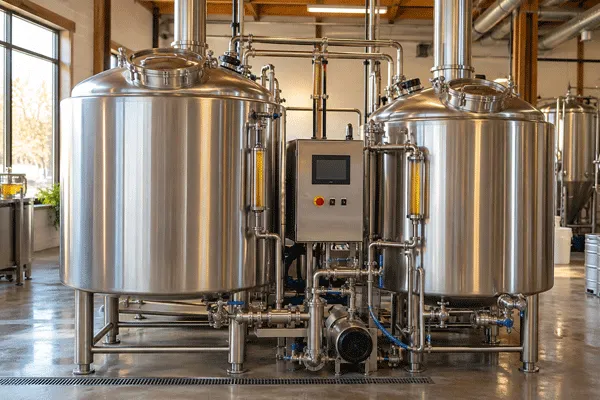
A typical 2-vessel brewing system may use:
- Mash/Lauter Tun
- Kettle/Whirlpool
This arrangement works well when a brewery wants a professional brewing process without using too much floor space.
During the mash, malt and water remain in the mash/lauter tun. After conversion, the brewer performs lautering and sparging in the same vessel. The liquid wort then moves to the brew kettle, where boiling and hop additions take place.
While the wort boils, the first vessel may eventually become available for cleaning and preparation. However, the next mash cannot always start immediately because the brewer must complete lautering, transfers, spent grains removal, and cleaning first.
That creates a natural gap between batches.
Practical strengths of a 2-vessel system
A 2-vessel brewhouse can be attractive because it offers:
- Fewer large tanks
- Smaller brewing area
- Simpler piping
- Fewer valves and controls
- Lower initial capital requirement
- Easier operation for a small brewing team
- Good suitability for one-batch brew days
For a brew pub producing fresh beer mainly for onsite sales, that may be enough.
If you brew one batch today and another tomorrow, maximizing overlapping operations may not add much business value.
The question changes when your brewery needs two, three, or more batches on the same day.
3. How Does a 3-Vessel Brewhouse Increase Process Overlap?
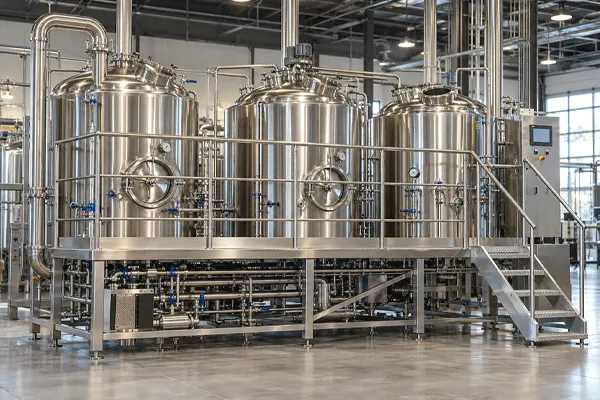
A 3-vessel brewhouse gives the brewer another dedicated process space.
A common three vessel configuration includes:
- Túnel de lavado
- Túnel de filtrado
- Kettle/Whirlpool
After the mash finishes, the mash can move into the lauter tun. That frees the mash tun earlier.
While the first batch is lautering or moving toward the kettle, the brewer may begin preparing the next mash, depending on tank layout, hot water availability, transfer capacity, and operating method.
This overlap is the main reason many growing breweries consider a 3 vessel brewing system.
The third vessel does not magically shorten mash conversion or boiling time. Instead, it reduces the amount of time one production step must wait for another vessel to become free.
Simplified workflow comparison
| Stage | 2-Vessel System | 3-Vessel System |
|---|---|---|
| Mash | Mash/Lauter Tun | Túnel de lavado |
| Lauter | Same Mash/Lauter Tun | Separate Lauter Tun |
| Boil | Kettle/Whirlpool | Kettle/Whirlpool |
| Next mash start | Must wait longer | Can potentially begin earlier |
| Process overlap | Limited | Greater |
| Best use | Lower batch frequency | Repeated brew cycles |
A three vessel system therefore becomes more valuable when time between batches matters financially.
For a brewery that produces one brew per day, the extra vessel may remain underused.
For one producing several batches back-to-back, it can become a major part of daily production efficiency.
4. 2-Vessel vs 3-Vessel: How Many Batches Can You Brew Per Day?
This is the question buyers should ask before selecting a system.
Do not ask only:
“How many barrels is the brewhouse?”
Also ask:
“How many times must I fill that brewhouse every day?”
ZPET’s current brewhouse configuration framework positions its compact two-vessel arrangement around lower-frequency brewing, while its three-vessel configuration is intended for higher-growth operations that need more back-to-back production.
The exact number of brews per day always depends on:
- Mash duration
- Lautering speed
- Heating rate
- Wort transfer time
- Boiling time
- Whirlpooling time
- Limpieza
- Water preparation
- Operator experience
- Automation
- Recipe type
So there is no universal rule that every 3-vessel brewhouse produces exactly three batches while every 2-vessel system produces one.
Still, the workflow difference is clear.
Illustrative production example
Assume a brewery needs 30 BBL of wort per production day.
Option A: 10 BBL 2-vessel brewhouse
The brewer needs:
3 × 10 BBL batches
If each brew is largely sequential, the production day can become long. Labor extends into cleaning and cellar transfer.
Option B: 10 BBL 3-vessel brewhouse
The brewery still needs:
3 × 10 BBL batches
But selected stages can overlap. The second mash may begin before the first brew completes every hot-side step.
The total brewing volume has not changed.
The workflow has.
That difference becomes even more important when a brewery is making larger batches day after day.
5. Which Vessel System Uses Labor More Efficiently?
Labor is often overlooked when buyers compare brewing equipment.
A lower-cost 2-vessel system may save money at the time of purchase. But if higher production later requires a brewer and assistant to work longer brew days several times a week, operating cost can rise.
The important metric is not simply:
equipment price
It is:
cost per usable batch over the working life of the brewery.
A compact system can still be the better financial choice when production is modest.
For example, imagine a brewpub needs only:
- Two brew days per week
- One batch on each brew day
- Several rotating beers
- No major wholesale distribution
A 3-vessel system may not generate enough additional production value to justify the extra vessel, controls, piping, utility demand, and floor space.
Now consider a regional craft brewery that needs:
- Three batches on production days
- Several brew days per week
- Continuous fermenter demand
- Regular keg or can packaging
In this case, reducing waiting time between batches may improve how the brewery uses labor.
One brewer can supervise several overlapping tasks more effectively when the brewing system, automation, valves, pumps, and operating platform are designed around that workflow.
This is why we look at production goals before vessel count when designing custom systems.
6. Do Mash Tun and Lauter Tun Separation Improve Brewhouse Efficiency?
Separating the mash tun and lauter tun can improve workflow, but it should not be confused with a guarantee of higher extract efficiency.
Brewhouse efficiency depends on many factors:
- Grain crush
- Mash temperature
- Water-to-grain ratio
- pH
- Grain bed depth
- Lauter screen design
- Sparging method
- Wort flow rate
- Operator technique
A dedicated lauter tun gives the brewer more control over the lautering stage and allows the mash vessel to become available sooner.
That is primarily a production-flow advantage.
For recipes with large grain bills or more demanding lautering, dedicated equipment can also make the process easier to manage. The lauter tun can be designed around grain bed geometry, false-bottom area, rakes, spent grains removal, and wort collection.
Meanwhile, the mash tun can be optimized for mixing and temperature control.
However, a properly engineered 2-vessel brewhouse can also achieve reliable wort quality.
Do not select a 3v system simply because someone claims “three vessels make better beer.”
Better beer depends on process consistency.
Choose three vessels when the workflow benefit supports your business.
7. How Do Kettle and Whirlpool Configuration Affect the Decision?
The phrase “3-vessel brewhouse” does not always describe exactly the same equipment.
One supplier may offer:
Mash + Lauter + Kettle/Whirlpool
Another may offer:
Mash/Lauter + Kettle + Whirlpool
Those two systems both contain three major vessels, but they solve different production problems.
This is why buyers should compare vessel functions, not just count tanks.
Configuration A: Separate Mash and Lauter
Best when the brewery wants to free the mash tun earlier and improve batch overlap.
Configuration B: Separate Kettle and Whirlpool
Best when the brewery wants the boil kettle available sooner after wort moves to a dedicated whirlpool vessel.
A separate whirlpool can become especially useful when repeated brewing causes the kettle to become the production bottleneck.
Once boiling finishes, wort can transfer to the whirlpool. The brew kettle is then available sooner for the next batch.
For higher-volume production, that may shorten the interval between brews.
This also explains why a 4 vessel or four-vessel system usually separates more stages:
Mash + Lauter + Kettle + Whirlpool
A typical four-vessel brewhouse is designed for breweries where continuous or near-continuous hot-side production matters.
So when selecting a system, ask:
Which vessel is most likely to become my bottleneck?
That question is more useful than simply asking whether two, three, or four vessels are “best.”
8. What Do Utilities Have to Do With Vessel Brewing System Throughput?
Adding another vessel is useful only when the brewery’s utilities can support it.
Imagine buying a 3-vessel system to run back-to-back batches, but your hot liquor supply cannot prepare enough water for the second mash.
Production still waits.
The same problem can happen with steam.
A larger or more active brewhouse may need enough boiler capacity to heat multiple vessels at overlapping times.
Important utility checks include:
Hot water
Hot liquor tanks must support:
- Strike water
- Agua de lavado
- Limpieza
- Repeated brew cycles
Calefacción
Electric, steam, and direct-fire systems all create different engineering requirements.
For repeated commercial production, steam is often selected because it can support stable heating across appropriately designed vessels. Smaller systems may use electric heating where local power infrastructure allows it.
Cold water
The brewery needs sufficient cold water or glycol-supported cooling to reduce wort temperature before fermentation.
Pumps and piping
A slow transfer can erase the throughput advantage created by an extra vessel.
Pump capacity, pipe diameter, valve arrangement, and automation all affect how quickly wort moves through the system.
CIP
More brewing also means more cleaning.
If the CIP process cannot keep up, cleaning becomes the next bottleneck.
This is why our engineering approach treats the brewhouse as part of a complete brewery rather than an isolated piece of beer brewing equipment.
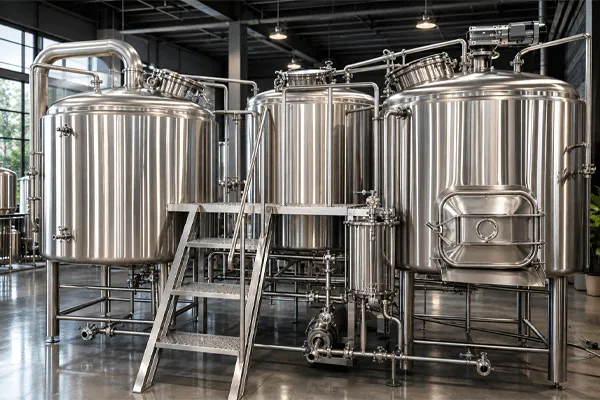
9. Does a 3-Vessel System Need More Floor Space?
Usually, yes.
An extra vessel needs physical room. But floor space is only part of the issue.
A professional brewing area also needs:
- Operating clearance
- Platform access
- Safe stairs
- Grain handling space
- Pipe routes
- Valve access
- Pumps
- Control panels
- Drainage
- Cleaning access
- Maintenance space
A compact brewery should therefore evaluate usable operating space, not only the tank footprint shown on a drawing.
For some small breweries, this makes a two-vessel layout the smarter option.
A brewpub may have a high-value commercial location where every square meter matters. Adding a third vessel could reduce customer seating, cold room space, or cellar capacity.
In a purpose-built production brewery, the calculation changes.
Floor space may be less valuable than daily throughput. If the extra vessel allows the brewery to produce more wort using the same working day, it may justify the larger brewing area.
Simple decision framework
| Situation | Likely Better Fit |
|---|---|
| Tight building | 2 recipientes |
| One batch per brew day | 2 recipientes |
| Lower startup budget | 2 recipientes |
| Frequent double brewing | 3 vasos |
| Several back-to-back batches | 3 vasos |
| Distribution-focused growth | 3 vasos |
| Continuous high-output brewing | Consider 4-vessel |
The right vessel type depends on the complete project.
10. When Should a Brewery Upgrade From 2-Vessel to 3-Vessel Brewing?
A brewery should consider upgrading when the existing brewhouse becomes the reason production cannot meet demand.
Common warning signs include:
- Brew days are becoming too long.
- You regularly need two or more batches in one day.
- The next mash waits for the current batch to finish lautering.
- Fermenters are available, but the hot side cannot fill them fast enough.
- Labor hours per batch are rising.
- Wholesale demand is increasing.
- Packaging and cellar capacity can already handle more beer.
- Your production goals exceed the practical output of the current brewhouse.
Do not upgrade simply because the brewery is growing.
First find the real bottleneck.
Sometimes the brewhouse is not the problem.
You may actually need:
- More fermenters
- Bigger fermenters
- More glycol capacity
- Faster packaging
- Additional cold storage
- A larger hot liquor tank
- Better automation
For example, installing a 3-vessel brewhouse does little for production if every fermenter is already full.
The hot side and cold side must grow together.
Illustrative expansion case
Consider a 10 BBL craft brewery.
Stage 1
- 2-vessel system
- 2–3 brew days per week
- 1 batch per day
- Mostly taproom sales
The system may operate efficiently.
Stage 2
Demand increases.
The brewery now needs:
- 5–6 batches per week
- Wholesale keg sales
- Regular packaging
- More predictable production days
The brewer begins double brewing.
At this point, waiting between mash, lauter, and kettle operations starts to matter.
A 3-vessel brewhouse or another workflow upgrade may become commercially attractive.
The upgrade decision comes from production pressure, not from vessel count alone.
11. When Should You Consider a 4-Vessel Brewhouse Instead?
There is a point where comparing only 2 or 3 vessel systems becomes too narrow.
A brewery planning several brews every day may need a 4 vessel configuration.
A common four-vessel system separates:
- Mash
- Lauter
- Kettle
- Whirlpool
This allows different brewing stages to move through dedicated equipment.
The goal is not complexity for its own sake.
The goal is shorter cycle time between batches.
For regional breweries and other higher-output plants, this can support a more continuous production rhythm.
However, a four-vessel brewhouse generally means:
- Higher equipment investment
- Larger brewing area
- More piping
- More valves
- Greater utility requirements
- More automation
- More complex installation
If your production plan does not need that throughput, the additional equipment may sit underused.
A correctly sized 3 vessel system can therefore be more economical than an oversized four-vessel brewhouse.
The best solution is the smallest system that reliably meets your production target with reasonable room for growth.
12. How Should a B2B Buyer Compare 2-Vessel and 3-Vessel Brewhouse Quotes?
Do not compare quotations using only:
“Supplier A has three tanks and Supplier B has two.”
Instead, compare the complete process.
Ask each equipment manufacturer to identify:
- Exact function of every vessel
- Working batch size
- Gross vessel size
- Mash capacity
- Grain loading capacity
- Lauter screen design
- Heating method
- Heating power
- Estimated transfer rates
- Pumps
- HLT capacity
- Wort cooling
- CIP
- Automation
- Platform
- Floor-space requirement
- Number of expected brews per day
- Installation scope
Also ask how the proposed system connects to your fermenter schedule.
A brewhouse that can produce three batches per day is useful only if your fermentation cellar can receive those batches.
Buyer comparison table
| Purchase Question | Por qué es importante |
|---|---|
| What does each vessel do? | Prevents misleading vessel-count comparisons |
| How many brews per day are realistic? | Defines production throughput |
| What limits the next batch? | Identifies bottlenecks |
| What utility capacity is required? | Prevents site infrastructure problems |
| How much labor is needed? | Affects operating cost |
| Can automation be added? | Supports future growth |
| Can another vessel be added later? | Improves expansion flexibility |
| Is the cellar sized for output? | Prevents hot-side overcapacity |
At ZPET, we design customized stainless steel brewhouses around batch volume, vessel functions, brew frequency, building dimensions, utility conditions, labor plan, and fermentation capacity.
That approach is more useful than selling the largest system a customer can afford.
FAQs About 2-Vessel and 3-Vessel Brewing Systems
Is a 3-vessel brewhouse always faster than a 2-vessel brewhouse?
Not always. A 3-vessel system creates more opportunities for overlapping work, but actual throughput still depends on heating, transfers, lautering, cleaning, water supply, automation, and operator workflow.
Can a 2-vessel brewhouse produce commercial craft beer?
Yes. Many small breweries and brewpubs can operate effectively with a professional 2-vessel system. It is especially practical when the brewery does not need several back-to-back batches each day.
What is the most common 2-vessel configuration?
A common commercial layout uses a mash/lauter tun and a combined kettle/whirlpool vessel. Other arrangements are possible, so buyers should always confirm the actual vessel functions.
What is the most common 3-vessel configuration?
One common 3-vessel brewhouse uses separate mash and lauter vessels with a combined kettle/whirlpool. Another design may combine mash/lauter and separate the kettle and whirlpool. The best configuration depends on where the brewery needs more process overlap.
Is BIAB the same as a commercial single-vessel brewing system?
No. BIAB, or Brew in a Bag, usually refers to a compact brewing method in which grain remains in a bag during the mash. An electric BIAB system or all-in-one system can work well for home brewing and some pilot applications, but a commercial vessel brewing system must be evaluated for sanitary design, working volume, cleaning, controls, and production throughput.
When should I choose a 4-vessel brewhouse?
Consider four vessels when repeated daily batches and short cycle times are central to the business model. If you only brew once or twice per day, a properly designed 2-vessel or 3-vessel brewhouse may be more economical.
Puntos clave
- A 2-vessel brewhouse is best when compact layout, lower investment, and simpler operation matter more than maximum batch overlap.
- A 3-vessel brewing system becomes more valuable when the brewery regularly runs back-to-back batches.
- Vessel count affects workflow more than beer quality.
- A separate mash tun and lauter tun can free equipment earlier for the next brew.
- A separate whirlpool can release the brew kettle sooner.
- More vessels only improve output when heating, water, pumps, CIP, and other utilities can support the faster workflow.
- Compare the exact function of every vessel rather than only counting tanks.
- Floor space should include operating and maintenance clearance, not just equipment dimensions.
- Check fermentation capacity before increasing hot-side output.
- If the brewery needs continuous high-volume production, a four-vessel system may make more sense.
- Choose equipment around brews per day, production goals, labor, utilities, and future growth.
At ZPET, we manufacture customized stainless steel 2-vessel, 3-vessel, and larger commercial brewhouse systems, as well as tanques de fermentación and turnkey brewery equipment for global B2B projects.
If you are selecting a system, send us your target batch size, expected brews per day, annual production target, building dimensions, heating preference, available utilities, and fermentation plan. We can then recommend a vessel configuration designed around how your brewery will actually operate—not simply how many tanks fit on a quotation.