David Zhang | Founder & CEO, ZPET (Shandong ZhongPi Machinery Equipment Co., Ltd.) | Published August 9, 2026
A “complete microbrewery for sale” has no standard scope. Packages reliably include brewhouse vessels, fermenters and a control panel; they routinely exclude the steam boiler, glycol chiller, water treatment, glycol trunk piping, freight and on-site installation. Normalize scope against a 27-line checklist before comparing any two quotations.
Why “complete” and “turnkey” carry no fixed meaning
No industry body defines either word. The Brewers Association defines brewery categories by annual output, with the microbrewery band running up to 15,000 BBL a year (Brewers Association, brewery definitions), but nothing in that framework or anywhere else specifies what a supplier must include when the word “complete” appears in a listing.
The practical consequence is that two packages described identically can differ by a third of the total installed scope. The difference sits almost entirely in the six categories below, and it is not usually hidden — it is simply not mentioned, because the buyer did not ask.
Work through the 27 items as a matrix. Put each supplier in a column, mark every line as included, optional, quoted separately or excluded, and only then compare.
Brewhouse: items 1–6
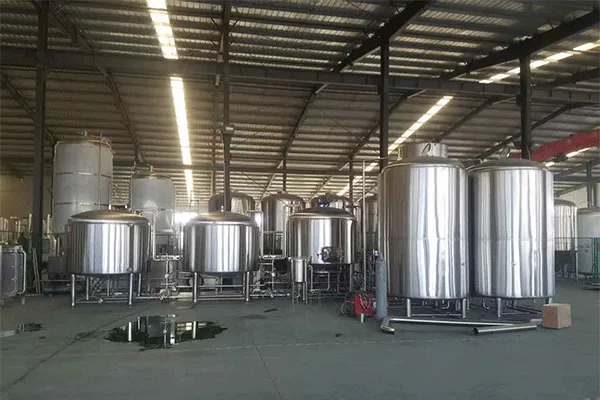
- Brewhouse vessels, with volumes stated two ways. Ask for total shell volume and working volume per vessel, plus the vessel count by function. Suppliers differ on whether the hot and cold liquor tanks are counted in a headline “3-vessel” or “4-vessel” figure, which alone can make two quotes look mismatched when the equipment is equivalent.
- Hot liquor tank and cold liquor tank. Frequently listed as vessels in the count but priced as separate items, or omitted where a supplier assumes you will heat water elsewhere. Confirm capacity relative to a full brew’s strike and sparge demand, not to batch size.
- Mill and grist handling. This is the most common omission inside the brewhouse group. A two-roller or four-roller mill, a grist case, and an auger or flexible screw conveyor are three separate line items, and packages regularly include none of them. Ask for mill throughput in kg/h and check it against your target mash-in time.
- Wort pumps, hoses and fittings. Count the pumps and ask whether variable frequency drives are included. Hoses, tri-clamp fittings and gaskets are consumable-adjacent and often left off entirely, which is a small line that stalls commissioning when it is missing.
- Wort heat exchanger, single or two-stage. A single-stage plate heat exchanger cooled by mains or cold liquor water cannot reach ale pitching temperature in a warm climate. Two-stage units need a glycol connection, which loops back to item 12. Ask for the design knockout duration and the coolant inlet temperature the sizing assumed.
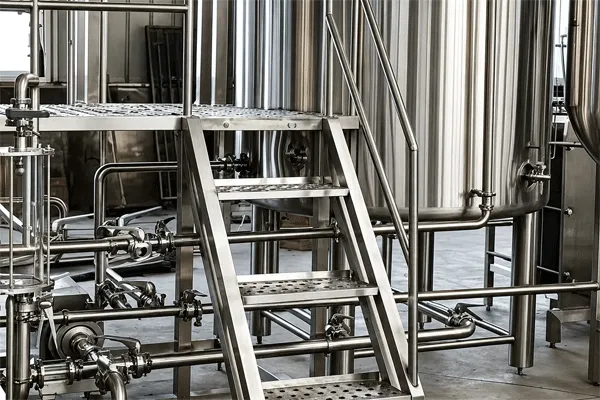
- Operating platform, stairs and handrails. Sometimes supplied, sometimes marked “customer to fabricate locally.” If supplied, ask for the load rating and whether the handrail geometry satisfies your local workplace code, because a platform that fails inspection is a platform you rebuild.
Cellar: items 7–11
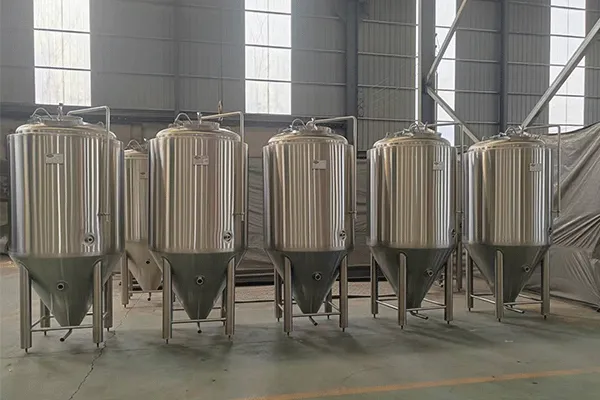
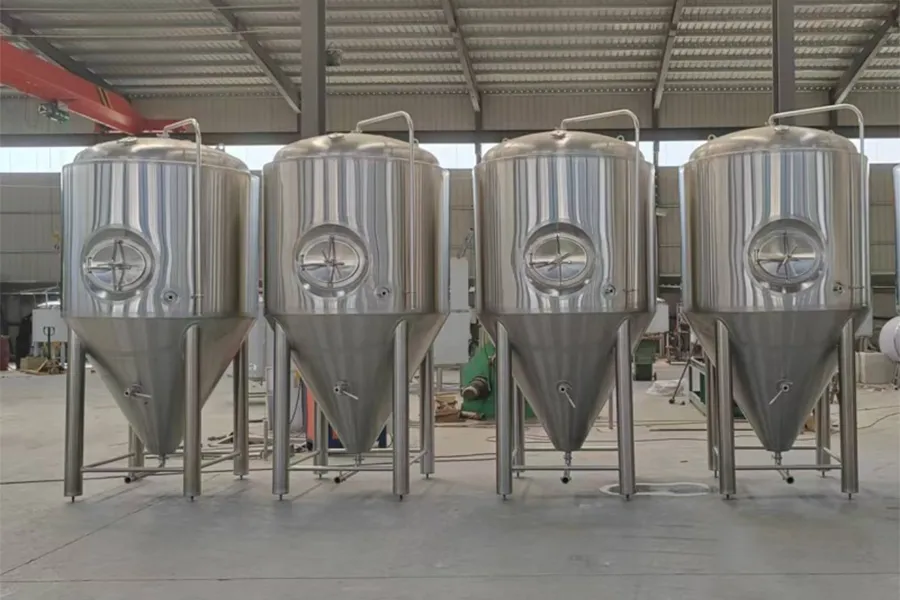
- Ферментационные баки, counted and volumed. Confirm the count and, again, working volume against total shell volume. Fermenters need 20–25% headspace for krausen, so a tank sold at your batch size in total volume will not hold your batch.
- Емкости для светлого пива, or unitanks instead. Some packages supply unitanks throughout and no dedicated bright tanks, which reduces vessel count and changes your conditioning capacity. Neither approach is wrong, but the two are not equivalent scope.
- Glycol trunk piping, insulation and per-tank valving. Here is the gap that surprises buyers most in the cellar. The tanks are quoted; the piping between the chiller and the tanks frequently is not. Balancing valves, solenoid valves per tank, insulation and the reverse-return loop are usually “customer’s contractor,” and without balancing the last tank in the loop will not hold setpoint.
- Tank fittings by name. Spray balls, rotatable racking arms, aseptic sample valves, thermowells, pressure relief valves, vacuum breakers, carbonation stones and cone dump valves. Some appear as standard, some as optional. The vacuum breaker in particular is worth confirming in writing, since a tank without one can collapse during a cold rinse after hot CIP.
- CIP system, with a flow rate. Ask whether it is a portable cart or a fixed skid, and get pump delivery in m³/h. Spray device requirements scale with tank circumference at roughly 2.5–3.0 US gpm per foot, so a 2,400 L fermenter needs on the order of 14 m³/h at the spray ball. A cart delivering 6 m³/h will not clean it, regardless of cycle length.
Utilities: items 12–18, where most exclusions live
- Steam boiler. Almost universally excluded, and the single largest omission by value in most packages. It is also a pressure vessel with its own local permitting and inspection regime, which means a local supplier is often the right answer anyway. What the equipment supplier owes you is the required output in kg/h, calculated from your kettle ramp and hot liquor recharge, before you shop for it.
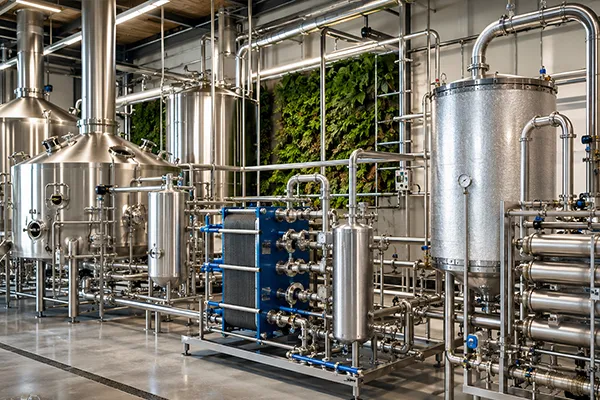
- Glycol chiller. Either excluded or specified thin. Ask for the capacity in kW or tons of refrigeration and, more importantly, ask what load basis produced it. Sizing on coincident peak — knockout overlapping active fermentation and a crash-cool — gives a very different machine than sizing on fermentation load alone.
- Glycol reservoir and circulation pumps. Separate from the chiller, and separately omitted. A reservoir buffers the one-hour knockout spike so the chiller does not have to be sized for it. Ask for reservoir volume and pump head against your trunk run length.
- Air compressor. Needed for pneumatic valve actuation on automated systems. Specify oil-free for anything near product contact, and check the free air delivery against the actuator count rather than accepting a nominal size.
- Water treatment. Carbon filtration, reverse osmosis and chloramine removal are excluded from nearly every package. Whether you need them is a question about your municipal water report, not about the equipment, but the treatment skid is real capital that belongs in your comparison.
- Electrical installation materials. The supplier provides the control panel and motors; cable, conduit, disconnects, and the connection from your service to the panel are almost always local scope. What the supplier does owe you is motors and drives specified for your destination voltage and frequency, because a 400 V / 50 Hz motor set arriving at a 480 V / 60 Hz site is a rewire.
- Effluent handling. A neutralization pit or pH dosing system for CIP discharge sits outside every equipment package I have seen quoted, and at microbrewery volumes it can be the difference between meeting your discharge permit and not. Cheap to build with the slab, expensive later.
Controls and instrumentation: items 19–21
- Control panel, with destination listing named. Semi-automatic or PLC/HMI changes the panel entirely. For North America, ask specifically for UL 508A panel construction with a marked short-circuit current rating, because a panel assembled from listed components is not itself a listed panel and a field evaluation after delivery costs more than specifying it correctly.
- Instrumentation, counted individually. Temperature sensors in thermowells rather than surface-mounted, a flow meter on sparge water if you are automating it, pressure gauges, and tank-level indication if you want it. Ask for the instrument list as a schedule with locations. HMI language and unit display also belong here: English interface with a °F and gallon toggle should be in the order, not a post-delivery request.
- Commissioning spare parts kit. Gaskets in each size, pump seals, one spare RTD, one spare valve actuator. Rarely included by default and rarely expensive, and the absence of it turns a two-hour fix into a three-week wait.
Logistics and commissioning: items 22–26
- Export packing. Seaworthy crating, moisture protection and, for wooden crates, heat treatment or fumigation certification under ISPM 15. Ask what the crate count and total volume will be, since it determines the next four items.
- Freight, with the Incoterms rule stated. This is where line-by-line comparison most often goes wrong. A quotation on EXW terms and a quotation on DAP terms are not comparable numbers, and the gap between them can be substantial for a container of tanks. Get the three-letter Incoterms rule in writing on every quote, and normalize all of them to the same basis before you compare anything.
- Import duty, customs clearance and brokerage. Under CIF you still owe duty, clearance and destination charges; under DDP those sit with the seller. Ask explicitly which party pays duty, who files, and whether destination terminal handling is included.
- Inland transport and rigging into position. Port to your door and door to final position are two different jobs. Rigging tanks through a doorway and into a cellar may need a crane, a forklift with adequate capacity, or removal of a wall section. Measure your access dimensions and share them before the quote, not after the truck arrives.
- Installation, commissioning and training. The critical distinction: “installation support” can mean technicians on your floor or a video call. Ask for the number of technicians, days on site, who pays flights, visas, accommodation and per diem, and how many days of operator training are included and in which language.
Documentation: item 27
- The document package, itemized.Ask for each of these by name, because the equipment can be correct while the paperwork holds your shipment at the port:
- Material certificates traceable to the plate, in EN 10204 3.1 format.
- Welding procedure specifications and welder qualification records, referenced to ISO 3834.
- Pressure and vacuum test records with hold durations and gauge calibration.
- Declaration of conformity and technical file for CE-marked equipment under the Pressure Equipment Directive 2014/68/EU, or the AS 1210 equivalent for Australia.
- Control panel listing documentation and SCCR marking.
- As-built electrical schematics, PLC program backup, and operation and maintenance manuals in English.
The eight exclusions that most often break a comparison
| Excluded item | Why it gets left out | What to ask for |
| Steam boiler | Locally permitted plant; supplier avoids the liability | Required output in kg/h, derived from your kettle ramp and HLT recharge |
| Glycol chiller | Sized late, or sized on fermentation load only | Capacity in kW plus the load basis used |
| Glycol trunk piping and balancing | Falls between equipment and building trades | Line sizes, insulation spec, balancing valve count |
| Mill and grist handling | Treated as an accessory | Throughput in kg/h against target mash-in time |
| Water treatment | Depends on local water, so omitted by default | Your water report reviewed against a stated treatment scope |
| Freight | Quoted at EXW or FOB without flagging it | The Incoterms rule in writing on every quotation |
| Installation labor | “Support” is ambiguous by design | Technician count, days on site, and who pays travel |
| Effluent neutralization | Outside equipment scope entirely | Whether your discharge permit requires it, before the slab is poured |
Two consequences of that table are worth stating plainly. A package that looks materially cheaper usually excludes several rows of it, and once you add them back the ranking can reverse. And a chiller specified on fermentation load alone is not a saving; it is a machine that cannot hold your cellar during knockout, discovered in your first warm month.
ZPET microbrewery scope of supply
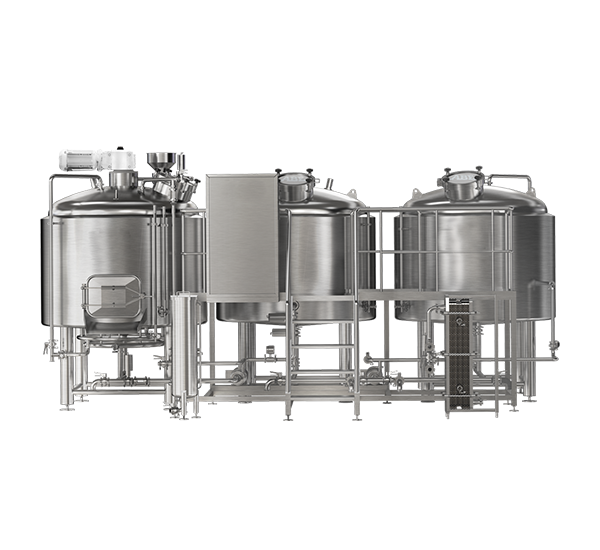
ZPET supplies оборудование для мини-пивоварен at the 7–30 BBL tier as engineered project scope rather than a fixed package, which means the boundary is set per order and written into the quotation.
| Артикул | What applies |
| Capacity tier | Microbrewery, 7–30 BBL (approx. 800–3,500 L); brewhouse configurations from 2-vessel to 5-vessel |
| Отопление | Steam, electric or direct fire, specified to capacity and site utilities |
| Контактные материалы | SS304 / SS316L санитарного класса |
| Отделка интерьера | Зеркальная полировка с точностью 0,4 мкм |
| Охлаждающая рубашка | Dimple jacket, laser-welded |
| Fabrication | Double-sided TIG argon arc welding; CNC laser cutting; automatic welding robots |
| Тестирование | Анализ материалов с помощью спектрометра; 24-часовое испытание на удержание давления; рентгеновский контроль сварных швов; 5-ступенчатый контроль качества |
| Гарантия на конструкцию | 10 лет |
| Соблюдение экспортного законодательства | Разработано с учетом требований PED (CE), UL/cUL и AS1210 |
| Pre-fabrication engineering | 3D brewery layout, technical drawings and process flow charts against your building footprint and utilities |
| Установка | Global on-site installation and commissioning teams |
| Technical response | Within one working day |
| Scope boundary | Confirmed per order; utilities such as boiler and chiller are quoted or excluded explicitly rather than assumed |
| Цены | Стоимость рассчитывается индивидуально для каждого проекта; опубликованного прейскуранта или диапазона цен нет |
The pre-fabrication engineering step is what makes the checklist above answerable rather than theoretical. A 3D layout drawn against measured building dimensions forces the trunk piping, the platform clearance and the rigging path into the open before fabrication, which is when they are cheap to change. Because equipment ships factory-direct without distributor markup, the budget that would sit in trading-company margin goes into plate thickness and component selection instead.
One honest note on scope: no supplier can quote your boiler and your water treatment accurately without your utility survey and your water report. A quotation that includes them without asking for either has guessed.
What this checklist cannot do for you
It does not compare quality at equal scope. Two suppliers can both include every one of the 27 items and deliver tanks with different plate thickness, jacket area and surface finish. Scope normalization is the first step, not the whole evaluation.
It adds work up front. Sending a 27-line matrix to four suppliers takes a day and generates follow-up questions. The alternative is comparing headline figures that describe different things.
Some exclusions are correct. A supplier declining to quote your boiler is often making the right call, since local supply and local permitting usually serve you better. An exclusion is not automatically a gap in the offer; it is a gap in your budget that you now know about.
It cannot tell you what you can afford. No monetary figures appear here, and pricing at this tier moves with capacity, vessel count, automation level and destination compliance requirements. The checklist makes quotations comparable; it does not make them predictable.
Send this with your enquiry
Give every supplier the same six inputs and the 27-line matrix, and the responses come back comparable:
- Target batch size in litres or BBL, stated as working volume.
- Year-three annual output target and active SKU count.
- Clear ceiling height measured to the lowest obstruction, plus door and access dimensions for rigging.
- Available utilities as numbers: steam capacity or boiler kW, electrical service in amps at a stated voltage and frequency, water flow rate.
- Destination country, which fixes the compliance pathway and panel listing.
- Your municipal water report.
Two adjacent subjects this list leaves out. Lead time and payment terms belong in the same conversation but follow different logic, since both are negotiated per order rather than specified. And used equipment changes the checklist substantially: items 22 through 27 get harder, documentation is frequently missing, and a tank with no material certificate or test record is difficult to bring into a regulated market. That deserves separate treatment before anyone buys a secondhand plant across a border.
Часто задаваемые вопросы
Q: What is normally included in a complete microbrewery package?
A: Reliably: brewhouse vessels, hot and cold liquor tanks, fermenters, wort pumps, a heat exchanger, a control panel and tank fittings. Variable: mill and grist handling, CIP system, platform, hoses and instrumentation. Usually excluded: boiler, glycol chiller, glycol trunk piping, water treatment, electrical installation materials, freight and on-site labor.
Q: How much does a complete microbrewery cost?
A: Pricing is quoted per project and no price list is published, because capacity, vessel count, automation tier, tank count and destination compliance requirements move the figure substantially. The more useful step is to normalize scope first: two quotations at different Incoterms and different inclusion lists cannot be compared as numbers at all.
Q: Is the steam boiler included with brewery equipment?
A: Rarely. It is separately permitted and inspected plant in most jurisdictions, so local supply is often the better route. What you should get from the equipment supplier is the required steam output in kg/h, derived from your kettle heat-up ramp and hot liquor recharge schedule.
Q: Why do two microbrewery quotes differ so much?
A: Most often the Incoterms rule and the exclusion list, not the equipment. An EXW quotation excluding boiler, chiller, trunk piping and installation against a DAP quotation including them describes two different projects. Mark all 27 items as included, optional, separate or excluded on both before drawing conclusions.
Q: Does “installation included” mean technicians come to my site?
A: Not necessarily. It can mean remote guidance. Ask for technician count, days on site, and who pays flights, visas, accommodation and per diem, plus the number of operator training days and the language.
Q: What size glycol chiller should be in the package?
A: Ask for capacity in kW and the load basis behind it. A chiller sized on fermentation heat alone will not hold the cellar when knockout overlaps a crash-cool. Sizing should be on coincident peak load, ideally with a glycol reservoir absorbing the knockout spike.
Q: What documents should arrive with the equipment?
A: Material certificates in EN 10204 3.1 format, welding procedure and welder qualification records referenced to ISO 3834, pressure and vacuum test records with hold durations, a declaration of conformity and technical file for CE markings under PED 2014/68/EU or the AS 1210 equivalent, control panel listing documentation, as-built schematics and the PLC program backup.