David Zhang — Founder & CEO, ZPET (Shandong ZhongPi Machinery Equipment Co., Ltd.) Published July 24, 2026
At 2 BBL (approx. 235 L), electric usually wins on permitting simplicity, steam wins on ramp speed if you already have three-phase power, and direct fire wins on upfront cost where gas venting is already in place. The deciding factors are local, not universal.
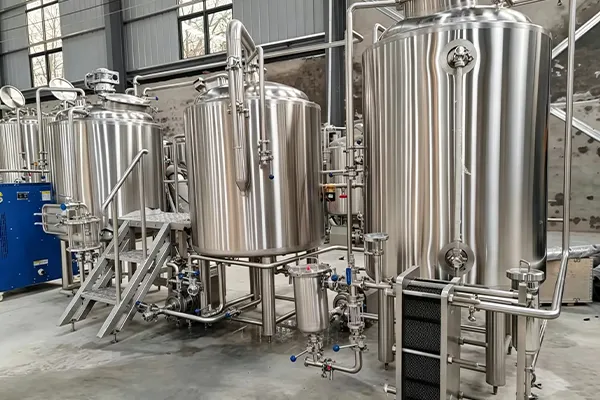
Three Constraints That Decide This, Not Preference
Most comparison pages online rank electric, steam and direct fire by generic pros and cons — faster ramp time, lower running cost, easier install — as if every brewpub sits on the same electrical grid and under the same fire code. It doesn’t work that way. Three site-specific constraints override any general ranking:
- Available amperage and phase.A 2 BBL electric brewhouse typically needs a dedicated three-phase circuit. If your building only has single-phase residential service, the heating elements are the cheap part — the panel upgrade and utility trench work are not.
- Gas permitting and venting.Direct fire needs a Class A chimney or equivalent flue, plus local fire marshal sign-off in most US and EU jurisdictions. Some strip-mall and mixed-use leases simply won’t allow a new roof penetration.
- Boiler regulation.Steam requires a pressure vessel (the boiler itself), which in many states and EU member countries means a licensed boiler operator, periodic inspection, and sometimes a separate boiler room with fire-rated walls.
Skip straight to whichever of these three your building already fails, and the “best” heating method usually picks itself.
Electric, Steam and Direct Fire at 2 BBL: Side by Side
| Factor | Электрический | Steam | Direct Fire |
| Typical power/fuel need | Three-phase electrical service; check panel capacity with a licensed electrician before ordering | Boiler (electric or gas-fired) plus feed water and condensate return | Natural gas or LPG line sized for kettle burner load |
| Venting requirement | None — no combustion, no flue | Boiler flue, sized separately from kettle | Class A chimney or direct-vent above the kettle |
| Typical permitting hurdle | Electrical permit only, in most jurisdictions | Boiler permit + periodic pressure-vessel inspection | Fire marshal / mechanical permit for gas appliance and venting |
| Ramp speed to strike temperature | Slowest of the three, since elements heat through direct contact with the liquid rather than a full jacket | Fastest, due to full-jacket steam contact | Fast, but uneven without good agitation — risk of scorching at the kettle base |
| Ongoing running cost driver | Electricity rate per kWh in your area | Boiler fuel plus boiler maintenance/inspection cost | Gas rate, generally the cheapest fuel per BTU in most US markets |
| Площадь занимаемой территории | Smallest — no boiler room needed | Largest — boiler plus mechanical room | Small, but chimney routing can be the limiting factor in a leased space |
| Where it usually loses out | Slow ramp on back-to-back brew days | Up-front boiler and mechanical-room cost rarely justified below 10 BBL | Scorching risk on darker malt bills; open flame restrictions in some leases |
None of the three is categorically better. A brewpub with three-phase service already run to the building and a tight brew-day schedule has different priorities than a taproom in a leased space where the landlord won’t allow a new roof penetration.
The Misconception That Costs People Money: “Electric Is Always Cheaper to Run”
This is the most common assumption new brewpub owners bring to a heating decision, and it’s only half true. Electric elements convert nearly all their input energy directly into wort heat, so per-BTU efficiency is high. But the electricity rate itself is usually higher per unit of delivered heat than natural gas in most US markets, and a slower ramp time means the elements run longer per brew — which partly offsets the efficiency advantage.
The number that actually matters is the blended cost: kWh rate × brew-day heating hours, compared against gas rate × BTU required, plus whatever the boiler or panel upgrade adds in financing cost if it’s not already in place. A brewer with cheap local electricity and an existing three-phase panel gets a very different answer than one paying commercial gas rates already routed to the building.
Sizing the Decision for a 2 BBL Brewpub or Taproom
At 2 BBL, most buyers fall into one of two situations: a ground-up build where the heating method can still be chosen freely, or a retrofit into an existing space where the building already has gas, steam, or three-phase power — and that existing infrastructure should usually decide the method rather than fight it.
For a ground-up build with no infrastructure yet, electric is worth defaulting to first. It carries the lowest permitting overhead in most jurisdictions covered by the Brewers Association’s small-brewery guidance, and it avoids combustion entirely, which removes fire-marshal review from the critical path of opening day.<cite index=”7-1″>Electric heating enables a compact and flexible design, which suits small spaces where boiler rooms and chimney routing aren’t practical.</cite>
What ZPET’s Brewhouse Line Covers at This Size
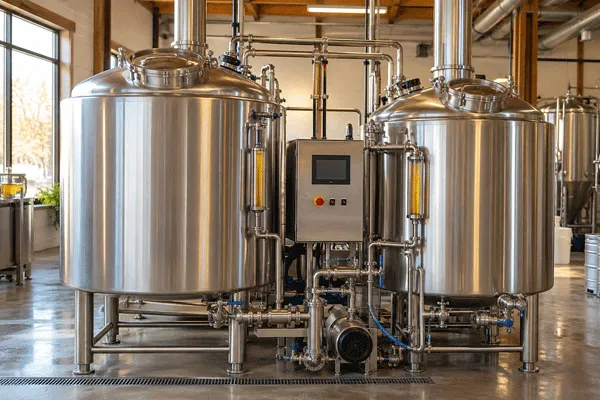
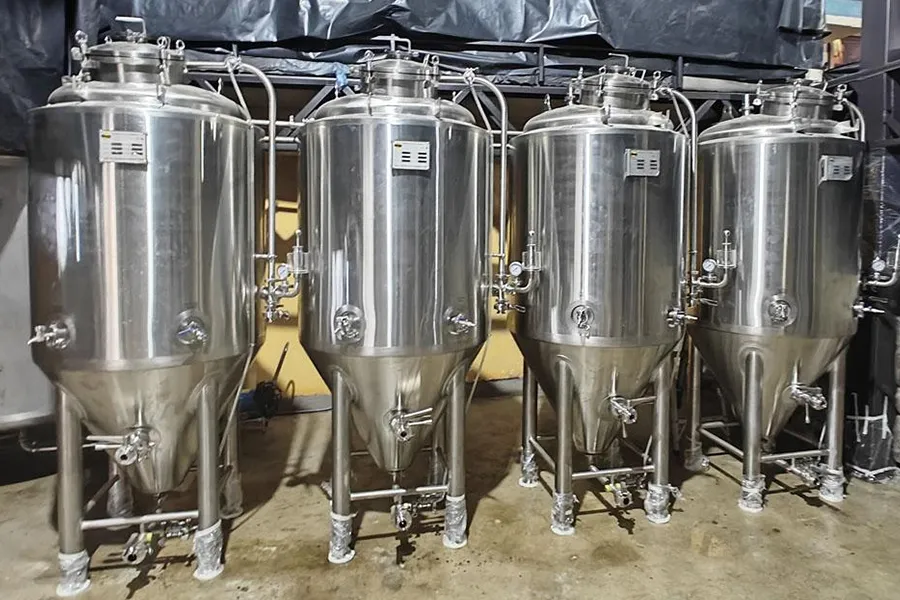
ZPET’s Системы пивоваренных заводов line runs from 2-vessel to 5-vessel configurations, with steam, electric, or direct-fire heating specified per order rather than fixed to one configuration per model. That matters at 2 BBL specifically, because a 2-vessel brewhouse (mash/lauter combined with kettle/whirlpool) is the standard footprint at this size, and the heating source is chosen against the building constraints above rather than defaulting to whatever a catalog page lists first.
The layout work happens before fabrication: a 3D drawing is built against the buyer’s actual floor plan and available utilities — panel location, gas line routing, floor drain positions — so the heating method decision gets made once, on paper, instead of being discovered mid-installation. Every vessel carries SS304/316L construction with a 0.4 μm mirror-polished interior and the same 10-year structural warranty regardless of which heating method is specified, backed by double-sided TIG argon arc welding and a 24-hour pressure hold test on every tank. Electric control panels on ZPET brewhouses are engineered to meet UL/cUL requirements for the North American market, which is the standard most local electrical inspectors will ask about during final sign-off.<cite index=”7-1″>Since 2003, electric brewing systems have used submerged heating elements so that heat energy is transmitted directly to the liquid rather than lost to the surrounding room</cite> — the same principle applies at 2 BBL as at larger scale, just with a smaller element load.
ZPET has delivered 200+ brewhouse and tank installations across 40+ countries, spanning nano through commercial scale, though the site does not yet publish a dedicated 2 BBL case study. Pricing for a 2-vessel electric or direct-fire brewhouse isn’t posted publicly; ZPET quotes factory-direct, without a trading-company markup added on top, but an actual number requires sending your building’s utility specs (panel amperage, gas line size, or existing boiler capacity if any) for a firm quote.
Compared with stock catalog brewhouses sold with one heating configuration built in and no site survey, a build-to-order 2-vessel system costs more design time up front but avoids the retrofit costs that show up later when the shipped configuration doesn’t match the building.
Where This Still Needs a Site Visit, Not a Table
No comparison chart replaces an electrician’s load calculation or a fire marshal’s read on your specific lease. The table above narrows the decision to one or two live options; confirming amperage, gas line sizing, or boiler licensing requirements for your exact address is a site-specific step no vendor comparison page can shortcut.
Часто задаваемые вопросы
Q: Can a 2 BBL system run on single-phase power?
A: Some manufacturers offer single-phase electric elements at this size, but total draw is limited compared to three-phase, which usually means a longer ramp time. Confirm available phase and amperage with your electrician before specifying elements.
Q: Does direct fire scorch the wort more than electric or steam?
A: It can, particularly with darker malt bills or thick worts, if the kettle lacks a false bottom or agitation near the flame contact area. This is a real trade-off, not a myth — it’s the main reason some brewers choose indirect (steam-jacketed) fire designs instead of open flame at this scale.
Q: Is steam ever worth it at 2 BBL?
A: Usually not on cost alone — a boiler and mechanical room rarely pencil out below roughly 10 BBL. It can still make sense if you’re retrofitting into a building that already has steam service for other equipment, such as a shared commercial kitchen.
Q: How long does permitting typically take for each method?
A: This varies by jurisdiction and isn’t something ZPET can state as a fixed timeline — electrical, gas, and boiler permitting all run through different local authorities with different review queues. Check with your local building department before committing to a heating method on a tight opening-day schedule.