David Zhang | Founder & CEO, ZPET (Shandong ZhongPi Machinery Equipment Co., Ltd.) | Published August , 2026
A 3 BBL brewing system handles 352 L per batch. Its brewhouse occupies roughly 2 m², but the working brewery needs 45–60 m² and 3 m of ceiling height. Weekly output is 6–13 BBL depending on fermenter count and tank turn time, not on brewhouse capacity.
The numbers behind the label
The size names in this category are approximate, and the gaps between them matter more than they look.
| System label | Working volume per batch | Half-barrel kegs per batch | US pints (16 oz) per batch |
| 2 бар | 235 L | 4.0 | 496 |
| 2.5 BBL | 293 L | 5.0 | 620 |
| 3 литра | 352 L | 6.0 | 744 |
| 3.5 BBL | 411 L | 7.0 | 868 |
Basis: 1 US beer barrel = 117.3 L. One half-barrel keg = 58.67 L. One 16 oz pint = 0.473 L. Figures are pre-loss brewhouse volumes; expect 5–10% total loss between knockout and keg through trub, yeast, and transfer.
Moving from 2 BBL to 3.5 BBL adds three kegs per batch, or 75% more beer for a vessel diameter increase of roughly 15 cm. That asymmetry is the core argument for buying at the top of this range rather than the bottom, and it is why “2 BBL is cheaper” is a weak basis for the decision.
Note also that a “3 BBL system” quoted by two suppliers may mean two different things. Some quote the kettle’s working volume; some quote the finished wort volume delivered to the fermenter after boil-off. The difference is 6–10%. Ask which number you are being given.
Vessel dimensions and how to check a supplier’s numbers
Vessel size follows from working volume plus required headspace, and the height-to-diameter ratio the fabricator chooses. Two suppliers can quote the same capacity with a 40 cm difference in overall height.
| Vessel | Working vol. | Design total vol. | Typical diameter | Straight-side height | Overall height incl. legs |
| 2 BBL mash/lauter tun | 235 L | ~295 L | 0.80 m | 0.59 m | 1.55–1.75 m |
| 2 BBL kettle/whirlpool | 235 L | ~295 L | 0.80 m | 0.59 m | 1.55–1.75 m |
| 3 BBL mash/lauter tun | 352 L | ~440 L | 0.90 m | 0.69 m | 1.70–1.95 m |
| 3 BBL kettle/whirlpool | 352 L | ~440 L | 0.90 m | 0.69 m | 1.70–1.95 m |
| 3.5 BBL kettle/whirlpool | 411 L | ~515 L | 0.95 m | 0.73 m | 1.75–2.00 m |
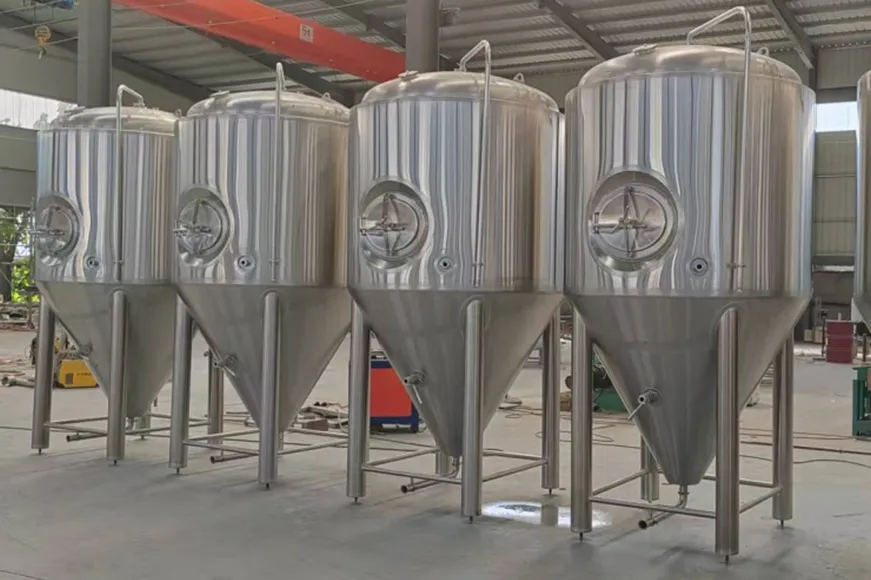
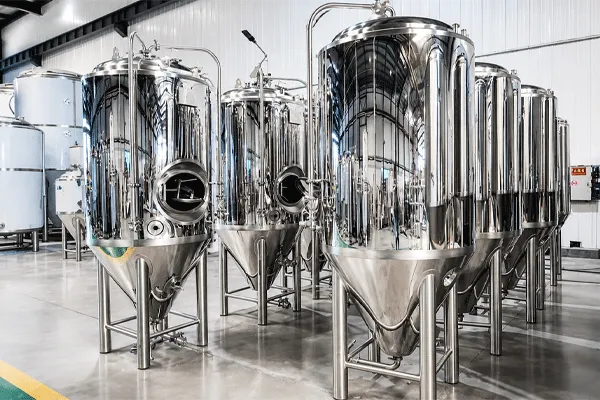
| 3 BBL fermenter (conical) | 352 L | ~460 L | 0.80 m | 0.85 m | 2.00–2.30 m |
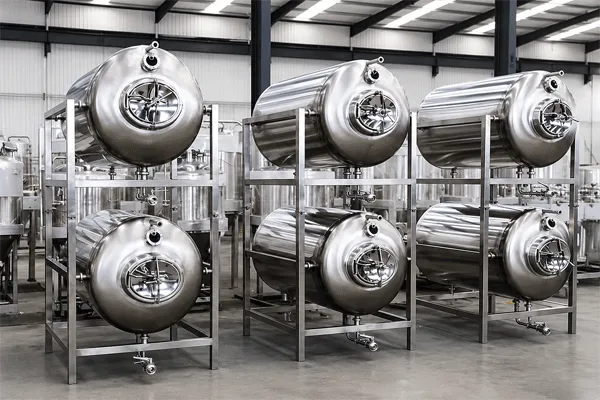
| 3 литра емкость для светлого пива | 352 L | ~390 L | 0.80 m | 0.78 m | 1.85–2.10 m |
Two checks worth running on any dimension sheet you receive:
Headspace on fermenters. A fermenter quoted at 352 L total rather than 352 L working will overflow. At 3 BBL scale a vigorous ale krausen needs 25–30% of tank volume. If the spec sheet gives one number, ask whether it is working or total.
Overall height versus your access path. Overall height on the table above is the standing dimension. Delivery clearance is governed by the vessel lying down, which means diameter plus skid, and by the diagonal it needs to swing through a doorway. A 0.90 m diameter kettle does not pass through a 0.80 m door regardless of how tall the room is.
Room footprint: why 2 m² of vessels needs 50 m² of brewery
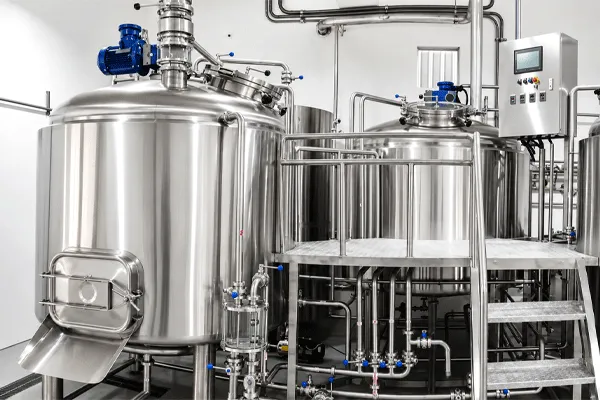
Adding vessel base areas together produces a number that has no operational meaning. Here is what a 3 BBL brewery with six fermenters actually consumes:
| Zone | Area | Notes |
| Brewhouse vessels (2-vessel) | 1.8–2.2 m² | Two vessels plus pump and heat exchanger on skid |
| Brewhouse service clearance | 8–10 m² | 0.9 m minimum around three sides; front face needs 1.2 m for hose handling and lauter raking |
| Fermenter row (6 × 3 BBL) | 5.0–5.5 m² | 0.80 m diameter, 0.15 m between shells for jacket access |
| Fermenter access aisle | 8–10 m² | 1.5 m clear in front for racking arms, hoses, and yeast harvest containers |
| Grain handling and mill | 4–6 m² | Mill, grist case, and one pallet of malt staged |
| Glycol chiller and manifold | 2–3 m² | If interior; exterior siting frees the area but adds line losses |
| CIP cart and chemical storage | 3–4 m² | Locked chemical storage is usually a code requirement |
| Keg washing, staging, cold store | 8–12 m² | The zone most often forgotten at lease signing |
| Circulation and drainage runs | 5–8 m² | Trench drain corridor plus safe walking route |
| Total | 45–60 m² | approx. 485–645 ft² |
A 2 BBL system reduces this by around 6–9 m². It does not halve it, because clearances, drainage, grain handling, and keg logistics are close to size-independent. This is the second reason the smallest option in the range is rarely the best value: you pay most of the space cost either way.
Ceiling height and floor loading
Ceiling. Take the tallest vessel’s overall height, add clearance to open the top manway, and add hoist travel if you plan to lift grain or a pump. For a 3 BBL fermenter at 2.30 m overall, 3.0 m is the practical minimum and 3.4 m makes the room workable. Sprinkler heads, ductwork, and lighting all reduce usable height below the structural slab, so measure to the lowest obstruction over each vessel position, not to the ceiling.
Floor loading. Calculate it rather than assume it:
Full vessel weight ≈ (working volume in L × 1.05 kg/L) + tank tare weight Point load per leg = full weight ÷ number of legs Distributed load = full weight ÷ vessel base area
For a 3 BBL fermenter, the liquid alone is about 370 kg. Add the tare weight, which you should request from the supplier rather than estimate, and divide by roughly 0.5 m² of base area. The distributed figure typically lands above 1,000 kg/m², which is inside most ground-floor concrete slab ratings and outside many suspended-floor ratings. If your space is not on grade, get the load figure to a structural engineer before ordering.
Batch math: turning 352 L into a weekly number
The specification that determines output is fermenter count, not brewhouse capacity. A 3 BBL brewhouse can be turned over twice in a day. A 3 BBL fermenter is occupied for 10 to 35 days.
batches per week = (fermenter count ÷ turn days) × 7
Turn days must include primary fermentation, dry hop or conditioning, cold crash, and CIP turnaround. Brewers who count only primary fermentation overestimate their own capacity by 30–40%.
3 BBL system output by fermenter count and turn time
| Turn time | 4 FVs | 6 FVs | 8 FVs | 10 FVs |
| 10 days (fast ale, no conditioning) | 8.4 BBL/wk | 12.6 BBL/wk | 16.8 BBL/wk | 21.0 BBL/wk |
| 14 days (standard ale) | 6.0 BBL/wk | 9.0 BBL/wk | 12.0 BBL/wk | 15.0 BBL/wk |
| 21 days (dry-hopped, extended crash) | 4.0 BBL/wk | 6.0 BBL/wk | 8.0 BBL/wk | 10.0 BBL/wk |
| 35 days (lager) | 2.4 BBL/wk | 3.6 BBL/wk | 4.8 BBL/wk | 6.0 BBL/wk |
Each figure = batches/week × 3 BBL. Brewing-day labor is the practical limit above about 4 batches per week on a single-operator brewery.
The same system across the 2–3.5 BBL band
At a 14-day average turn and 48 brewing weeks per year:
| Система | 4 FVs annual | 6 FVs annual | 8 FVs annual |
| 2 бар | 192 BBL | 288 BBL | 384 BBL |
| 2.5 BBL | 240 BBL | 360 BBL | 480 BBL |
| 3 литра | 288 BBL | 432 BBL | 576 BBL |
| 3.5 BBL | 336 BBL | 504 BBL | 672 BBL |
Read those two tables against demand rather than against each other. A 60-seat taproom pouring 1,000 pints weekly needs 473 L, about 4 BBL. A 90-seat venue with a busy weekend trade runs 8–10 BBL weekly. The first is served by 3 BBL with four fermenters; the second needs six to eight, and a 2 BBL system cannot reach it at any fermenter count that fits the room.
Work the calculation backwards for your own plan: divide target weekly BBL by batch size to get batches per week, multiply by your realistic turn days, divide by seven. That is your fermenter count. Order that number of fermenters, or leave the piping and control channels to add them.
Utility loads you can calculate now
These figures decide whether a building works, and they are answerable before any site visit.
Electric kettle sizing. Energy to raise wort from mash-out to boiling:
kWh = (litres × 4.186 × ΔT °C) ÷ 3,600
For 352 L rising 30 °C from mash-out to boil: 12.3 kWh. Delivered over 45 minutes that is a 16 kW element draw. Maintaining a boil is a separate calculation, driven by evaporation rather than temperature:
kW to sustain boil = (litres × boil-off rate × 2,257 kJ/L) ÷ 3,600
At a 7%/hour boil-off, a 3 BBL batch evaporates 25 L/hour, requiring about 15.5 kW continuous. Combined with HLT heating, an electric 3 BBL brewhouse commonly needs 30–40 kW of three-phase capacity. Check your panel before you check your budget: securing that supply in a leased retail unit is frequently the hardest part of a nano or small-scale fit-out.
Glycol load. Peak demand, not average, sets chiller size. Peak usually means one fermenter shedding fermentation heat while a second is being crash-cooled.
Cooling kW = (litres × 4.186 × ΔT) ÷ (hours × 3,600)
Crashing 352 L from 20 °C to 2 °C over 24 hours needs 0.31 kW; over 12 hours, 0.61 kW. Add roughly 0.3–0.5 kW for active ферментацию exotherm on a parallel tank, then add line and ambient losses, which run higher if the chiller sits outdoors in summer. Sizing against the sum of realistic simultaneous demands, with margin, is what separates a system that holds 2 °C in August from one that holds 6 °C and produces hazy, poorly-conditioned beer.
Water. Plan on 3–5 times batch volume per brew day, so 1,050–1,760 L for a 3 BBL batch including mash, sparge, and cleaning. Strike and sparge together account for roughly 1.5–1.7 times working volume, which sets your minimum HLT size.
Grain. At around 1.050 OG, a 352 L batch takes roughly 65–70 kg of malt at typical small-system efficiency. This produces one of the least-discussed constraints on the size, covered next.
The high-gravity limit nobody quotes
A 3 BBL mash/lauter tun with 440 L total volume comfortably handles a 68 kg grain bill at a 2.8 L/kg liquor-to-grist ratio: roughly 190 L of strike water plus 46 L of grain displacement, well inside the vessel.
Double the gravity to 1.100 and the grain bill goes to about 135 kg. Strike water at the same ratio is 378 L, grain displacement is 90 L, and the mash needs 468 L in a vessel that holds 440. The system cannot mash the beer in a single vessel.
The workarounds all cost something: tighten the mash ratio toward 2.2 L/kg and accept worse conversion and a harder lauter, split the mash across two runs and double the brew day, or add brewing sugar in the kettle and change the beer. Anyone whose lineup centers on imperial stouts, barleywines, or triples should size the mash tun against their heaviest recipe rather than against nominal system capacity, which in practice means a mash/lauter tun one size above the kettle.
This is the specification error most commonly discovered after installation, because system capacity is advertised at a standard-gravity assumption that no supplier states.
2-vessel versus 3-vessel at this scale
| 2-сосуд | 3-сосуд | |
| Floor area (3 BBL) | 1.8–2.2 m² | 2.6–3.1 m² |
| Brew day, one batch | 5–7 часов | 5–7 часов |
| Two batches, one shift | Kettle must clear before second lauter | Practical with dedicated whirlpool |
| Вода для промывки | Separate HLT or on-demand heating required | HLT integrated |
| Knockout time | Longer; whirlpool rest in kettle | Faster; dedicated whirlpool |
| High-gravity handling | Constrained per the section above | Better, if the added vessel is the mash tun |
| Капитальные затраты | Ниже | Выше |
For a single batch per brew day, which describes most brewpub operation at this scale, 2-vessel is usually correct, and the money is better spent on additional fermenters. The third vessel earns its floor area once you brew twice in a shift or once high-gravity beers become routine.
ZPET 3 BBL systems: specification set
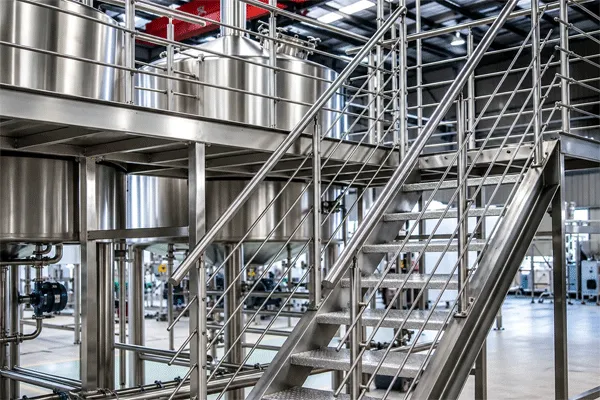
Our 2–3.5 BBL systems fall under the Оборудование для нанопивоварни line, built on the Системы пивоваренных заводов platform in 2-vessel or 3-vessel configuration.
| Параметр | Технические характеристики |
| Capacity band | 117–587 L (1–5 BBL); this article covers 235–411 L (2–3.5 BBL) |
| Варианты конфигураций варочных цехов | 2-vessel to 5-vessel available; 2- or 3-vessel typical at this scale |
| Отопление | Паровой / электрический / с прямым нагревом |
| Материалы | SS304 или SS316L, санитарный класс |
| Отделка внутренних поверхностей | Зеркальная полировка с точностью 0,4 мкм |
| Охлаждение ферментера | Охлаждающая рубашка с углублениями |
| Доступ к баку | Стандартный верхний люк; боковой люк — опция |
| Сварка | TIG / double-sided argon arc; automatic welding robots; CNC laser-cut plate |
| Incoming material check | Spectrometer analysis on stainless |
| Испытания под давлением | 24-часовое испытание на удержание давления |
| Контроль сварных швов | Рентгеновский контроль сварных швов; 5-этапная схема контроля качества |
| Temperature control | Precision control on brewhouse and per-zone fermentation |
| Operating platform | Ergonomic platform designed to vessel height |
| Гарантия на конструкцию | 10 лет |
| Соблюдение экспортного законодательства | Разработано с учетом требований PED (CE), UL/cUL и AS1210 |
| Pre-order deliverable | 3D brewery layout, technical drawings, and process flow chart |
Three notes on that table.
The 0.4 μm interior finish is a roughness specification, the same property ASME BPE addresses in its hygienic surface finish designations, and it is the parameter that determines whether cleaning-in-place removes soil or merely wets it. Ask for it in μm Ra rather than as a polish grade name, since grade nomenclature varies between fabricators.
“Engineered to meet PED (CE), UL/cUL and AS1210” is precise wording and worth understanding. It means vessels and control panels are designed against the requirements of those standards. It is a different statement from holding a third-party certificate for a specific unit. Any supplier should be able to tell you which of the two they are offering, and should be able to show you the document.
Vessel dimensions are set per order rather than fixed to a catalogue, because at this scale the design is fitted to the building. We produce the 3D layout against your measured floor plan, drain positions, ceiling obstructions, and available electrical service before fabrication starts, which is what prevents a vessel arriving that cannot enter the room or stand under the sprinkler line.
Compared with the second-hand dairy and food-industry tanks often presented as a low-cost path into this capacity band, purpose-built brewing vessels differ in four specific respects: jacket coverage sized to fermentation heat load rather than to product holding, a conical bottom geometry for yeast harvest, a pressure rating that permits spunding and natural carbonation, and documented material traceability. The converted tanks are cheaper per litre. The brewery assembled from them generally is not.
Часто задаваемые вопросы
Q: How many kegs does a 3 BBL batch produce?
A: Six US half-barrel kegs from 352 L, before losses. Budget 5.5 kegs as the realistic figure after trub, yeast, and transfer losses of 5–10%.
Q: How much floor space does a 3 BBL brewing system need?
A: The brewhouse vessels themselves cover about 2 m². A working brewery with six fermenters, glycol, CIP, grain handling, and keg logistics needs 45–60 m² (485–645 ft²), plus packaging space if applicable.
Q: What ceiling height does a 3 BBL system require?
A: 3.0 m minimum, 3.4 m comfortable. Fermenters at this scale reach 2.0–2.3 m overall, and you need clearance above the top manway. Measure to the lowest obstruction, including sprinklers and ductwork, not to the structural slab.
Q: 2 BBL or 3 BBL?
A: 3 BBL in most cases. It yields 50% more beer per batch for roughly the same brew-day labor, the same clearances, and 6–9 m² more room. The 2 BBL option makes sense only where the room genuinely cannot take the larger footprint or where a single 235 L batch matches a deliberately small, high-rotation tap program.
Q: How much electrical supply does an electric 3 BBL brewhouse need?
A: Commonly 30–40 kW three-phase across kettle and HLT. Kettle element sizing follows from ramp time and boil-off rate: about 16 kW to reach boil in 45 minutes, and about 15.5 kW to sustain a 7%/hour boil on 352 L.
Q: Can a 3 BBL system brew high-gravity beer?
A: Not at full batch volume above roughly 1.080 OG in a standard 3 BBL mash tun, because the grain bill plus strike water exceeds vessel volume. Options are a tighter mash ratio, a split mash, kettle sugar additions, or specifying an oversized mash/lauter tun at order.
Q: What is the difference between 3 BBL and 3.5 BBL systems?
A: 59 L, or one additional half-barrel keg per batch. Vessel diameter increases by roughly 5 cm and floor area by under 0.5 m², so where the room allows it, 3.5 BBL is generally the better throughput-per-footprint choice.