David Zhang | Founder & CEO, ZPET | Published August 13, 2026
A commercial brew kettle boils wort at a controlled rate, drives hop utilization and volatile removal, and prepares the batch for whirlpool separation and cooling. Correct specification depends on working volume, heat input, venting, geometry, controls, cleaning access, and the utilities available in the brewery building.
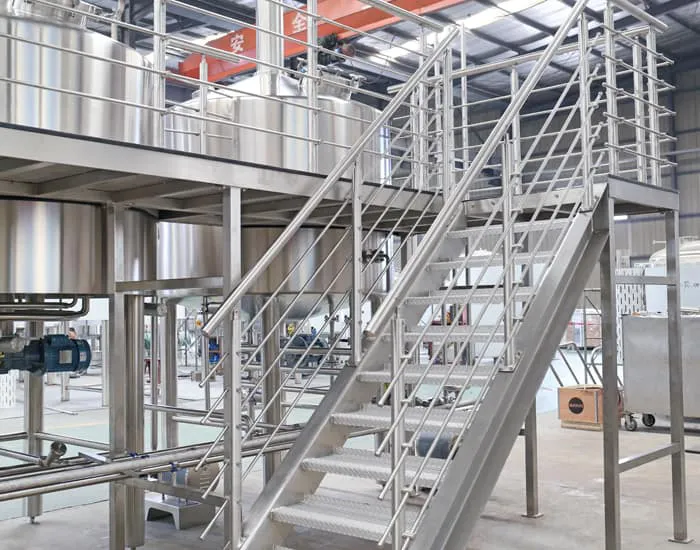
Commercial brew kettle specification at a glance
| Decision | What to put in the specification | Why it changes the project |
|---|---|---|
| Вместимость | Target cast-out volume, pre-boil volume, total vessel volume and maximum foam allowance | Prevents boilover and avoids comparing nominal shell volume with usable capacity |
| Отопление | Steam, electric or direct fire; available pressure, voltage or fuel; required heat-up time | Determines connected load, plant-room equipment, ventilation and local approvals |
| Vessel geometry | Diameter, straight-side height, bottom form, outlet position and head design | Affects heating surface, foam behavior, drainage, access and building clearance |
| Venting | Stack diameter, condensate path, roof penetration, fan requirement and make-up air | Controls moisture and heat while keeping condensate out of the wort |
| Controls | Temperature, pressure, level or mass input, steam or power modulation, alarms and interlocks | Makes the boil repeatable and protects operators and equipment |
| Очистка | Spray device, CIP flow at the device, return path, access, drainage and chemical compatibility | Determines whether soil can be removed without manual entry |
| Документация | Materials, finish, weld records, pressure testing, drawings, utility schedule and destination requirements | Reduces fabrication, installation and site-acceptance risk |
1. Size the kettle from pre-boil volume
Do not size a kettle from packaged beer volume alone. Begin with the intended cast-out volume, then account for evaporation, trub, line losses and any process-specific additions. The supplier should state both working volume and total vessel volume. Those values are not interchangeable.
For capacity planning, 1 US beer barrel equals 117.3 L. A 10 BBL batch is therefore about 1,173 L, but the kettle needs more space than the batch designation suggests because the wort expands and foams during heat-up and boil. The final allowance belongs in the recipe and equipment design review; it should not be assumed from a catalog label.
Ask the supplier to show the normal liquid level and the maximum operating level on a sectional drawing. Check the distance from the upper liquid level to the vent connection. A narrow margin can create boilover risk, while an oversized vessel may use more floor area, cleaning solution and fabrication material than the production plan requires.
2. Match the heat source to the building
A commercial brew kettle can use steam jackets, electric elements or direct fire. The choice is a building-and-process decision, not a preference selected in isolation.
| Источник тепла | Advantages | Constraints to resolve |
|---|---|---|
| Steam | Modulated heat input, no immersed element in the wort, practical for multi-vessel commercial plants | Boiler, water treatment, steam pressure, condensate return, ventilation, inspection and trained operation |
| Электрический | No boiler or combustion exhaust; direct control of staged or modulated power | Connected electrical load, element watt density, panel size, cable routes and element cleaning |
| Прямой огонь | Can suit sites with available fuel and limited steam infrastructure | Burner turndown, combustion air, exhaust, flame supervision, hot surfaces and local gas approval |
The utility schedule should state more than the selected heat source. For steam, record pressure and demand at the kettle connection. For electric heat, record voltage, phase, frequency and full connected load. For direct fire, record gas type, supply pressure, exhaust route and combustion-air requirement. The related electric, steam and direct-fire comparison explains the trade-offs at smaller scale; the same utility logic applies when loads increase.
3. Review geometry, fabrication and product-contact finish
Diameter and height affect more than appearance. A wider vessel can change the heating area and evaporation behavior. A taller vessel changes platform elevation, headroom and cleaning reach. Bottom geometry and outlet position influence full drainage and the amount of wort left behind.
Specify the product-contact material and finish, then ask how those requirements are verified. ZPET’s disclosed brewhouse options use SS304 or SS316L sanitary-grade stainless steel and a 0.4 micrometer mirror polish, with TIG/double-sided argon-arc welding. The project quotation should identify the material used for the shell, fittings and any jacket components rather than relying on a general brochure statement.
ASME BPE provides industry definitions and guidance relevant to hygienic equipment and surface condition. Referencing it does not mean a kettle is ASME BPE certified. The purchase specification must state which design, material, finish, examination and documentation requirements actually apply.
4. Give vapor and condensate a controlled path
Boiling transfers water vapor and heat into the room unless the stack and ventilation system remove them. Specify the kettle vent from the hood or head connection through the building penetration. Include condensate collection, cleanout access, slope and support. Condensate should not run back into the wort.
Coordinate the stack with the mechanical contractor before fabrication. Roof height, elbows, horizontal runs and termination details can change draft behavior. If a fan is required, define how it starts, how airflow is proven and what happens to heating when airflow is lost. The room also needs adequate make-up air; exhausting vapor from a sealed room can create pressure and burner problems.
5. Define controls around the boil sequence
The control narrative should describe what the operator does from kettle fill through transfer to the whirlpool. At minimum, identify temperature measurement, heat-output modulation, pump permissives, low-level protection and emergency shutdown behavior. If the system uses automated valves or recipes, list each controlled path and the manual recovery method.
A temperature reading alone does not prove a repeatable boil. Operators also need a consistent fill basis, heat-up endpoint, boil duration and transfer sequence. For larger brewhouses, a mass or level input may be integrated into the batch record, but the measuring method and accuracy must be agreed before fabrication.
The control panel for a destination market needs a project-specific electrical review. ZPET may engineer control systems to meet UL/cUL requirements for North America, but listed components do not by themselves make a complete panel listed. Confirm panel construction, short-circuit current rating, drawings, component availability and local inspection responsibility.
6. Prove the cleaning circuit on the drawing
A cleanable commercial brew kettle needs complete wetting, adequate mechanical action, controlled chemistry and a return path that drains. Ask the supplier to identify the spray device, required flow and pressure at that device, supply line, return line and the valve positions for every CIP step.
Common errors include quoting only pump discharge pressure, leaving a dead leg at an instrument connection, and placing an outlet where the vessel cannot fully drain. A removable part is not automatically easy to clean if it requires lifting over a platform or entering a confined area. Review access and hose handling with operators before approving the layout.
Сайт 3-A Sanitary Standards organization is a useful external reference for hygienic equipment principles. The exact standards applicable to a brewery project must be selected by the responsible engineering and regulatory teams.
7. Integrate the kettle with the complete brewhouse
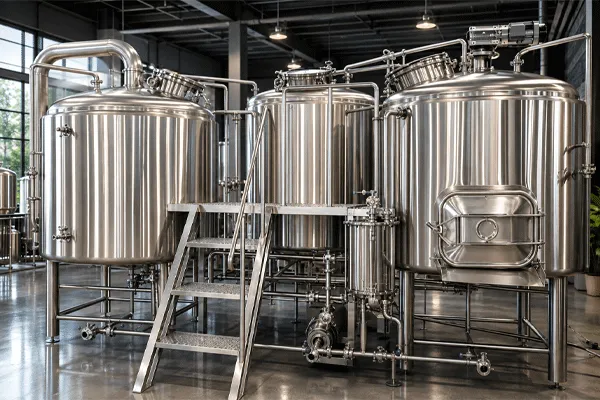
The kettle receives wort from the lautering stage and sends it to a whirlpool or combined separation vessel. Its cycle time therefore depends on the mash/lauter schedule, hot-liquor availability, whirlpool residence and wort-cooling capacity. A fast kettle does not increase daily turns if the adjacent vessel or heat exchanger is the bottleneck.
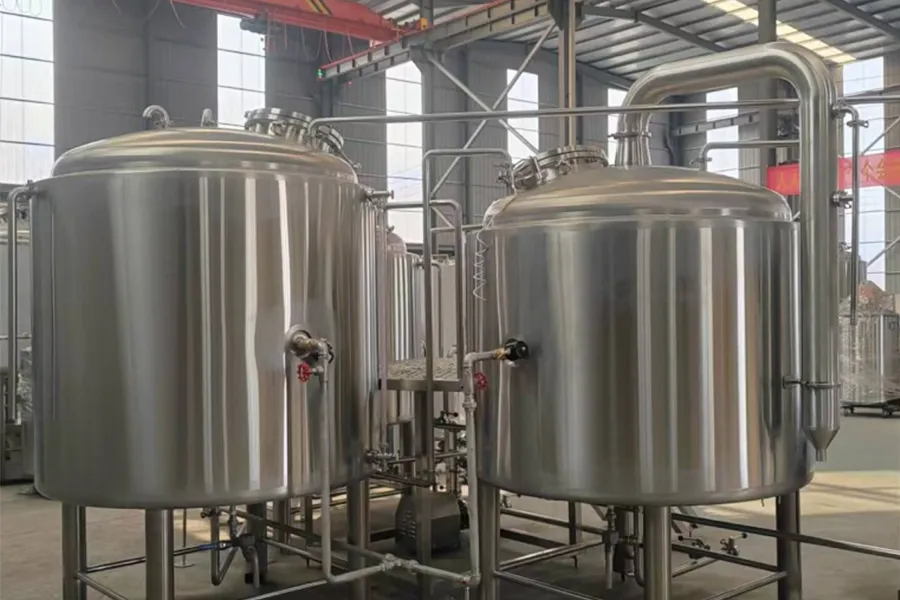
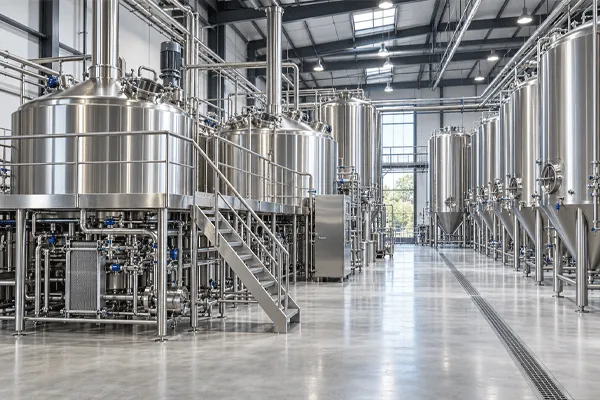
Compare two-, three- and four-vessel arrangements against the actual brew-day sequence. The brewhouse configuration guide shows how vessel separation affects overlap and throughput. For a site-level view, use the brewery layout and utilities guide to coordinate platforms, drains and service clearance.
Commercial brew kettle acceptance checklist
- Approve a sectional drawing showing working volume, total volume, normal level and freeboard.
- Approve the heat-up requirement and the utility input used to calculate it.
- Confirm product-contact materials, finish, weld treatment and drainability.
- Coordinate the vapor stack, condensate route, exhaust and make-up air with the building.
- Review the control narrative, alarms, interlocks and manual recovery steps.
- Verify CIP flow at the spray device and trace supply and return paths on the P&ID.
- Confirm delivery access, platform clearance, maintenance access and future expansion interfaces.
- Require material checks, weld inspection and pressure-test records appropriate to the project.
ZPET reports spectrometer material analysis, X-ray weld inspection, a 24-hour pressure hold test and five-step quality control as company-level fabrication practices. Application to a particular kettle must be written into its inspection and test plan. ZPET also states a 10-year structural warranty; buyers should confirm the covered components, exclusions and claim procedure in the contract.
Часто задаваемые вопросы
What is the difference between kettle working volume and total volume?
Working volume is the intended usable liquid volume under defined operating conditions. Total volume is the physical internal capacity. The difference provides space for expansion, foam and operational margin.
Is steam always the best choice for a commercial brew kettle?
No. Steam is common in multi-vessel plants, but boiler infrastructure and inspection add complexity. Electric or direct-fire heat can be appropriate where their connected loads, controls, ventilation and local approvals fit the building.
How should buyers compare kettle quotations?
Compare working and total volume, material, surface finish, heating area and input, venting, fittings, controls, CIP requirements, documentation, testing and included site interfaces. A price comparison without the same scope is not meaningful.
Does a commercial kettle require a pressure-vessel certification?
The product side is generally operated near atmospheric pressure during boil, while steam jackets and connected components may fall under pressure-equipment rules. Requirements depend on design and destination. Confirm them with the supplier and local authority before fabrication.
Request a project-specific kettle specification
Send ZPET the intended batch volume, brew-day sequence, building drawing, available utilities, destination market and preferred heating method. The engineering review can then define the kettle, adjoining vessels, utility loads, piping, controls and service clearances as one coordinated brewhouse system.
Last reviewed: August 13, 2026 | Reviewed by David Zhang, Founder & CEO