Buying the wrong brewing equipment can limit production before your first commercial brew is sold. A tank may be too small, a chiller may lack capacity, or your layout may slow every brew day. The solution is to plan the complete brewery as one connected production system.
What equipment do you need to start a brewery? A commercial brewery normally needs malt handling equipment, a brewhouse with mash and kettle vessels, wort cooling, fermenters, glycol cooling, CIP cleaning, pumps, controls, beer storage tanks, and keg, bottle, or can packaging equipment. The exact equipment list depends on batch size, annual production, beer style, packaging method, automation, and available building space.
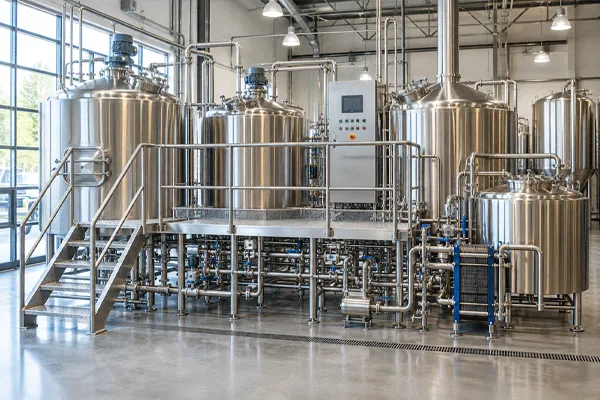
A commercial brewery is very different from a homebrew setup. You are not simply making a larger batch. You are building a sanitary production line that must repeat the same brewing process safely and efficiently many times each week.
The Brewers Association also treats brewery planning as more than equipment selection. Its planning resources cover financial planning, business goals, equipment, taproom design, and beer quality, which reflects an important point: a successful brewery starts with a complete project plan, not a shopping list of tanks.
As a professional brewery and beverage equipment manufacturing plant, we work with craft breweries, brewpubs, taprooms, beverage startups, cideries, kombucha producers, wineries, distilleries, cold brew producers, investors, and engineering contractors. From our experience, the best equipment plan starts with one question:
How much finished product do you need to produce, and how often do you need to produce it?
Everything else follows from that.
Commercial Brewery Equipment List at a Glance
Before looking at each piece of equipment, here is a practical overview.
| Production Stage | Essential Equipment | Main Purpose |
|---|---|---|
| Malt Preparation | Malt mill, grain hopper | Crush malt before brewing |
| Hot Side | Mash tun, lauter tun, brew kettle, whirlpool | Produce wort |
| Wort Cooling | Plate heat exchanger, pump | Cool hot wort before fermentation |
| Fermentation | Fermenter, glycol system | Ferment and control temperature |
| Conditioning | Brite beer tank | Carbonate and prepare finished beer |
| Очистка | Система CIP | Clean tanks and piping |
| Коммунальные услуги | Boiler, chiller, air compressor, water treatment | Support production |
| Controls | Control panel, sensors, VFDs | Manage temperature, pumps, motors |
| Packaging | Keg washer/filler, bottling or canning line | Package beer |
| Quality Control | Hydrometer and testing tools | Monitor production |
This is the essential equipment for most commercial systems, but exact specifications change with your business model.
1. What Brewery Equipment Do You Need Before the First Brew?
Before you start a brewery, divide your equipment into four groups:
- Brewhouse equipment
- Cellar and fermentation equipment
- Utility and cleaning systems
- Packaging equipment and supplies
The mistake we often see from a new brewery is focusing almost completely on shiny brewhouse vessels. The brewer chooses a mash tun and brew kettle, then later discovers that the glycol system is too small, there are not enough fermenters, or there is no practical space for CIP.
Your equipment checklist should therefore follow the actual production path:
Malt → Mash → Wort → Cooling → Fermentation → Conditioning → Packaging
Think in process order. It makes missing equipment much easier to spot.
2. What Malt and Mash Equipment Is Required for Brewing Beer?
Every brew begins with raw materials, and malt handling is the first equipment stage.
For many commercial systems, you’ll need:
- Malt mill
- Grain hopper
- Auger or conveying system
- Варочный чан
- Делать больше
- Spent grain discharge system
The mill crushes the malt so water can reach the starches inside the grain. During the mash, enzymes convert those starches into fermentable sugars. The liquid that comes from this stage becomes wort.
Small breweries may move grain manually. Larger commercial breweries may use hoppers, augers, grist cases, and automated feeding systems because moving hundreds of kilograms of grain by hand becomes slow and difficult.
What about all-grain brewing?
Most commercial craft systems use all-grain brewing, so mash and lautering performance matter a great deal.
The right mill gap, vessel geometry, false bottom, raking system, and pump setup can affect extraction, brew time, and process consistency.
For a small home brew batch, simple brew pots can work. For commercial grain brewing, you need purpose-built sanitary vessels designed for repeat production.
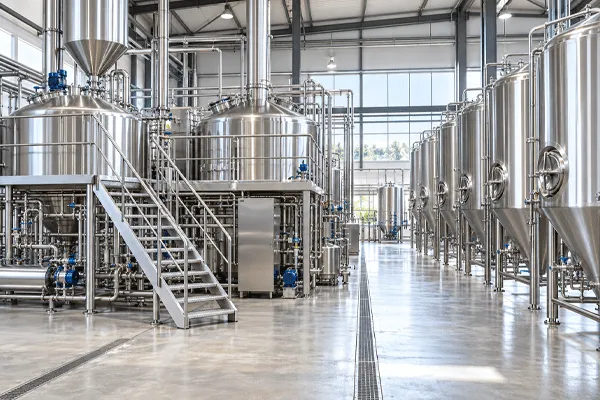
3. Which Brewhouse and Brewing Systems Do You Need?
The brewhouse is where a large part of the visible beer brewing equipment sits.
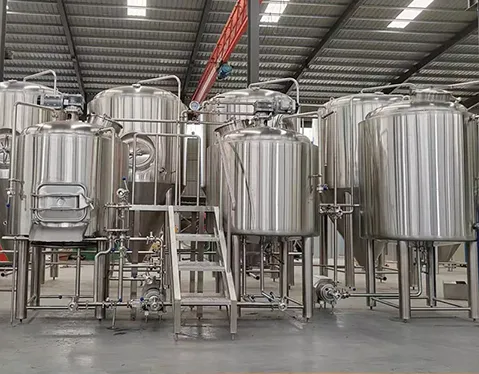
A typical commercial brewhouse may include:
- Варочный чан
- Делать больше
- Чайник
- Whirlpool
- Hot liquor tank
- Cold liquor tank
- Wort grant
- Sanitary pumps
- Теплообменник
- Operating platform
- Control system
These functions may be combined into two vessels or separated into three, four, or more vessels.
2-vessel vs. 3-vessel vs. 4-vessel
| Тип пивоварни | Best Fit | Main Advantage |
|---|---|---|
| 2-Vessel | Small brewpub or taproom | Compact and economical |
| 3-Vessel | Growing microbrewery | Better workflow |
| 4-Vessel | Higher production brewery | Allows overlapping batches |
| Multi-Vessel | Large production facility | High throughput and automation |
A small brewer making one batch per day may not need a complex four-vessel system. A brewery making three or four batches per day may gain much more value from separate vessels.
This is why choosing the right brewery system is about throughput, not simply tank size.
4. Why Is Wort Cooling Equipment Essential on Brew Day?
After boiling, hot wort cannot go directly into a fermenter at boiling temperature.
It must cool quickly to the temperature required for yeast.
Most commercial systems use a plate heat exchanger. Hot wort flows through one side while cold water or glycol-assisted water removes heat through the other side.
A sanitary pump moves wort through the cooling system and into the fermentation tank.
Cooling affects several parts of production:
- Brew day length
- Yeast health
- Water consumption
- Fermentation start time
- Product consistency
The system must also match your batch volume.
A chiller that works well for a small brewpub may be undersized for a larger production brewhouse. If cooling takes too long, your brewer loses time between batches.
We therefore size wort cooling together with the brewhouse, water system, and glycol demand rather than treating it as a separate accessory.
5. How Many Fermenters Does a New Brewery Need?
The fermenter may be the most important capacity decision after brewhouse sizing.
Here is why.
A brewhouse can finish one brew in several hours. But fermentation may occupy a tank for days or weeks.
That means cellar capacity often becomes the production bottleneck.
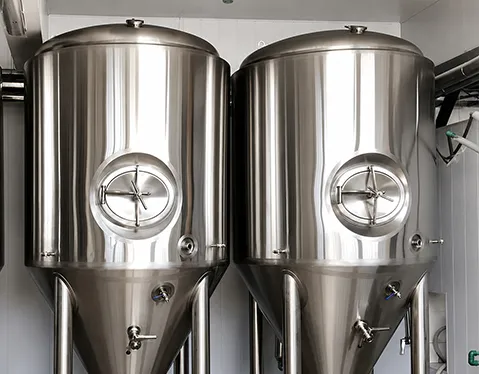
A commercial fermenter normally includes:
- Stainless steel body
- Коническое дно
- Охлаждающая рубашка
- Изоляция
- Temperature sensor
- Pressure gauge
- Safety valve
- Образец клапана
- Racking outlet
- CIP spray device
- Sanitary fittings
After wort enters the tank, yeast converts sugars into alcohol, carbon dioxide, and flavor compounds. Stable fermentation temperatures help the brewer produce consistent beer from one batch to the next.
Illustrative fermentation planning example
Suppose a 10 BBL brewhouse makes four brews each week.
10 BBL × 4 brews/week
        ↓
40 BBL of new wort each week
        ↓
Multiple weeks in fermentation/conditioning
        ↓
Several fermenters required
If you install only two бродильные ёмкости, the expensive brewhouse may spend much of the week waiting.
That is why we ask about recipe cycles before recommending a fermenter quantity.
6. What Cooling Equipment Helps Maintain Fermentation Temperatures?
Temperature control is one of the most important parts of producing beer consistently.
Commercial fermenters normally use cooling jackets connected to a glycol system.
A typical setup includes:
- Glycol chiller
- Glycol tank
- Circulation pumps
- Insulated piping
- Solenoid valves
- Temperature controllers
The system sends cold glycol through the jacket when the tank becomes warmer than its set temperature.
Different styles may require different fermentation temperatures. A brewer producing ales, lagers, cider, kombucha, or another beverage may also need different tank temperature ranges.
This is one reason we do not size a chiller only by tank count. We consider tank volume, ambient conditions, crash cooling requirements, production schedule, and future expansion.
If the cooling plant is too small, adding tanks later may not increase real production.
7. Do You Need Brite Tanks, Kegs, Bottles, or a Canning Line?
Once fermentation is complete, you need a plan for the finished beer.
Many breweries use brite beer tanks for conditioning, carbonation, storage, and packaging preparation.
From there, the beer may go into:
- Keg
- Bottle
- Can
- Serving tank
The correct choice depends heavily on your sales model.
Taproom-focused brewery
A taproom may mainly use kegging and direct draft service.
Typical equipment includes:
- Keg washer
- Keg filler
- CO₂ system
- Cold storage
Bottle packaging
A smaller bottle line may require:
- Bottle rinser
- Filler
- Capper
- Labeler
- Date coder
- Packing table
Manual or semi-automatic equipment may be enough at first. Larger operations may install automated filling lines.
You will also need enough clean beer bottles, caps, boxes, and storage space.
Canning
A growing distribution brewery may invest in a canning line because cans are widely used for retail and wholesale sales.
Do not choose packaging equipment only by maximum speed. Match it to the actual number of barrels of beer you expect to package each week.
In the United States, the TTB defines one beer barrel as 31 U.S. gallons, which is useful when converting your production plan between liters, gallons, and BBL.
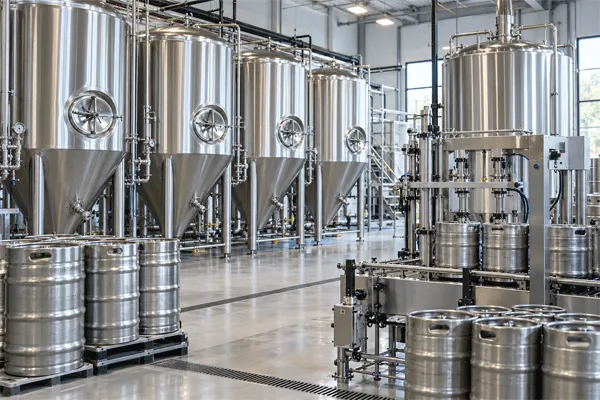
8. What Cleaning and Sanitation Equipment Does a Brewery Need?
You can buy excellent brewing vessels and still make poor beer if cleaning is weak.
Commercial production requires repeatable sanitation.
A typical CIP—or Clean-in-Place—system may contain separate tanks for:
- Hot water
- Caustic cleaning solution
- Acid solution
- Sanitizing solution
Pumps move cleaning liquid through tanks, piping, spray balls, and other equipment.
Good CIP design helps the brewery sanitize equipment without dismantling every pipe after each brew.
You should also consider:
- Floor drains
- Washdown hoses
- Chemical storage
- Cleaning brushes
- Personal protective equipment
- Drainage slope
- Ventilation
A homebrewing starter kit may rely on buckets and small cleaning tools. Commercial equipment needs a more controlled cleaning process because there are larger vessels, longer pipe runs, and much higher production volumes.
The Brewers Association emphasizes quality-oriented planning when opening and operating a brewery, including equipment and production considerations, rather than treating equipment purchasing as an isolated task.
9. Which Utilities Are Essential Equipment for Operating a Brewery?
Utilities are easy to overlook because they are less exciting than a polished fermenter.
Yet without them, you cannot brew beer efficiently.
Отопление
Your heat source may be:
- Электрический
- Steam
- Прямой огонь
Electric heating can work well for some smaller systems. Steam becomes attractive as production scale and brewing frequency increase.
A steam brewery may require:
- Boiler
- Steam piping
- Pressure controls
- Condensate return
- Local safety equipment
Вода
Brewing water affects both production and cleaning.
Depending on source water, equipment may include:
- Mechanical filter
- Activated carbon filter
- Water softener
- Reverse osmosis
- Storage tank
Compressed air
Pneumatic valves and some packaging systems require compressed air.
Электричество
Your control panel, pumps, motors, chiller, filling machines, lighting, and auxiliary systems all require correct electrical capacity.
Never finalize new equipment until voltage, frequency, phase, water pressure, fuel supply, and drainage have been confirmed.
10. What Control and Automation Equipment Do You Need?
Not every brewery needs full automation.
But almost every modern commercial system benefits from reliable controls.
A basic control panel may manage:
- Tank temperature
- Отопление
- Pumps
- Agitators
- Rakes
- Motors
More advanced brewing systems may use PLC and HMI controls for:
- Automatic temperature steps
- Recipe management
- Water filling
- Pump speed
- Pneumatic valves
- Transfer sequences
- Alarm monitoring
Automation should fit production volume.
For a small brewpub, simple controls may keep the investment sensible. For a brewery running several batches per day, greater automation can reduce repetitive work and help improve process repeatability.
From our manufacturing experience, the best automation plan is usually not “as much as possible.” It is as much as the brewing process genuinely benefits from.
11. Homebrew vs. Commercial Brewery Equipment: What Changes?
People who learn to brew beer at home often understand the basic production stages very well.
The process still includes:
Mash → Boil → Cool → Ferment → Package
But commercial scale changes almost everything around those stages.
| Homebrewing | Commercial Brewery |
|---|---|
| Small brew pot | Sanitary brewhouse |
| Plastic/glass fermenter | Jacketed stainless fermenter |
| Ice bath / small chiller | Plate heat exchanger |
| Small bottle batch | Commercial keg/bottle/can packaging |
| Hand cleaning | Система CIP |
| Simple thermostat | Industrial control system |
| Small starter kit | Integrated production line |
Homebrewing equipment is designed for small volumes and personal use. A commercial brewery must handle repeated production, sanitation, pressure, cooling, safe access, and workflow efficiency.
A basic homebrew starter kit may include a kettle, fermenter, hydrometer, bottling bucket, tubing, sanitizer, and capper.
That is useful for brewing at home, recipe development, or education.
It is not a replacement for commercial brewery equipment.
Some craft breweries do keep a small pilot system or beer making kits for recipe trials. That can be useful. The successful recipe then moves to the main commercial system.
12. How Should You Build an Equipment Checklist to Open a Brewery?
Your brewery business plan should come before the final equipment purchase.
Before you open a brewery, answer these questions:
Production
- What batch size do you want?
- How many brews per day?
- How many brew days per week?
- What annual production do you expect?
- What type of beer will you produce?
Погреб
- How long will each product ferment?
- How many fermenters do you need?
- Will you use brite tanks?
- Do you need lagering capacity?
Packaging
- Draft only?
- Kegging?
- Bottle?
- Can?
- Multiple packaging formats?
Building
- What is the ceiling height?
- How much floor space is available?
- Where are floor drains?
- Where will raw materials enter?
- Where will packaged goods leave?
Коммунальные услуги
- What power supply is available?
- What heat source will you use?
- Is steam available?
- What is the water quality?
- Where will wastewater go?
Growth
- Will you add tanks later?
- Is the glycol system expandable?
- Is there enough electrical capacity?
- Can the piping layout accept more tanks?
This planning step turns an equipment list into a real production design.
13. How Do You Choose the Right Brewery Size?
There is no universal best brewery size.
The right size depends on sales.
Consider two businesses.
Case A: Taproom Brewery
A taproom expects most customers to drink on site.
It may value:
- Smaller batches
- More recipe variety
- More fermenters
- Keg service
- Compact equipment
- Frequent new beer releases
Case B: Distribution Brewery
A regional brewery sells large volumes through distributors.
It may prefer:
- Larger batches
- Higher brewhouse throughput
- Larger fermentation tanks
- Automated controls
- High-speed packaging
- More warehouse space
Both businesses make craft beer, but they need different equipment.
This is why we never recommend a brewing system from capacity alone.
The building, sales channel, production plan, labor model, and future growth all matter.
The Brewers Association’s equipment planning guidance similarly notes that beverage type, production output, and building footprint differ from one brewery to another, supporting the need for equipment tailored to a facility’s actual requirements.
14. What Equipment Do Beverage Producers Beyond Beer Need?
A flexible beverage facility may produce more than beer.
We also work with:
- Kombucha producers
- Cideries
- Wineries
- Distilleries
- Cold brew coffee producers
- Other beverage startups
Some equipment and supplies can be shared across beverage production, such as:
- Stainless steel tanks
- Cooling systems
- CIP
- Sanitary pumps
- Temperature controls
- Piping
But the process is not identical.
For example, mixing, pressure, temperature, carbonation, filtration, and packaging requirements may change.
The Brewers Association noted in 2026 that breweries expanding beyond beer should evaluate equipment, infrastructure, packaging, staffing, and business resources before launching a new product.
So if you plan to make beer today and another beverage tomorrow, tell your equipment manufacturer during the design stage.
It may be possible to make the facility much more flexible from the beginning.
15. What Information Should You Send a Brewery Equipment Manufacturer?
If you ask:
“I need a brewery. Please send price.”
the supplier still lacks most of the information required to design it.
For a useful proposal, send:
- Target brew capacity
Example: 500L, 1000L, 2000L, 10 BBL. - Annual production target
- Brews per day and week
- Main products
Beer, cider, kombucha, cold brew, spirits, or other beverages. - Fermentation cycle
- Packaging format
Keg, can, or bottle. - Building dimensions
- Ceiling height
- Available utilities
- Automation preference
- Target market and local standards
- Future expansion plan
With this information, we can determine the equipment needed far more accurately.
As a professional manufacturing plant, our work can include customized stainless steel brewhouses, fermenters, brite tanks, cooling systems, CIP, controls, piping, equipment layout, and complete turnkey brewery solutions.
The goal is not to sell you every possible type of equipment.
The goal is to design the equipment you need to reach your production target with a practical workflow and room to grow.
FAQs About Brewery Equipment
What equipment do you need to start a small brewery?
A small brewery typically needs a malt mill, brewhouse, plate heat exchanger, fermenters, glycol cooling, pumps, controls, CIP cleaning equipment, and a packaging method such as kegs. Water treatment, a boiler, an air compressor, and cold storage may also be required depending on the system.
How many fermenters should I buy for a new brewery?
The number depends on brewhouse capacity, brews per week, and how long each beer remains in fermentation. A brewery that brews frequently may need many more fermenters than brewhouse vessels. Production scheduling should determine the final quantity.
Can I use home brewing equipment to start a commercial brewery?
Generally, no. Home brewing equipment works well for recipe testing and personal beer making, but commercial production requires sanitary vessels, reliable temperature control, proper pressure ratings, industrial pumps, cleaning systems, and repeatable production capacity.
Should I use bottles, cans, or kegs?
It depends on how you sell beer. Taprooms often rely heavily on kegs. Retail distribution may make bottles or cans more important. Some breweries begin with keg sales and add automated bottle or can packaging when volume grows.
Do I need a brite tank?
Not every brewery uses one in exactly the same way, but a brite tank can help with clarification, carbonation, storage, and packaging preparation. Whether you need one depends on your fermentation process, packaging method, tank schedule, and production volume.
What is the most important piece of equipment in a brewery?
There is no single answer. The brewhouse makes wort, but fermenters often determine actual production capacity. Cooling, CIP, pumps, controls, and utilities are also essential. A brewery works best when all systems are sized together.
Final Brewery Equipment Checklist
If you are planning a brewery project, remember these key points:
- Start with your production target, not an equipment catalog.
- Plan malt handling, mash, kettle, wort cooling, fermentation, conditioning, cleaning, utilities, and packaging as one system.
- Match the brewhouse to the number of batches you expect to brew each day.
- Size fermentation capacity around actual product cycle times.
- Include enough cooling capacity to maintain fermentation temperatures.
- Decide early whether your finished beer will go into a keg, can, bottle, or serving tank.
- Include CIP and sanitation systems from the start.
- Confirm electricity, water, drainage, compressed air, and your chosen heat source before finalizing equipment.
- Do not use homebrew equipment as the basis for a commercial production line.
- Build future expansion into the layout, piping, cooling, and utility design.
- Choose automation according to production needs rather than simply choosing the most automated option.
- Include packaging and storage space in your brewery layout.
- Provide your manufacturer with batch size, annual output, building dimensions, product type, utility data, and packaging plans.
- The best brewery equipment is the system that works together as one complete production line.
A brewery is not just a collection of stainless steel tanks.
It is a production system.
When the brewhouse, fermentation cellar, cooling, cleaning, controls, utilities, and packaging equipment are correctly matched, your brewer can spend less time solving equipment problems and more time making consistent beer.
For craft breweries, brewpubs, taprooms, microbreweries, commercial breweries, beverage startups, and project investors, that planning can reduce installation risk and make future expansion much easier.
If you are preparing to start a brewery, the most useful first step is to define your capacity, products, building, packaging method, and future growth plan. From there, a customized equipment configuration can be built around the way you actually intend to produce and sell your beverages.