David Zhang | Founder & CEO, ZPET (Shandong ZhongPi Machinery Equipment Co., Ltd.) | Published August 8, 2026
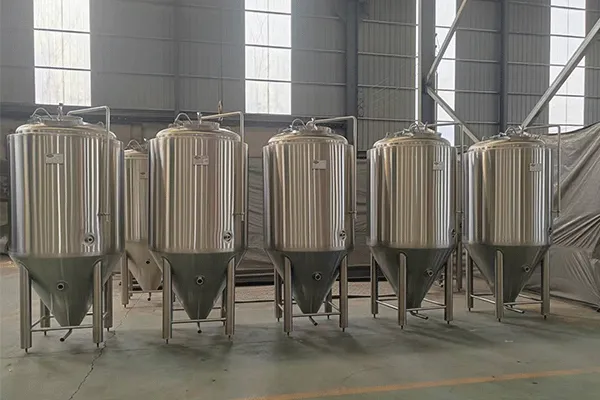
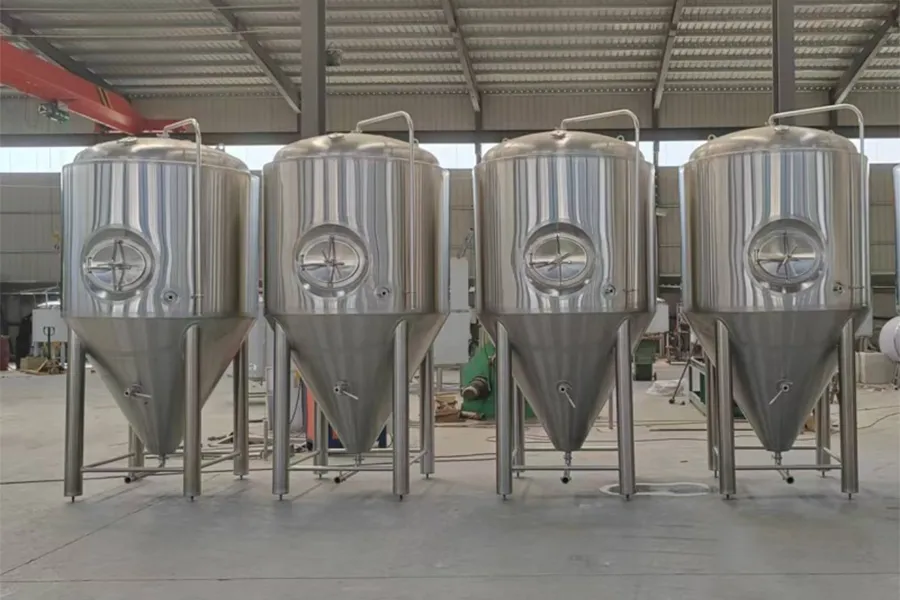
Ферментационные баки and bright beer tanks share materials and finish but differ on four specs: bottom geometry (60° cone versus dished), design pressure (typically 0.15–0.30 MPa versus 0.30 MPa), jacket zone count, and headspace allowance (20–25% versus 5–10%). At equal working volume, a bright tank stands roughly 1.2 m shorter.
The spec fields that decide service life
Most tank quotations list capacity, material and price. The fields that determine whether a tank is still in service in year twelve are usually the ones left off:
| Spec field | Why it decides service life |
| Working volume vs total volume | Determines whether the tank actually holds your batch, and whether krausen reaches the PRV |
| Shell and cone plate thickness | Sets deformation resistance under pressure and vacuum cycling |
| Design pressure and vacuum rating | Vacuum collapse during CIP is the most common avoidable total loss |
| Jacket type, zone count and coverage | Sets achievable cooling rate and glycol inventory |
| Surface finish (Ra), and where it applies | Drives CIP time and pitting resistance |
| Material grade by component | Chloride resistance, not strength, is the real 304-vs-316L question |
| Manway position | Trades floor-level access against jacket area and a pressure-boundary penetration |
| Passivation and material traceability | Determines whether the steel behaves like the steel on the drawing |
Each of these gets its own section below, with values. The head-to-head fermenter/bright tank comparison sits in its own section further down.
Working volume or total volume? Pin this down first
A tank sold as “10 BBL” can mean either 1,200 L of beer or 1,200 L of steel. The difference is the headspace allowance, and it is 20–25% on a fermenter.
A fermenter with 1,200 L (approx. 10 BBL) of working volume needs roughly 1,500 L of total shell volume, because krausen at high kräusen needs somewhere to go that is not your pressure relief valve or your blowoff line. Buy a 1,200 L total-volume tank for a 1,200 L batch and you will be cleaning krausen out of the PRV on every hoppy ale.
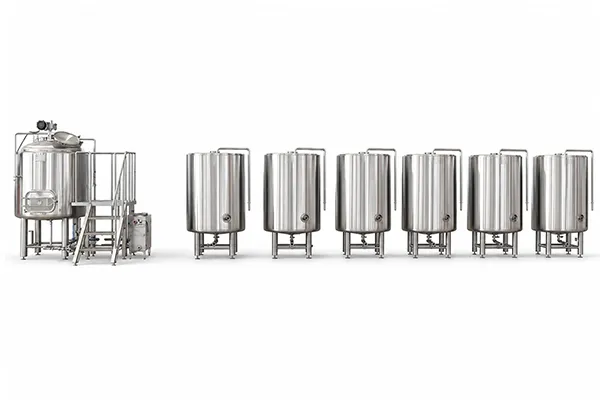
Bright tanks need far less. Beer entering a bright beer tank is past active fermentation, so 5–10% headspace is enough, mostly for carbonation foaming and thermal expansion.
Ask every supplier for three numbers, not one: total shell volume, working volume, and the headspace percentage used to derive one from the other. If a quotation gives you only one number, it is not a specification, it is a marketing figure.
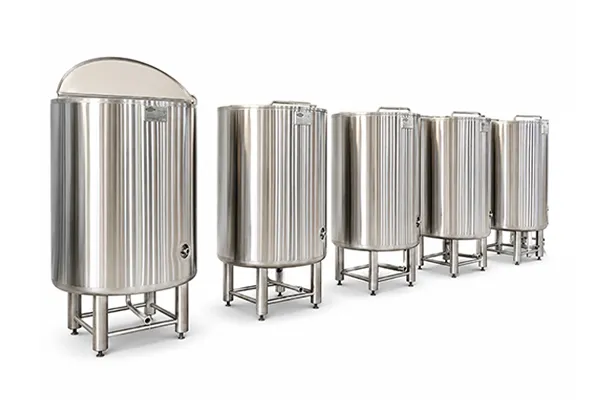
Dimensions by capacity
Figures below assume a 60° cone on fermenters (cone wall at 60° from horizontal), dished bottom on bright tanks, 25% headspace on fermenters and 10% on bright tanks, with adjustable legs included in overall height.
Fermentation tanks (cylindroconical)
| Рабочий объем | Total shell volume | Diameter | Cone height | Cylinder height | Overall height with legs | Minimum clear ceiling |
| 600 L (approx. 5 BBL) | 750 L | 0.90 m | 0.78 m | 0.92 m | approx. 2.6 m | 3.1 m |
| 1,200 L (approx. 10 BBL) | 1,500 L | 1.10 m | 0.95 m | 1.26 m | approx. 3.2 m | 3.7 m |
| 2,400 L (approx. 20 BBL) | 3,000 L | 1.40 m | 1.21 m | 1.55 m | approx. 3.9 m | 4.4 m |
| 4,700 L (approx. 40 BBL) | 5,875 L | 1.80 m | 1.56 m | 1.79 m | approx. 4.6 m | 5.2 m |
Емкости для светлого пива (dished bottom, vertical)
| Рабочий объем | Total shell volume | Diameter | Cylinder height | Overall height with legs | Minimum clear ceiling |
| 600 L (approx. 5 BBL) | 660 L | 0.90 m | 1.04 m | approx. 2.0 m | 2.4 m |
| 1,200 L (approx. 10 BBL) | 1,320 L | 1.10 m | 1.39 m | approx. 2.4 m | 2.9 m |
| 2,400 L (approx. 20 BBL) | 2,640 L | 1.40 m | 1.72 m | approx. 2.9 m | 3.4 m |
| 4,700 L (approx. 40 BBL) | 5,170 L | 1.80 m | 2.03 m | approx. 3.3 m | 3.8 m |
Two things worth reading off those tables.
At equal working volume, the bright tank is 1.2–1.3 m shorter, all of which comes from the cone and the extra headspace. In a building with 3.5 m of clear height, 2,400 L bright tanks fit and 2,400 L fermenters do not. That single constraint has redirected more cellar layouts than any other.
The minimum clear ceiling column is not the tank height. It adds clearance to lift a spray ball out through the top manway and to swing the manway cover. Measure to the lowest obstruction in the tank’s footprint, which is usually a sprinkler head or a glycol trunk, not the deck.
Shell and cone construction
| Компонент | Typical plate thickness | Notes |
| Cylindrical shell (jacketed) | 3.0 mm to 2,400 L; 4.0 mm above | Jacket adds stiffness, but not vacuum resistance in unjacketed zones |
| Cone | 3.0–4.0 mm | Carries the full liquid load plus yeast; thicker than shell on larger tanks |
| Top head | 3.0 mm | Dished, not flat; flat heads deform under vacuum |
| Outer cladding | 0.8–1.0 mm SS304 | Cosmetic and insulation retention, not structural |
| Изоляция | 50–80 mm polyurethane foam | Thickness determines how long a tank holds temperature with glycol off |
Cone angle deserves a note. A 60° cone (measured from horizontal) is the brewing standard because it collects yeast reliably without adding excessive height. A 72° cone drops yeast faster and gives a tighter harvest, at the cost of roughly 0.35 m of extra height on a 2,400 L tank. If your ceiling is tight, 60° is the right compromise. If you harvest and repitch aggressively, 72° earns its height.
On material grade, the common misconception is that SS316L is “stronger” than SS304. It is not; the mechanical properties are close. What 316L has is molybdenum, which gives markedly better resistance to chloride pitting. That is the actual decision:
- SS304 shellis appropriate where water chlorides are low and your sanitizer program is not chlorine-based.
- SS316Lis worth specifying where municipal water carries elevated chlorides, where you use any chlorinated cleaner, or on components that hold standing liquid — cone sections, valve bodies, sample ports.
Paying for 316L throughout while sanitizing with bleach is spending money in the wrong place. Bleach will pit 316L too.
Jacket: type, zones and coverage
Dimple jackets, laser-welded to the shell, are the commercial standard. Against a half-pipe coil jacket, the dimple pattern gives higher heat-transfer coefficient per unit area and holds far less glycol, which matters when you multiply glycol inventory across a cellar. Half-pipe handles higher jacket pressure, which brewing does not need.
Zone count scales with tank size:
| Tank size | Jacket zones | Coverage |
| Up to 1,200 L | 1 zone | Lower shell, sometimes cone |
| 1,200–3,000 L | 2 zones | Cone plus lower shell, independently valved |
| Above 3,000 L | 2–3 zones | Cone, lower shell, upper shell |
Independent zone valving is what lets you crash the cone while holding the upper shell warmer, or cool from the top down to set up convection. On a single-zone tank you get one setpoint and whatever stratification the tank gives you.
Ask for the jacket area as a number, in m². It is the figure that sets your achievable cooling rate, and it is the figure a side manway eats into.
Note also that the jacket is a separate pressure space from the tank interior. Under the EU Pressure Equipment Directive 2014/68/EU, categorization depends on the product of maximum allowable pressure and volume, and the jacket is assessed on its own PS and V rather than being folded into the vessel. It carries its own relief requirement.
Pressure and vacuum rating: the specification people forget
| Rating | Fermentation tank | Bright beer tank |
| Design pressure | 0.15–0.30 MPa (1.5–3.0 bar) | 0.30 MPa (3.0 bar), sometimes 0.40 MPa |
| Working pressure | 0.10–0.15 MPa (1.0–1.5 bar) | 0.15–0.25 MPa (1.5–2.5 bar) |
| Vacuum rating | Full vacuum, −0.1 MPa | Full vacuum, −0.1 MPa |
| Relief devices | PRV plus vacuum breaker | PRV plus vacuum breaker |
Bright tanks carry the higher pressure rating because they hold carbonated beer and have to take counter-pressure during transfer to a filler. A tank rated for 0.15 MPa cannot support counter-pressure filling, and finding that out after installation is an expensive discovery.
The vacuum row is the one that ends tanks. Here is the failure sequence: you finish a hot caustic CIP cycle, the tank interior is full of steam and hot air, you close the valves, then you introduce cold rinse water. The vapor condenses, the internal volume drops, and atmospheric pressure does the rest. A cylindrical shell is very strong in tension and comparatively weak against external pressure — a tank rated to 3 bar internal can implode at 0.3 bar of differential vacuum if it was never designed for it.
Three consequences for your specification:
- Require a stated vacuum rating in the quotation, not “pressure tested.” Full vacuum, −0.1 MPa, in writing.
- Require a vacuum breaker fitted and piped, and confirm during commissioning that it is not isolated behind a closed valve. Operators close it during carbonation and forget.
- Confirm the top head is dished. A flat top head at this diameter has almost no vacuum capacity.
This is also the clearest case where a warranty will not help you. More on that below.
Surface finish, and where the Ra number applies
ASME BPE defines surface designations and Ra measurement conventions for hygienic process equipment, and 3-A Sanitary Standards govern drainability, crevice-free geometry and product-contact surface requirements. Both are the reference points worth quoting an RFQ against.
A 0.4 μm Ra mirror-polished interior cleans faster at a given CIP flow than a coarser finish and gives biofilm less to anchor to. But the number is only as good as its scope, so ask two questions:
- Does the stated Ra cover welds, heads and the cone, or only the cylindrical shell interior?Interior shell polish is straightforward. Polishing an internal weld seam and the cone-to-shell transition to the same Ra is labor, and it is where cheaper tanks diverge.
- Was the tank passivated after final polish, and with what?Citric or nitric passivation restores the chromium oxide layer that grinding removes. An unpassivated polished surface looks perfect and pits within a year.
Related field practice: if anyone welds a new port into a tank on site, that heat-affected zone must be re-passivated. Skipping it produces pitting around the new fitting, and field welding usually voids the structural warranty as well.
Manway position: side or top
| Aspect | Side manway | Top manway |
| Access | Floor level; walk-in inspection on larger tanks | Requires platform or ladder |
| Dry hopping | Straightforward at floor level | Awkward on tall tanks |
| Jacket area | Removes jacket coverage in that shell zone | No effect |
| Pressure boundary | Additional penetration in the shell | Penetration in the head, lower stress zone |
| Cleaning risk | Gasket groove is a crevice at product level | Gasket sits above beer level |
| Practical fit | Sensible above about 2,400 L | Standard below that |
On tanks under 1,200 L, a side manway removes a meaningful fraction of available jacket area on a shell that does not have much to spare. Above 2,400 L the access benefit generally wins, and jacket area is proportionally less affected. Bright tanks take side manways more readily because their cooling load is a fraction of a fermenter’s, so losing jacket area costs less.
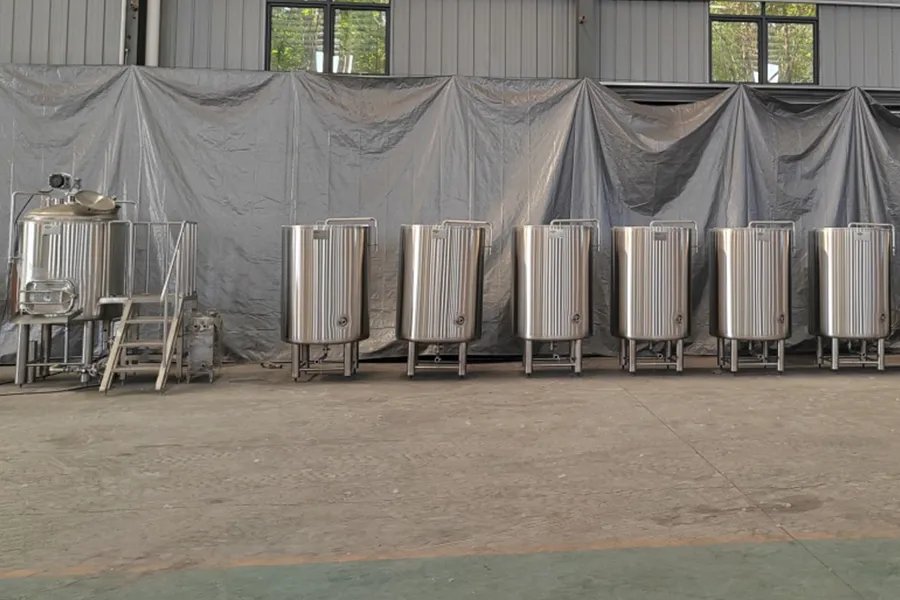
Fermenter vs bright tank: the specification differences
This is the head-to-head. Everything above applies to both tank types; the table below is where they part.
| Технические характеристики | Fermentation tank | Bright beer tank |
| Bottom geometry | 60° or 72° cone, for yeast collection | Dished, or shallow 5–15° slope to a side drain |
| Headspace allowance | 20–25% for krausen | 5–10% for foaming and thermal expansion |
| Design pressure | 0.15–0.30 MPa (1.5–3.0 bar) | 0.30 MPa (3.0 bar) and up, for counter-pressure filling |
| Cylinder aspect ratio (H:D) | 2:1 to 3:1, encourages convection during fermentation | 1.5:1 to 2:1, lowers hydrostatic head for even carbonation |
| Jacket coverage | Cone plus shell, 2–3 zones | Shell only, usually 1 zone |
| Cooling duty | Heat of fermentation plus crash cooling | Holding at 0–2 °C only |
| Изоляция | 50–80 mm, load-bearing on cooling rate | 50–80 mm, load-bearing on holding time |
| Опорный рычаг | Rotatable racking arm above the yeast bed | Not required; bottom outlet |
| Yeast dump | Butterfly valve at cone apex | None |
| Камень для карбонизации | Дополнительно | Стандарт |
| Образец клапана | Aseptic sample valve, cone and mid-shell | Single aseptic sample valve |
| Overall height at equal working volume | Baseline | approx. 1.2–1.3 m shorter |
| Typical service temperature range | −2 °C to 25 °C | −2 °C to 4 °C |
Two operational implications fall out of that table.
A unitank — a fermenter specified with the higher pressure rating and a carbonation stone — can do a bright tank’s job, which is why small breweries buy them and skip bright tanks entirely. It works. What you give up is a fermenter that could have been fermenting, and cone geometry means you are carbonating over a yeast bed. That is a capacity decision disguised as a tank spec.
Going the other direction does not work. A bright tank cannot ferment, because it has no cone to collect yeast and its jacket cannot absorb heat of fermentation.
What a 10-year structural warranty covers, and what it doesn’t
Being specific about this matters more than the number of years, because the gap between what buyers assume and what any structural warranty means is wide.
| Covered under a structural warranty | Not covered |
| Shell, cone and head weld integrity | Gaskets, O-rings and seals (consumables) |
| Jacket weld integrity and leaks | Valves, actuators, pumps (component warranties, typically 12–24 months) |
| Base material defects traceable to the plate | Temperature sensors, controllers, gauges |
| Structural deformation within rated pressure and vacuum | Vacuum collapse where no vacuum breaker was fitted, or it was isolated |
| Weld porosity found on inspection | Over-pressure damage with the PRV isolated or plugged |
| — | Chloride pitting from water chemistry or chlorinated sanitizers |
| — | Abrasion or passivation loss from steel wool, scouring pads or bleach |
| — | Freeze damage from glycol setpoint or control error |
| — | Rigging and transit damage |
| — | Anything after unauthorized field welding or port addition |
The two lines in that right-hand column that cause the most disputes are chloride pitting and vacuum collapse. Both look like material failure and neither is. Pitting from bleach or high-chloride water is a chemistry outcome the steel is behaving normally under; vacuum collapse with a blocked breaker is an operating event.
So the useful questions to ask a supplier are not about the headline term. They are: what documents back it, and what do I have to do to keep it valid? On the first, ask for material certificates traceable to the plate in EN 10204 3.1 format, welding procedure specifications and welder qualification records referenced to ISO 3834, pressure and vacuum test records with hold duration and gauge calibration, and the passivation method. On the second, get the maintenance conditions in writing before the order, not after a failure.
ZPET fermentation and bright beer tank specifications
Both tank lines are built to the same base specification set, with geometry and ratings differentiated by function.
| Артикул | Технические характеристики |
| Product lines | Fermentation Tanks; Bright Beer Tanks |
| Контактные материалы | SS304 / SS316L санитарного класса |
| Отделка интерьера | Зеркальная полировка с точностью 0,4 мкм |
| Охлаждающая рубашка | Dimple jacket, laser-welded |
| Люк | Стандартный верхний люк; боковой люк — опция |
| Изоляция | Polyurethane foam with SS304 cladding |
| Fabrication | Double-sided TIG argon arc welding; CNC laser cutting; automatic welding robots |
| Тестирование | Анализ материалов с помощью спектрометра; 24-часовое испытание на удержание давления; рентгеновский контроль сварных швов; 5-ступенчатый контроль качества |
| Гарантия на конструкцию | 10 лет |
| Соблюдение экспортного законодательства | Разработано с учетом требований PED (CE), UL/cUL и AS1210 |
| Диапазон производительности | Nano 1–5 BBL through commercial 40 BBL and above |
| Engineering deliverables | 3D cellar layout, technical drawings and process flow charts before fabrication |
| Technical response | Within one working day |
| Цены | Стоимость рассчитывается индивидуально для каждого проекта; опубликованного прейскуранта или диапазона цен нет |
The 24-hour pressure hold test is worth singling out, because hold duration is where test protocols vary most between suppliers. A tank that holds pressure for ten minutes has demonstrated much less than one that holds for a day; slow-leaking weld porosity only shows up over hours. X-ray weld inspection catches the subsurface defects a visual check and a dye penetrant test miss, which are precisely the defects that surface as jacket leaks in year three.
On the layout side, the ceiling constraint from the dimension tables above is the thing to resolve on paper. Producing a 3D cellar layout against measured building dimensions before fabrication is how you avoid discovering that a 2,400 L fermenter clears the door but not the sprinkler line. Because tanks ship factory-direct without distributor markup, the budget difference shows up as plate thickness, jacket area and fitting quality rather than as margin.
Trade-offs worth stating plainly
Thicker plate is not free.
A 4 mm shell on a 1,200 L tank adds weight, cost and thermal mass, and the tank will not last meaningfully longer if your failure mode is chloride pitting rather than deformation. Match the thickness to the actual risk.
A mirror finish raises the cleaning standard you have to meet.
At 0.4 μm Ra, mechanical scouring is off the table permanently — one pass with a scouring pad and that surface is gone in that spot. Breweries that cannot enforce a chemical-only cleaning policy get less from the finish than they paid for.
Unitanks trade capacity for capital.
Skipping bright tanks saves vessels and floor area, and costs you fermenter turns during conditioning and carbonation. At a low SKU count and moderate volume it is the right call. As turns per week rise, it stops being one.
Side manways cost cooling.
The floor-level access is real, and so is the jacket area you give up. On smaller fermenters that trade goes the wrong way more often than suppliers mention.
Spec sheet to send with an RFQ
Ask for these as numbers, in writing, before comparing anything:
- Total shell volume, working volume, and the headspace percentage between them.
- Plate thickness for shell, cone and top head, listed separately.
- Material grade by component, including valve bodies and sample ports.
- Design pressure, working pressure and vacuum rating, in MPa or bar.
- Jacket type, zone count and total jacket area in m².
- Ra value, and the exact surfaces it applies to, including welds and cone.
- Passivation method and whether it followed final polish.
- Insulation thickness and cladding gauge.
- Cone angle, measured from horizontal, and overall height including legs.
- Fitting schedule with sizes: manway, racking arm, CIP, thermowell, sample valve, PRV set pressure, vacuum breaker, carb stone, dump valve.
- Test protocol with hold durations, and which non-destructive method is used on welds.
- Document package: material certificates, welding qualifications, test records, declaration of conformity.
Two adjacent subjects this specification comparison leaves out, both of which change tank selection: horizontal bright tanks, which solve a low-ceiling cellar at the cost of floor area and a less convenient CIP geometry; and glycol trunk line balancing across a tank farm, where the last tank in an unbalanced loop cannot hold its setpoint no matter how good its jacket is. Raise the second one whenever you are adding tanks to an existing cellar rather than building a new one.
Часто задаваемые вопросы
Q: What is the difference between a fermentation tank and a bright beer tank?
A: A fermenter has a 60° or 72° cone to collect yeast, 20–25% headspace for krausen, and jacket coverage on both cone and shell. A bright tank has a dished bottom, 5–10% headspace, a higher pressure rating for counter-pressure filling, and shell-only cooling. At equal working volume the bright tank is about 1.2 m shorter.
Q: Can I use a fermenter as a bright tank?
A: Yes, if it is specified as a unitank with a 0.30 MPa design pressure and a carbonation stone. That is common at low SKU counts. The cost is fermenter capacity tied up during conditioning, and carbonating over a yeast bed. A bright tank cannot be used to ferment.
Q: Should I specify SS304 or SS316L?
A: They have similar mechanical strength; 316L resists chloride pitting better because of its molybdenum content. Specify 316L where water chlorides are elevated, where any chlorinated cleaner is used, or on components holding standing liquid. SS304 is appropriate elsewhere. No grade survives routine bleach exposure.
Q: Why does vacuum rating matter on a brewing tank?
A: Because condensing steam after a hot CIP cycle can pull a partial vacuum, and a shell strong in tension is comparatively weak against external pressure. Require a stated full vacuum rating of −0.1 MPa, a fitted and piped vacuum breaker, and a dished top head.
Q: What does a 10-year structural warranty actually cover?
A: Weld integrity on shell, cone, head and jacket, base material defects traceable to the plate, and deformation within rated pressure and vacuum. It does not cover gaskets and seals, bought-in components, chloride pitting from water chemistry or sanitizers, vacuum collapse with an isolated breaker, freeze damage, transit damage, or anything following field welding.
Q: What ceiling height do I need for a 20 BBL fermenter?
A: About 4.4 m of clear height for a 2,400 L (approx. 20 BBL) working-volume cylindroconical tank at 1.4 m diameter, which is roughly 3.9 m of tank plus clearance to lift a spray ball and swing the manway. Measure to the lowest obstruction in the tank footprint, not to the deck.
Q: Is 0.4 μm Ra worth paying for?
A: It shortens CIP time at a given flow and gives biofilm less anchorage, so yes at production scale — provided the figure covers welds and the cone rather than shell interior only, and provided the tank was passivated after final polish. It also commits you to chemical-only cleaning permanently.
Q: How much do commercial brewing tanks cost?
A: Pricing is quoted per project. Capacity, material grade, plate thickness, jacket area, pressure rating, fitting schedule and destination compliance requirements all move the figure, and no price list is published. Send capacity, cellar dimensions and a fitting schedule for a quotation.