Дэвид Чжан | Основатель и генеральный директор компании ZPET (Shandong ZhongPi Machinery Equipment Co., Ltd.) | Опубликовано 7 августа 2026 года
Промышленное пивоваренное оборудование means systems at 4,700 L (approx. 40 BBL) and above, where four thresholds shift at once: pressure-vessel conformity assessment becomes mandatory, CIP outgrows portable carts, glycol must be sized on coincident peak load, and control panels need destination-market listing. Volume alone is the smallest change.
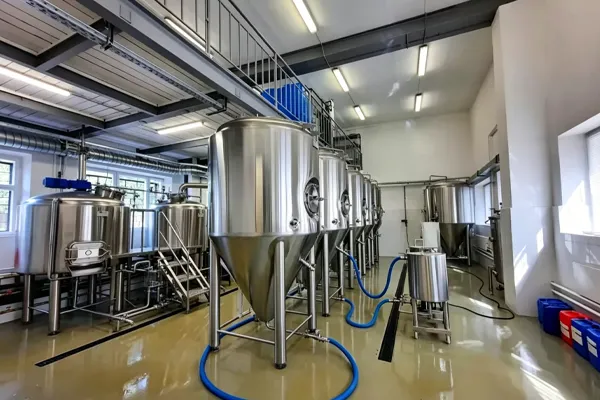
Where “commercial” actually starts
The word gets used loosely. A brewpub selling pints across a bar is running a commercial operation on 700 L of steel, and nobody would call that оборудование для коммерческих пивоваренных заводов in a procurement sense.
Практическую границу здесь определяет годовой объем производства. Именно по этому принципу Ассоциация пивоваров США (Brewers Association) классифицирует пивоварни: для микропивоварен верхний предел составляет 15 000 баррелей в год, а для региональных пивоварен диапазон простирается от этого значения до 6 000 000 баррелей (определения пивоварен Brewers Association). Производители оборудования выделяют на этой основе три основные категории:
- Nanobrewery, 1–5 BBL.Recipe development, brewpub taprooms, single-operator brew days.
- Microbrewery, 7–30 BBL.The working majority of independent production breweries. Portable CIP, packaged chillers, semi-automatic controls.
- Промышленные, от 40 баррелей (BBL).Multi-shift operation, skidded utilities, PLC-driven process control, engineered building services.
The jump from the second tier to the third is not proportional. Doubling from 20 to 40 BBL doubles wort volume, but it more than doubles cooling demand at peak, changes which regulatory pathway your vessels fall under, and moves cleaning from a task one person does with a cart to a fixed system with its own footprint and chemical inventory.
Четыре порога, которые вы пересекаете при 40 BBL
Все приведенные в этом руководстве сведения сводятся к следующим ключевым пунктам. Если выделить четыре главные мысли:
- Оценка соответствия для сосудов под давлением перестает быть формальностью.PED categorization is driven by the product of maximum allowable pressure and volume, so vessel size alone can push a fermenter out of the “sound engineering practice” route and into a category requiring notified-body involvement.
- Гликолевую систему необходимо рассчитывать по совмещенному пику, а не по сумме номинальных нагрузок.Wort knockout is the spike, and above 40 BBL it starts overlapping with crash cooling on other tanks.
- CIP flow is set by tank circumference, not tank volume.That single fact is what retires the portable cart.
- Панели управления должны иметь сертификацию для целевого рынка, и сертифицированный компонент не делает панель сертифицированной.Это самая частая и дорогостоящая неожиданность при импорте оборудования такого масштаба.
Варочный цех: коммунальные расходы, о которых нужно думать сразу
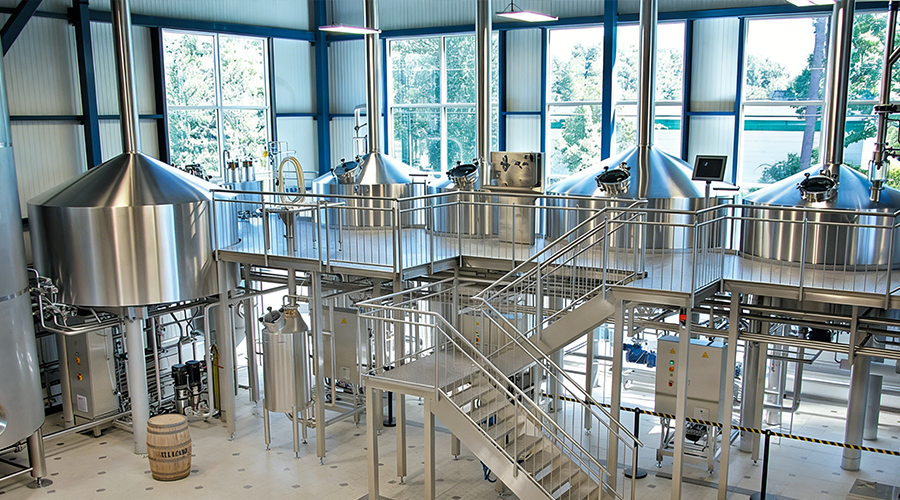
Промышленная варочная система производительностью 4700 л за варку с точки зрения парогенератора представляет собой две крупные тепловые нагрузки, которые можно включить либо одновременно, либо последовательно.
Boil-off. При интенсивности испарения 7% в час на объем 4700 л выпаривается примерно 330 кг воды в час. С учетом удельной теплоты парообразования около 2260 кДж/кг, это дает почти 207 кВт непрерывной тепловой мощности только на поддержание активного кипения.
Фаза нагрева. Raising 4,700 L of wort from 72 °C to boiling in 40 minutes needs about 526,000 kJ, or 219 kW. The ramp, not the boil, sets your peak.
Нагрев воды в баке горячей воды (HLT). Bringing 6,000 L of strike and sparge water from 15 °C to 78 °C over three hours adds about 146 kW.
Если совместить нагрев сусла в сусловарочном котле и подогрев бака горячей воды (HLT) в один и тот же интервал времени, суммарная потребность составит порядка 365 кВт. С учетом потерь при распределении и запаса мощности для этого потребуется паровой котел производительностью порядка 700–900 кг пара в час. Если же разнести эти процессы по времени и подогревать HLT во время кипения сусла, с этой задачей справится существенно меньший котел. Логику такого чередования следует закладывать в программу ПЛК, и решить этот вопрос стоит еще на этапе проектирования обвязки, а не после покупки парогенератора.
Heating method changes with scale too. Direct fire becomes impractical above roughly 2,000 L because the heat flux at the pan scorches wort. Electric elements stay viable to about 3,000 L before the connected load and element density get awkward. Above 40 BBL, steam through a jacketed or external calandria commercial brew kettle is effectively the default, and the boiler becomes a permitted piece of plant with its own inspection regime in most jurisdictions.
Гликолевая система: расчет по совмещенному пику
This is where large scale brewing equipment projects most often get under-specified, because the person sizing the chiller adds up every load in the cellar and then, alarmed at the total, applies a discount to something. The correct method is to identify which loads actually happen at the same time.
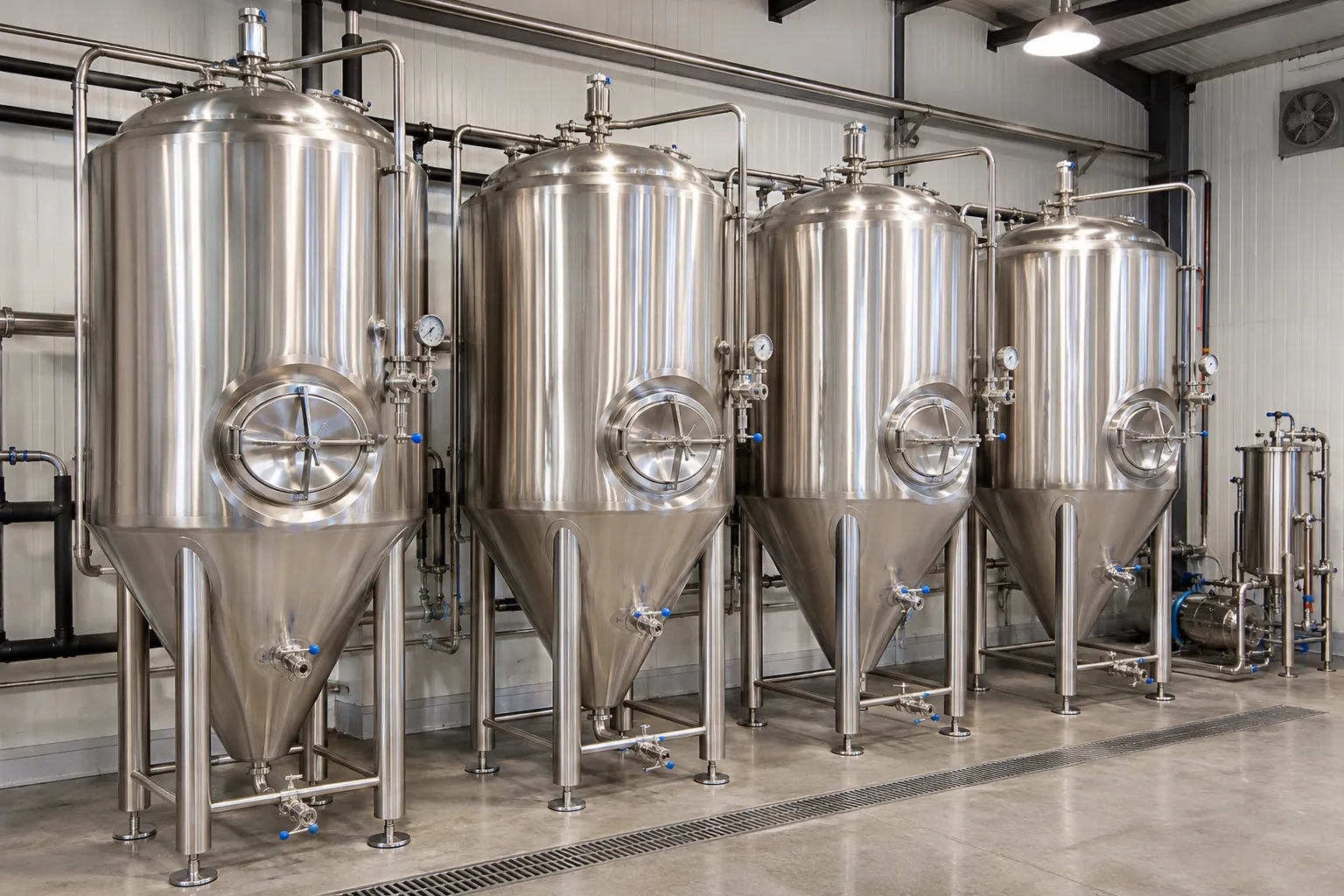
Практический пример: варочный порядок на 4700 л, обеспечивающий шесть ферментеров двойной варки объемом 9400 л (примерно 80 баррелей).
| Нагрузка | Basis | Пиковая нагрузка |
| Wort knockout, second-stage cooling | 4700 л с 18 °C до 10 °C за 60 мин | 42 kW |
| Активное брожение, два танка на стадии декке (высоких завитков) | 18 800 л при мощности приблизительно 0,8 кВт на 1000 л | 15 kW |
| Crash cooling, one tank | 9 400 л с 20 °C до 4 °C за 24 ч | 7 kW |
| Bright tank выдержка плюс потери в магистральной линии | — | 4 kW |
| Совпадающий пик | 68 kW | |
| С запасом по проектированию 20 % | прибл. 82 кВт (прибл. 23 тонны охлаждения) |
Notice the shape of that table: knockout is 62% of the peak and it lasts one hour. Sizing a chiller to cover it means buying a machine that spends most of the week at part load, short-cycling compressors and running below its rated efficiency.
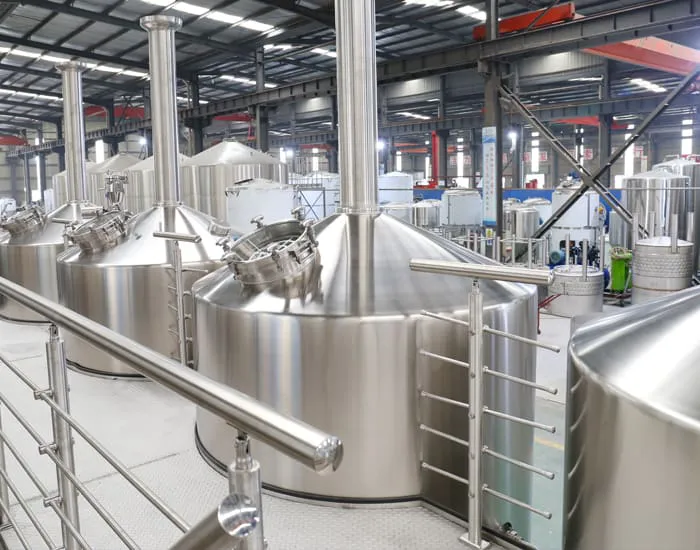
Альтернативой является резервуар с гликолем, который компенсирует пиковую нагрузку. Для поглощения всех 42 кВт в течение часа при перепаде температуры гликоля 6 K потребовался бы резервуар примерно на 6 600 л — это больший буферный объём, чем большинство предприятий готовы разместить. Поэтому в реальных установках выбирают компромисс: резервуар на 2 000–3 000 л плюс чиллер, рассчитанный примерно на 60–70 % совпадающего пика, при этом выбивку планируют вне периодов аварийного охлаждения. Внесите это правило планирования в программу управления — и резервуар выполнит свою задачу. Оставьте это на усмотрение того, кто находится в смене, и рано или поздно проведёте выбивку в тёплом подвале.
Две детали, которые при таком масштабе часто упускают в коммерческих предложениях:
- Концентрация гликоля.Пропиленгликоль в концентрации 30–35 % обеспечивает защиту примерно до −13...−17 °C, но также повышает вязкость, что снижает коэффициент теплопередачи и увеличивает требуемый напор насоса. Указывайте концентрацию, а не просто «гликоль».
- Проектирование магистральных линий.При 40 BBL и более магистрали становятся достаточно длинными, и именно контур с обратной подачей и правильно подобранная магистральная труба (обычно от 2 дюймов) определяют, сможет ли последний резервуар в контуре вообще удерживать температуру. Балансировочные клапаны на каждом резервуаре — не роскошь.
CIP перестаёт быть чем-то, что вы подкатываете
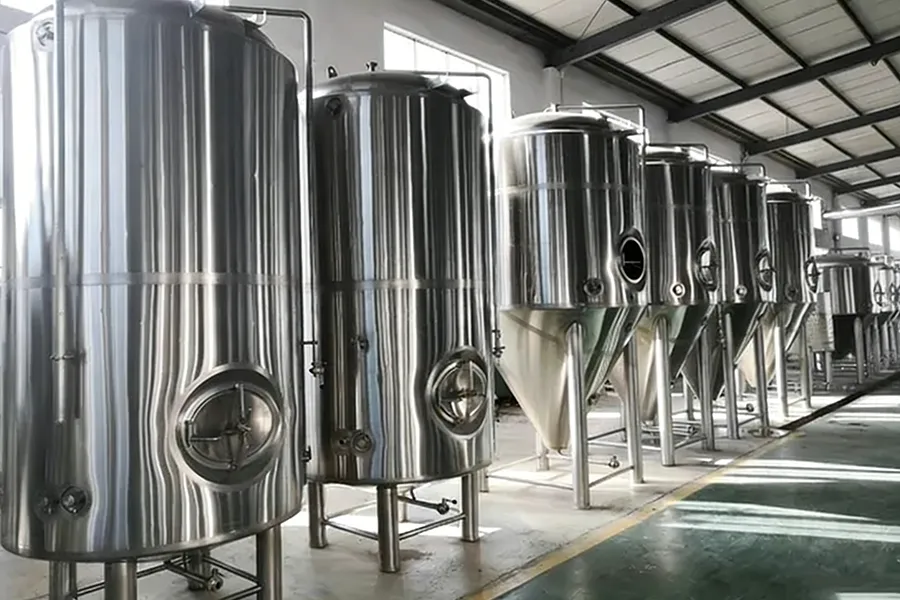
Требования к расходу через распылительное устройство зависят от окружности очищаемой ёмкости, а не от её вместимости. Рабочий ориентир — 2,5–3,0 галлона США/мин на фут окружности танка.
A 9,400 L fermenter at roughly 2.4 m diameter has a circumference of 7.5 m, or 24.7 ft. That calls for 62–74 gpm, which is 14–17 m³/h delivered at the spray ball, not at the pump discharge. Portable CIP carts typically manage 5–8 m³/h. The gap is not something you close with a longer cycle time; below the design flow, a static spray ball simply does not produce full coverage.
Итак, при объёме свыше 40 BBL вы покупаете CIP-станцию, а вместе с ней:
| Элемент | What changes at production scale |
| Подающий насос | 14–17 м³/ч при 2–3 бар на распылительном устройстве |
| Обратный насос и линия | Подобран по производительности подачи; сливные линии обычно 2–2,5 дюйма |
| Бак для щёлочи | Регенерируется и используется повторно, а не сливается; рабочий объём 400–800 л |
| Бак для кислоты | Отдельный резервуар; фосфорная или азотная кислота в концентрации 0,5–1 % |
| Отопление | Пар или электрический нагрев для поддержания температуры каустика 70–80 °C по всему контуру |
| Контроль проводимости и температуры | Автоматизированное переключение фаз и журналирование верификации |
| Стоки | Нейтрализация перед сбросом; производственные объёмы обычно требуют разрешения |
Эта последняя строка удивляет людей. Микропивоварня, сбрасывающая каустик в траншейный дренаж, часто случайно укладывается в местные нормативы. При 40 BBL и трёх циклах в день колебания pH и нагрузка по БПК нередко приводят к необходимости разрешения на сброс с обязательствами по отбору проб. Уточните это до заливки плиты, потому что нейтрализационный приямок недорого построить, но дорого дооснащать.
Качество обработки поверхности здесь важнее по той же причине. ASME BPE определяет обозначения поверхностей и правила измерения Ra для гигиенического технологического оборудования, а санитарные стандарты 3-A регулируют дренируемость и конструкцию без щелей. Внутренняя поверхность с Ra 0,4 мкм очищается быстрее при заданном расходе, чем более грубая поверхность, что напрямую отражается на продолжительности CIP на один резервуар при трёх циклах в день. Уточните, распространяется ли заявленное значение Ra на сварные швы и днища или только на внутренние поверхности обечайки.
ПЛК и HMI: что автоматизировать, а что оставить без автоматизации
Коммерческая автоматизированная пивоваренная система такого масштаба обычно предусматривает управление ПЛК следующими функциями:
- Ступенчатое повышение температуры затора с таймерами выдержки и блокировками мешалки.
- Расход и температура промывочной воды, обычно с помощью расходомера и регулирующего клапана.
- Интенсивность кипячения в варочном котле регулируется модулирующим паровым клапаном, а не режимом вкл./выкл.
- Время выдержки в вирпуле и температура перекачки в вирпул с ПИД-регулированием на стороне охлаждающей жидкости теплообменника.
- На-танковое брожение температуру с индивидуальным управлением электромагнитными клапанами и профилями уставок.
- Последовательность рецептов CIP, длительность фаз и переключение по показаниям проводимости.
- Журналирование данных партии: каждая уставка, фактическое значение и отклонение сохраняются для каждой партии.
Этот последний пункт оправдывает себя в производственном масштабе. Когда параметры партии выходят за допуски при объёме варки 4 700 л, журнал — это разница между диагностикой и догадкой.
Теперь о заблуждении, которое стоит назвать. Автоматизация не заменяет контрольно-измерительные приборы. Рецепт, автоматизирующий затирание, всё равно зависит от точности дозирования солода, если на мельнице нет измерения массы. ПИД-контур температуры перекачки в вирпул столь же хорош, насколько правильно размещён его датчик RTD. Прежде чем согласовывать уровень автоматизации, перечислите все измеряемые переменные, от которых зависит программа, и убедитесь, что для каждой есть датчик, установленный в разумном месте и допускающий калибровку.
Two more specification points that only bite after delivery:
- PLC brand and local support.Siemens, Allen-Bradley and Mitsubishi platforms all work. What differs is whether an integrator within driving distance of your plant can open the program and whether spare I/O cards are stocked in your country. A lower-cost platform with no local support is a downtime exposure, not a saving.
- HMI language and units.Panels programmed in metric with a Chinese-language interface arriving at a US brewery is an avoidable problem. Specify English HMI text and a °F/gallon display toggle in the purchase order.
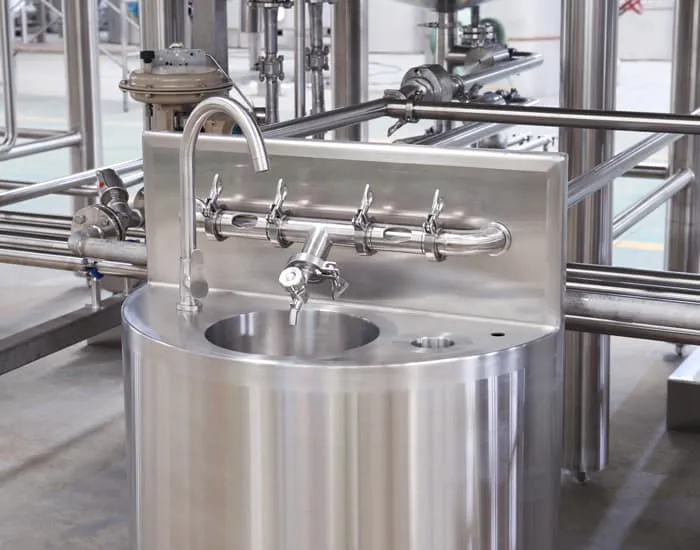
The 24/7 duty cycle changes component selection
Professional brewing equipment running one turn a day and the same equipment running three turns a day are not the same specification, even when the drawings look identical.
Pumps.
Continuous-duty centrifugal pumps need mechanical seals rated for the hours, and seal flush arrangements on anything running hot. A seal that lasts two years at one turn a day fails in eight months at three.
Motors.
Continuous duty S1 rating, IP55 or better for washdown areas, and VFDs specified for the destination voltage and frequency. A 400 V / 50 Hz motor set delivered to a 480 V / 60 Hz site is a rewire at best.
Valve actuators.
At three turns a day, a butterfly valve in a CIP circuit sees several thousand cycles a year. Actuator cycle life belongs on the datasheet.
Redundancy.
This is the real difference. At microbrewery scale, a failed glycol pump delays a brew day. At 40 BBL with tanks in active fermentation, it threatens product. N+1 on glycol circulation pumps and on the compressed air supply is the usual answer, along with a commissioning spare kit: gaskets, seals, one spare RTD, one spare actuator, one spare solid-state relay.
Building services people forget to check
A 9,400 L fermenter holds about 9,400 kg of beer and weighs perhaps 1,400 kg empty. That is 10,800 kg standing on four legs, or roughly 2,700 kg per leg as a point load. A 100 mm unreinforced slab will not take it. Production cellars generally want 150–200 mm reinforced concrete with spread footings under tank legs, and that is a structural engineer’s call against your soil report, not a number to take from a vendor brochure.
Alongside that:
- Clear height. A 9,400 L cylindroconical fermenter needs roughly 5.5–6.5 m to the lowest obstruction, plus clearance to swing a manway and to lift a spray ball out.
- Trench drains. Size for CIP dump volume, not for hose washdown. A 600 L caustic drop needs somewhere to go quickly.
- Water supply. Plan on 4:1 to 7:1 water to beer at production scale, including CIP and knockout. Metered supply capacity, not just pressure.
- Electrical service. Total connected load across brewhouse, chiller, air compressor, CIP skid and packaging typically pushes a 40 BBL plant into a service upgrade conversation with the utility. Lead times on that can exceed equipment lead times.
Export compliance: the requirements that only appear at this scale
A 5 BBL system crosses a border as machinery. A 40 BBL plant crosses as pressure equipment plus an industrial control assembly, and each has its own documentary pathway.
| Market | Framework | What it means in practice |
| European Union / EEA | Pressure Equipment Directive 2014/68/EU | Category depends on PS × V and fluid group. Above the Article 4.3 “sound engineering practice” threshold, conformity assessment with notified-body involvement applies. The glycol jacket is a separate pressure space, assessed on its own PS and V. |
| United States / Canada | UL 508A (industrial control panels), plus state and local AHJ | The panel assembly needs its own listing and a marked short-circuit current rating. Provincial and state pressure-vessel registration may also apply to the vessels. |
| Australia | AS 1210 (pressure vessels), with hazard-level classification per AS 4343 | Hazard level determines whether design registration with the state regulator is required before installation. |
The single most common failure is on the control panel, so it is worth spelling out. A panel built from UL-listed components is not a UL-listed panel. Listing applies to the assembly, and the assembly must carry a marked SCCR that exceeds the available fault current at the point of installation. Fault current at a production site fed from a dedicated transformer is far higher than at a taproom on a shared service, so a panel that passed inspection at 20 BBL premises can fail at 40 BBL premises. The remediation path is an NRTL field evaluation after the fact, which costs more than specifying it correctly and can hold up your occupancy permit.
The documentation package matters as much as the hardware. Ask for, at minimum:
- Material certificates traceable to the plate, in EN 10204 3.1 format.
- Welding procedure specifications and welder qualification records, referenced to ISO 3834 quality requirements and ISO 9606 welder qualification.
- Pressure test records, including hold duration and gauge calibration.
- Nameplate data with PS, TS, volume and fluid group.
- Declaration of conformity and a technical file for CE-marked equipment.
- Electrical schematics as-built, not as-designed, with the PLC program backed up and handed over.
If a supplier can produce the equipment but not the file, you own the compliance problem at the port.
ZPET оборудование для коммерческих пивоваренных заводов
ZPET builds turnkey systems at 40 BBL and above, engineered against the buyer’s building and utilities rather than configured from a catalogue page.
| Артикул | Технические характеристики |
| Capacity tier | 40 BBL (approx. 4,700 L) and above; brewhouse configurations from 2-vessel to 5-vessel |
| Автоматизация | PLC/HMI control with recipe management, per-tank fermentation profiles and CIP sequencing |
| Duty | Designed for 24/7 continuous operation |
| Отопление | Steam, electric or direct fire, specified to capacity and site utilities |
| Контактные материалы | SS304 / SS316L санитарного класса |
| Отделка интерьера | Зеркальная полировка с точностью 0,4 мкм |
| Fabrication | Double-sided TIG argon arc welding; CNC laser cutting; automatic welding robots |
| Тестирование | Анализ материалов с помощью спектрометра; 24-часовое испытание на удержание давления; рентгеновский контроль сварных швов; 5-ступенчатый контроль качества |
| Гарантия на конструкцию | 10 лет |
| Соблюдение экспортного законодательства | Разработано с учетом требований PED (CE), UL/cUL и AS1210 |
| Engineering deliverables | 3D brewery layout, technical drawings and process flow charts completed before fabrication |
| Установка | Global on-site installation and commissioning teams |
| Technical response | Within one working day |
| Цены | Стоимость рассчитывается индивидуально для каждого проекта; опубликованного прейскуранта или диапазона цен нет |
The pre-fabrication engineering step carries more weight at this scale than at any other. A 4,700 L brewhouse that does not fit under a 5.2 m ceiling, or a cellar layout that puts the last fermenter 40 m down a glycol trunk with no balancing valve, is a problem that costs a drawing revision to fix in June and a shutdown to fix in December. Because systems ship factory-direct without distributor markup, the budget that would otherwise sit in trading-company margin goes into plate thickness, valve quality and instrumentation count instead.
What this scale costs you
Being straight about the downsides, because they are decision-relevant:
Utility capital comes before revenue.
Boiler, chiller, air compressor, electrical service upgrade and slab work are largely spent before your first commercial batch. At microbrewery scale several of those are packaged or deferrable. At 40 BBL they are not.
Flexibility drops.
A 4,700 L minimum batch means a small seasonal release either fills tanks you would rather use for a core brand or does not get brewed. Breweries with a dozen active SKUs and a taproom-led sales mix often find the batch size fights their range.
Staffing changes shape.
Three turns a day on an automated system still needs two brewers per shift plus someone competent on the PLC and the utilities. That is a different hiring problem from a two-person microbrewery, and the automation reduces labor per barrel without reducing headcount to zero.
Compliance becomes a recurring cost.
Pressure vessel re-inspection intervals, boiler inspections, effluent sampling and calibration schedules all arrive annually once you are at this scale.
Sequence for getting a usable quotation
Work through these in order. Answering them out of order is how plants end up with a brewhouse the cellar cannot absorb or a chiller the service cannot feed:
- Year-three annual barrelage target, and the SKU count behind it.
- Turns per brew day you will actually staff, and brew days per week.
- Fermentation capacity in batch-volumes, with average days on tank by beer style.
- Destination market, which fixes the compliance pathway and the panel listing before anything else is drawn.
- Building constraints measured on site: clear height to lowest obstruction, slab thickness and reinforcement, drain locations, door and access dimensions for rigging.
- Available utilities as numbers: steam capacity in kg/h or boiler kW, electrical service in amps at a stated voltage and frequency, water flow rate.
- Automation tier, listed as the variables you want under closed-loop control.
- Spares and service expectations, including who supports the PLC locally.
Two subjects this guide deliberately leaves aside, both of which change the economics above 40 BBL: vapor condensers with heat recovery, which can return a large fraction of that 207 kW boil-off load and shift the boiler sizing above; and packaging line integration, where canning or bottling speed becomes the plant bottleneck long before the brewhouse does. Raise both in the same conversation as capacity, since they compete for the same floor and the same capital.
Часто задаваемые вопросы
Q: What counts as commercial brewery equipment?
A: In procurement terms, systems at 4,700 L (approx. 40 BBL) per batch and above, with PLC/HMI control, a fixed CIP system and utilities engineered as plant rather than packaged appliances. The distinguishing features are the duty cycle and the compliance pathway, not the vessel size alone.
Q: How much does a commercial brewing system cost?
A: Pricing is quoted per project. Capacity, vessel count, heating method, automation tier, destination compliance requirements and scope of utilities all move the figure substantially, and no price list is published. Send capacity target, building dimensions and utility details for a quotation and a 3D layout.
Q: What size glycol chiller does a 40 BBL brewery need?
A: Size it on coincident peak load, not the sum of all loads. For a 4,700 L brewhouse with six 9,400 L fermenters, coincident peak lands near 68 kW, or about 82 kW with margin. A 2,000–3,000 L glycol reservoir plus knockout scheduling lets you buy a smaller machine that runs closer to its efficient range.
Q: Can I use my existing CIP cart on 40 BBL tanks?
A: No. Spray device flow scales with tank circumference at 2.5–3.0 gpm per foot, so a 9,400 L fermenter needs 14–17 m³/h at the spray ball. Portable carts deliver 5–8 m³/h, and running below design flow leaves uncovered surface regardless of cycle length.
Q: Does a UL-listed PLC mean my control panel is compliant in the US?
A: No. Listing applies to the panel as an assembly, and the assembly must carry a marked short-circuit current rating that exceeds available fault current at your service. Specify UL 508A panel construction at order stage; an NRTL field evaluation after delivery costs more and can delay occupancy.
Q: Is Chinese-made commercial brewing equipment acceptable in the EU and Australia?
A: Country of manufacture is not the compliance question; the technical file is. What matters is whether the equipment is engineered to PED (CE) and AS 1210 requirements, whether the correct conformity assessment route was followed for the vessel category, and whether material certificates, welding qualifications and pressure test records are supplied with the shipment.
Q: How much fermentation capacity should sit behind a 40 BBL brewhouse?
A: As a planning figure, allow roughly two batch-volumes of fermentation capacity per weekly turn on a 14-day ale schedule. Two turns a day across four days is eight turns weekly, pointing to about 16 batch-volumes. Lagers at 28 days and extended dry-hop programs raise that.
Q: Steam, electric or direct fire above 40 BBL?
A: Steam, in nearly all cases. Direct fire becomes impractical above roughly 2,000 L because heat flux at the pan scorches wort, and electric heating gets awkward on connected load and element density above roughly 3,000 L.